
What Peace Asks of Us
A reflection on The Future is Peace: A Shared Journey Across the Holy Land by Aziz Abu Sarah and Maoz Inon.
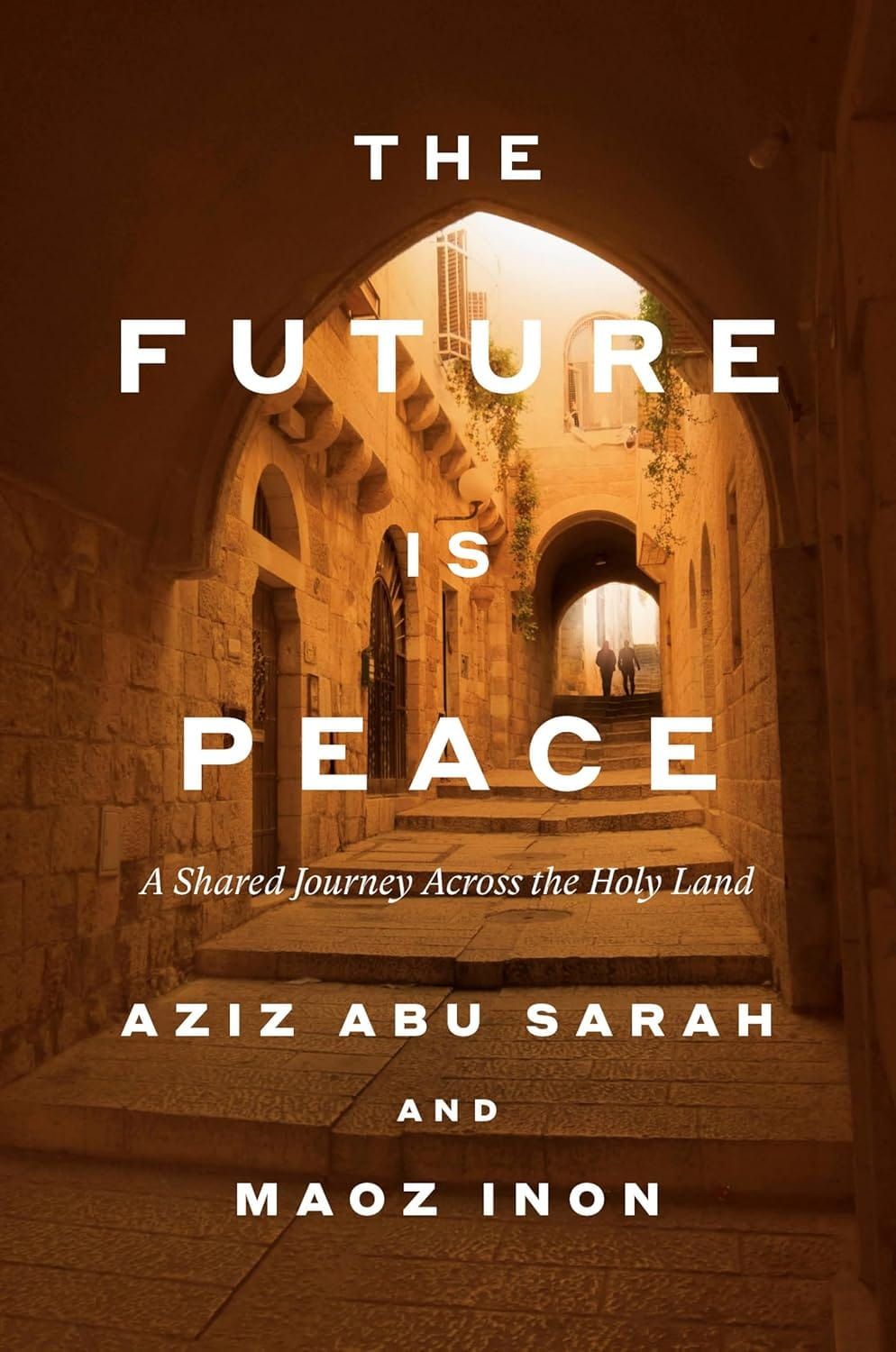
I found The Future is Peace on The Daily Show. Jon Stewart was interviewing the authors — Aziz Abu Sarah, a Palestinian, and Maoz Inon, an Israeli — two men who had each lost family to the conflict and were, somehow, sitting next to each other on late-night television talking about peace. I had been growing weary of Israel-Palestine coverage for months. The ratio of heat to light had become unbearable. But this interview held me. It wasn't the usual rehearsed performance. Nobody was scoring points. Two people who had every reason to hate each other were describing, in plain terms, what it had taken not to. I ordered the book that night and read it in one day.
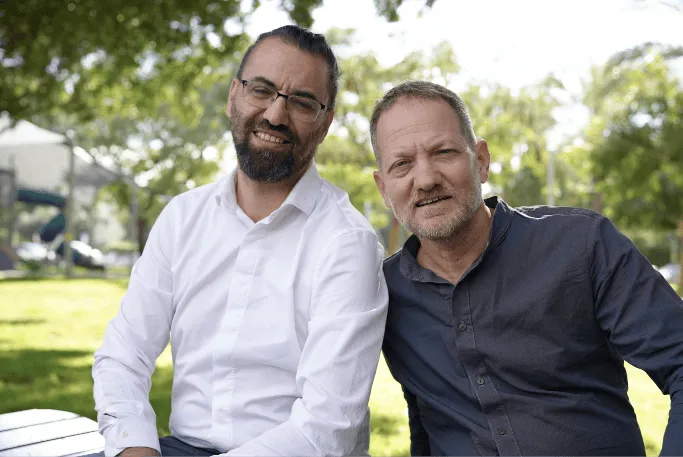
I came to it expecting a break from the discourse. What I found was a more demanding book than the title suggests — and a more demanding argument than the book itself fully makes. Abu Sarah and Inon argue that peace between Israelis and Palestinians is possible — and they have built that argument from their own lives, which they have structured around the refusal to become what their losses would have made them. Abu Sarah's older brother, Tayseer, died after beatings in an Israeli military prison; Inon's parents were murdered and burned in their home on October 7. Their book is the record of a friendship between two people whose grief could easily have pointed them in opposite directions and didn't.
I also believe that peace is possible. But I think it is harder than their book lets on — not politically, but personally. Their most important argument is not the optimistic one on the cover. It is the quieter one threaded through every chapter: that the self the conflict has shaped is not the only self available, and that becoming a different one is costly work most people are not prepared to do.
Narratives as Enclosed Worlds
Abu Sarah and Inon argue that enduring conflicts are sustained not only by competing interests but by competing realities. Each side sees its own suffering vividly and the other’s dimly, if at all. Their book is structured as an eight-day journey across the land they share, and what that structure reveals is how little each side has been permitted to see of the other.
To live inside a narrative is to have information filtered before it reaches you, to have empathy pointed in a single direction, to have moral clarity pre-structured by the time you’re old enough to ask a question. You do not interpret events differently from the other side. You learn, over years of exposure, to see only what confirms your own position. The filtering happens upstream of thought.
Abu Sarah puts this precisely: he was eighteen before he met an Israeli who was not a soldier or a settler. Inon was in his thirties before he truly connected with a Palestinian who wasn’t a worker on his father’s farm. Two men who grew up within driving distance of each other lived, for decades, in different countries of the mind — and neither had chosen the separation. It had simply been the shape of the world they were given.
I encountered the conflict as a child through a single frame: Palestinian loss, reported daily and without interruption. This was during the Second Intifada, and Al Jazeera was always on in the house. The numbers came through the television with a regularity that made them seem natural, like weather reports. Israeli deaths, suicide bombings inside Israeli cities, the specific mechanics of what was happening — none of that reached me. I did not disagree with Israeli suffering. I simply didn’t know it existed.
After school I wrote the number of deaths down in a notebook, one day after another. I didn’t analyze them. I recorded them. It was a child’s way of taking something seriously — a way of honoring what the adults around me were calling out for.
This is what Abu Sarah and Inon mean by narrative separation, but my experience pushes their claim a step further. I was not comparing narratives. I was contained within one. The problem in my childhood was not that I had chosen a bad interpretation of competing facts. It was that the other reality had not yet arrived to be interpreted. There was no moral tension, because there was no second perspective to generate it.
The numbers made the conflict legible, but they also made it distant. I understood death as a unit of measurement long before I understood context, causality, or reciprocity. A child can grasp that a number went up. The same child cannot grasp what it means that the number corresponds to a person, who had a mother, who was loved, who had particular reasons to be where they were when they died. The ledger format of the news stripped away everything except quantity. This is the first danger of a sealed narrative — it traps you in a system where certain truths cannot be said.
That system shapes who you become. The child who learns to record one side’s losses without registering the other’s is a child whose moral architecture is being poured, during the years when moral architecture hardens. Information can be added later. Architecture is harder to revise.
Abu Sarah and Inon are right to begin with narratives. But the harder question — the one that runs underneath the entire book — is what happens when the self those narratives have built encounters something that doesn’t fit. Because by then, it is not just information at stake.
The Difference Between Proximity and Intimacy
A central claim in The Future is Peace is that contact changes perception. When individuals from opposing groups encounter one another through dialogue, shared programs, or structured interaction, the abstract enemy becomes a person. Abu Sarah describes this vividly in the story of his Hebrew teacher, who greeted him in Arabic on his first day of class. He writes that it was the first time he had been treated “like a human being” by an Israeli. He dates a turn in his life to that morning.
This was a simple moment: a teacher doing her job and choosing, in one small gesture, to reach across the line. No facilitator arranged it. No funder measured it. The encounter worked precisely because it wasn’t designed.
Inon describes a similar reorientation during his first visits to Nazareth to build a guest house business with Palestinian citizens of Israel, where the inherited warnings — you can’t trust Arabs, they will come after you — started to dissolve against the evidence of his own senses. The book is full of such moments. The argument is intuitive, well supported, and underlies most of the peace-building infrastructure that currently exists.
However, if contact works, why does hostility persist in the places where contact is densest? Why is it that Palestinians and Israelis, who live in closer geographic proximity than most groups in conflict anywhere on earth, have produced some of the most durable hatred in modern history? Abu Sarah and Inon are right that contact matters. What their book does not fully work out is why some forms of contact produce the change they describe while others do not — a distinction the research literature has begun to sharpen in useful ways.
Here is the distinction I want to draw. Proximity is structured contact: dialogue programs, peace workshops, intergroup initiatives. It is intentional, and identity is foregrounded. The participants know what role they are playing and who they are playing it for. Intimacy is something else. It is unstructured. It happens over meals, in friendships, in the ordinary rhythm of shared life. Identity is not the frame of the interaction; it is a fact about the participants that recedes while something else — a joke or a shared task — takes the foreground.
What Abu Sarah and Inon study most often is proximity — people deliberately brought together across lines of conflict. What their book gestures at but does not fully theorize is intimacy — people living together without those lines being constantly activated. Proximity and intimacy produce different things because they put people in different relationships to their own identities. In a structured dialogue, a Palestinian is asked, implicitly, to speak as a Palestinian. An Israeli is asked to speak as an Israeli. The conversation is representational before it is personal. In ordinary life, identity recedes. People act as individuals who have forgotten, for a few hours, what they represent.
This is why Abu Sarah’s Mejdi Travel tours seem to work as well as they do. The dual-narrative structure matters, but so does everything around it — the bus rides, the meals, the logistics of moving a group through a day. Those unstructured hours are where the representational frame loosens and people start behaving like people who happen to be sharing a trip.
This is not a small distinction. Structured dialogue, at its worst, does something stranger than simply fail. It provides a stage on which people rehearse their conflict in a more civilized key — where identity performance is encouraged and refined. A participant who enters a dialogue program as a moderate version of their group’s narrative often leaves as a more articulate version of it, because they have spent their time being asked to explain their group to outsiders. The program has handed them a microphone and a receptive audience. Why would it not sharpen their identity? Contact in this form can deepen the very thing it was designed to dissolve.
The recent empirical evidence supports this reading. A large survey of Jewish and Palestinian residents of mixed neighborhoods in seven Israeli cities — one of the few places in the country where ordinary civilian contact still happens — found that interactions between the two groups are overwhelmingly positive rather than negative, and that positive contact correlates with greater support, among Jews, for the concrete compromises peace would actually require: a two-state solution, the dismantling of settlements, the return of refugees. This the contact of shared hallways and grocery stores and neighbors borrowing tools. A parallel body of research on online intergroup dialogue finds the reverse pattern: structured, narrative-heavy exchanges on social media between Israelis and Palestinians tend to produce defensive responses and mutual recrimination, not convergence. The mechanism that works is the mechanism that lets identity recede. The mechanism that fails is the one that keeps it foregrounded.
My earliest encounters with Jewish people were ordinary friendships in school — meals, conversations, time spent without any sense that we were crossing a divide. No one had convened us. No one was observing. There was no program or facilitator asking us to share our experiences. We were just friends, and the idea that we came from communities potentially in conflict was, in those days, completely absent.
Contact of that kind did not change my mind. It prevented it from hardening. I didn’t unlearn hatred because I never formed it to begin with. This is the mechanism the book underdescribes: the most effective form of contact is preventative, not corrective. It is easier to stop a narrative from solidifying than to break one that already has.
Peace-building models tend to focus on repair — on changing minds after conflict has formed them. Abu Sarah and Inon’s own work, including the dual-narrative tours and the convenings they describe in the book, is largely in this register. It is difficult work, and often moving. But the model has a built-in limit: by the time adults are willing to sit in a room together to do narrative exchange, they have already become the kind of people who need it. The earlier childhood friendships that keep the narrative from ever closing are both more powerful and more difficult to engineer. These types of interactions cannot easily be programmed or measured. They require a kind of social structure that permits ordinary interaction across the line of conflict, which is precisely what occupation and segregation are designed to prevent.
The deeper insight here is that contact only works when it occurs off the clock from identity. The goal is not to bring people together as Palestinians and Israelis. It is to allow them, however briefly, to forget that their identities are defined by conflict.
This distinction also explains why some forms of peace remain fragile even after decades. Agreements can create proximity between states. They do not automatically produce intimacy between people.
Political Peace and Social Peace
Abu Sarah and Inon devote significant attention to the question of whether peace is actually achievable in this region. Their answer — shaped by their own losses, and arrived at through real confrontation with the violence — is that it is. They point to South Africa, Northern Ireland, and Rwanda as cases where people not unlike themselves chose to end what seemed unendable. They also point, more specifically, to the peace between Israel and Egypt, and to the transformation that occurred when Anwar Sadat’s plane landed in Tel Aviv in 1977 and Israelis took to the streets waving Egyptian and Israeli flags in the same hand. That moment, in the book, stands as proof that even the deepest enmity can be converted into something else.
But what does that peace look like from below? The absence of war does not necessarily produce the presence of peace. Forty-nine years after Sadat’s visit, Egypt and Israel have no war, significant security cooperation, and functioning embassies. They also have two populations whose social distance has, in some ways, grown rather than shrunk.
I grew up visiting Egypt every summer, and whatever the treaty said, peace with Israel was not in the air. Israel was the antagonist in the songs that played at weddings and on the radio. It was the reason for rhetorical throat-clearing in sermons and in political speeches that had nothing else in common. Hostility was simply assumed. The word normalization existed almost exclusively as an accusation — something one might be guilty of, not something anyone described themselves as practicing.
I was an adult before I met anyone in Egypt who differentiated between Jews and Israelis, or treated Israel as a political issue rather than a hated category. The treaty, which had been signed before I was born, was a fact of international relations. It was not a fact of social life. Nothing about the Egypt I visited growing up treated Israelis as neighbors, even though they were, geographically, exactly that.
I remember hearing the popular Shaaban Abdel Rahim song Ana Bakrah Israel — “I Hate Israel” — which was a hit across the Arab world when I was growing up in the early 2000s. It became, eventually, the kind of phrase people quoted at each other casually, the way people quote jingles. No one needed to argue the premise. The title did the argumentative work, and the fact that it was set to a danceable beat made the sentiment feel less like an ideology than a given. This was more than two decades into the peace treaty. I was uncomfortable with it even then, in the way you are uncomfortable with something catchy that you know you shouldn’t be singing. I didn’t hate Israel in the way the song assumed I did. But I didn’t think twice about it either. The discomfort never became a question.
That is what cold peace is. It is not the active cultivation of hatred. It is the absence of anything that would interrupt hatred’s drift through ordinary life.
Abu Sarah and Inon identify the same phenomenon at a smaller scale, in the specific register of language. Before their joint TED talk, Maoz told Aziz that they needed to use the same vocabulary for their losses. If Aziz said his brother was murdered, Maoz would say the same of his parents. If one said killed, so would the other. The insistence is anti-slogan at its root: a refusal to let parallel grief be categorized differently, because different vocabulary is the machinery by which parallel narratives are maintained. Two peoples can sign a treaty and still never agree on what to call each other’s dead. The song I Hate Israel and the vocabulary asymmetry Maoz wanted to interrupt are the same mechanism at different scales — the pervasive preservation of hostility through language that never had to be argued for.
Political peace is the absence of war between states: agreements, diplomatic recognition, institutional cooperation, reduced violence. Social peace is the presence of shared life between peoples: meaningful interaction, normalized coexistence, humanization that does not require a program to produce it. One can exist without the other. The Egypt–Israel case demonstrates that the first does not automatically generate the second.
Without social peace, the mechanism of intimacy cannot operate. There are no friendships, no ordinary encounters in which identity might be revised. Narratives remain intact on both sides because nothing in daily life challenges them. Peace becomes an abstraction, something that exists in treaties but not in experience. It is neither felt nor internalized.
Can a peace agreement survive if it never becomes a social reality? Or does it remain an imposition — stable for a time, but not accepted?
Abu Sarah and Inon would push back here, and their push-back has force. When Sadat landed in Tel Aviv, thousands of Israelis did turn out with both flags in their hands — that was not a bureaucratic response, it was a social one. Mejdi Tours operates in more than thirty countries on the bet that ordinary people meeting ordinary people changes both. In their telling, Egypt–Israel is not the case against social peace. It is the case for giving it more time, and for doing the work that governments will not.
I take the point. But I want to hold open the possibility that both things are true: that ordinary meetings can shift something, and that without a sustained social infrastructure around them, what they shift is local and does not accumulate. Abu Sarah and Inon are themselves evidence of this. They have spent their lives building the structures that would allow contact to become connection — work that most governments, including the ones that sign the treaties, do not undertake. The intimacy their book documents is downstream of their own labor, not downstream of the political peace that preceded it.
What Rupture Actually Does
The logic of Abu Sarah and Inon’s book assumes that exposure to the other side’s suffering and perspective can unsettle the narrative one was raised inside and open the possibility of empathy. The book is full of such moments: Rami Elhanan inviting Palestinian bereaved parents to tour Yad Vashem (the Holocaust memorial) with his father; Israeli activists asking to learn about the Nakba in return; the Parents Circle organization creating a space where Palestinians and Israelis could ask each other sensitive questions without burning down the room. In these stories, being confronted with a version of events that doesn’t fit one’s inherited narrative becomes the raw material for reconsidering it.
However, being confronted with a conflicting account does not always produce reconsideration.
The first time I encountered a reality that did not fit my framework was after 9/11. I was young enough that what I remember most clearly is the adults. The house was quiet in a way it had not been before. All eyes were on the news. And at some point, on one of the channels, there was footage of a small group of people in Jerusalem handing out sweets in celebration — a woman ululating into a camera, children with flags. It played and replayed. I remember not being able to look away and also not being able to make sense of what I was looking at. The country I loved was grieving. The people I had been taught to grieve with were the ones on the screen, smiling. I did not know what to do.
The problem was incomprehension. I did not know how to place what I was seeing into the narrative I had inherited. I did not have a slot for it. My framework was built to register Palestinian suffering caused by Israelis. It was not built to register Palestinian celebration of American suffering, and I could not hold both the celebration and my inherited identification with the people celebrating in the same thought. I was also too young to differentiate between elements of Palestinian society. It was like watching two films stuck in the same projector.
Exposure to a conflicting account does not automatically produce empathy. It produces rupture. Rupture is the breakdown of narrative coherence, the loss of the interpretive framework that had been doing the work of making events legible. When a new reality cannot be absorbed, it destabilizes one’s understanding. And destabilization, in the short term, feels like the ground giving way.
There is evidence that this breakdown is not only metaphorical. When researchers scanned the brains of Jewish-Israeli and Palestinian adolescents watching images of someone in pain, they found that the first response was the same regardless of whose pain it was. The brain registered it automatically, the way it registers any person’s suffering. A fraction of a second later, something else kicked in. The response to their own side’s pain amplified. The response to the other side’s pain was suppressed. The instinctive empathy was still firing, but it was being actively overridden. And the adolescents who behaved most hostilely toward peers from the other side, and whose views on the conflict were most uncompromising, showed the strongest version of this override. The environment builds the wiring, and once built, it edits what the person sees before they have a chance to think about it.
What followed, in my case, was a withdrawal from the framework altogether. I stopped writing the numbers. I stopped tracking the Palestine-Israel conflict. Because I had lost my orientation and did not yet have another one to replace it.
The withdrawal lasted years. I was so thoroughly disengaged that when my mother would take me to pro-Palestine rallies at the state capitol, I would slip inside the building and wander the legislative chambers, looking at the art on the walls. I was not opposed to the protest. I was embarrassed to be seen near it. The embarrassment was ideological and social at once — I had lost my framework and didn’t know what I believed, but I had also absorbed enough of the world around me that Palestinian identity felt like a liability I wasn’t sure I wanted to carry. The child who had once recorded the daily death toll with the seriousness of a keeper of records was now hiding from the people who mourned them.
This is what I think the book’s model does not fully account for. Abu Sarah and Inon assume a sequence: exposure, processing, empathy. The missing step is interpretation. Exposure alone is not enough. It must be accompanied by some way of making sense of what has been exposed, some framework capable of holding the conflicting accounts without dissolving under them. Without that, exposure produces confusion; confusion produces withdrawal; withdrawal looks like neutrality but is actually damage.
Here the book pushes back, and the push-back belongs to Aziz personally. When he first visited Yad Vashem at eighteen, he expected propaganda. What he found, instead, was a history that did not fit the framework he had been given — a Jewish suffering that his narrative had rendered small or strategic and that was neither. He describes having feared, beforehand, that empathizing with the enemy would be a betrayal of his own pain. What happened instead was that his framework widened to include two histories at once. That is the sequence the book wants to generalize: rupture metabolized into a larger understanding, which becomes empathy, which becomes the ground of peace work. My rupture did not go there. It went into withdrawal. The difference is worth pondering, because the book presents Aziz’s outcome as though it were the natural endpoint of exposure, and my experience suggests it is not.
What separates the two cases is the difference between where Aziz and I were at the time of our exposure. Aziz was eighteen and actively looking for a framework large enough to hold what he was seeing. He had already begun to suspect that what he had been calling justice was revenge. The rupture at Yad Vashem arrived to someone who was in the market for a revision. I was an elementary-aged child, and I was not in the market for anything. Rupture in that condition is more likely to trigger collapse.
The Parents Circle works because the organization has built a structure in which exposure can be processed. The Holocaust survivor does not just tell his story and leave. The Palestinian bereaved parent does not just hear it and nod along. They stay in the room long enough for the rupture to resolve into something — a more complex picture that can hold both histories at once. That interpretation is what turns rupture into understanding.
The difference between Abu Sarah and Inon here is worth preserving. Abu Sarah’s rupture at Yad Vashem resolved through understanding. The change was intellectual, gradual, something he walked through. Inon’s rupture after October 7 resolved through interruption. In the weeks after his parents’ murder, he became consumed by a plan to hold the government accountable — so consumed, he writes, that he had stopped functioning as a husband and father. His wife Shlomit and his children had to stage an intervention to pull him back from a rage he could not exit alone. One story is about what exposure to a conflicting narrative can do when you are ready for it. The other is about what community can do when you are not. Both are necessary.
Empathy is Not Enough
Much of Abu Sarah and Inon’s framework depends on a premise that recognizing the humanity of the other produces empathy, and that empathy, in turn, opens the path to peace. The book’s most affecting chapters are ultimately arguments from emotional demonstration. Their pain, publicly held and publicly transformed, is offered as evidence that empathy can heal even the worst losses.
I believe them. I also think empathy is not a stable enough foundation to build a peace on.
Empathy, as a psychological phenomenon, is a reflex. It is immediate, emotional, and reactive. It fires in response to images, stories, proximity, and the thousands of cues the brain uses to decide whom to feel for. It can be activated, redirected, and manipulated. Anyone who has spent time inside a media environment during wartime knows this at the level of intuition: the footage shown, the footage withheld, the music under the footage, the order of the segments, the tone of the anchor. All of these direct empathy. None of them change its underlying nature as a reflex.
People do not lack empathy. They direct it. When the environment around them directs it consistently — my side’s suffering vividly, the other’s dimly or not at all — empathy strengthens exactly the loyalties that sustain the conflict. The most empathetic people within a given community are not always the most likely to question that community’s narrative. Sometimes they are the most bound to it, because their empathy has been thoroughly claimed by the suffering the narrative has made visible to them.
I want to state this as plainly as I can, because I think the peace-building literature has been slow to say it: empathy can sustain conflict just as easily as it can dissolve it. A soldier who feels deeply for his fallen comrades can become more willing to kill, not less. A civilian who weeps at every image of her own side’s children can find her capacity for political compromise shrinking in proportion to the weeping. The moral feeling is real. It is also, on its own, no guarantee of where the person feeling it will end up. Empathy does not decide direction; it amplifies whatever direction has already been set.
Fritz Breithaupt, who has written the sharpest recent critique of empathy’s role in humanitarianism, argues that the sequence most of us assume — first we witness, then we feel, then we take a side — has the order backwards. In his account, side-taking comes first, often for reasons too quick and too arbitrary to inspect, and empathy follows to justify and deepen it. Once this happens, empathy becomes a bias-reinforcement cycle: we see the situation through the chosen side’s eyes, we espouse their perspective, and our initial side-taking is ratified by feelings that now seem to have arisen from the evidence. This is why, Breithaupt observes, empathy tends to radicalize conflicts rather than resolve them. Both sides feel deeply, each on behalf of its own, and the depth of feeling is mistaken for the depth of insight.
Here the book presents the key to productively harnessing empathy — it must be extended, deliberately, to the narrative of the other. Within days of his parents’ murders on October 7, while the details of what had happened to them were still being confirmed, Maoz and his siblings said publicly that they sought no revenge, that what they wanted was peace and equality. He describes this as a choice — a statement made against the current of what he was actually experiencing, which was the rage his wife Shlomit would later have to interrupt. The statement cost him something. That cost is the point. Abu Sarah, for his part, describes the decades-long recognition that what he had been calling justice for his brother’s death was actually revenge — a revision of his own interior that required him to change the word he had been using to describe his motivation.
Both men describe their empathy for the other side as something that had to be chosen and re-chosen, often against the current of what they were feeling. Their lives show that empathy can be stabilized. They also show what it costs to do so — years of deliberate practice, a community of others doing the same work, and the conscious decision to build both. The empathy is real. It is also, in the fullest sense of the word, a discipline.
I came to my first small version of that decision in the fall of 2000, during the Bush–Gore election. Members of my community were enthusiastically praying for Bush to win. When I asked why, they told me it was because Gore’s vice presidential pick, Joe Lieberman, was Jewish. That if he were to win it would be good for Israel and bad for Palestinians.
I was a kid who had absorbed the political views of the adults around me without noticing I was doing it, and I repeated those views confidently as though they were my own conclusions. My father, listening to me on a drive to school, told me directly that what I was saying was not actually mine. That I should think for myself instead of repeating the silly things that I might hear.
It felt less like an invitation than an interruption. I was embarrassed. I was also, in a way I didn’t have language for at the time, being offered something that most children don’t get offered: the suggestion that the opinions I had been carrying were not automatically right just because I had them. What changed was not what I thought, but how I understood thinking itself.
What followed was not immediate re-engagement with the conflict but something more general: I began doing my own research on political questions rather than inheriting positions. I evaluated candidates and issues on the evidence rather than on what the community around me had decided. This is how I arrived, over time, at different conclusions than my community about a range of things — and eventually, when I returned to the Israel-Palestine issue after years away from it, at different conclusions there too.
My father’s intervention changed my relationship to thinking itself. Most people are taught what to think. They are not taught that they could, if they chose, stop reproducing the views of the people around them and begin to examine those views themselves. Without that move, empathy does whatever the environment directs it to do, and the environment in a conflict is not neutral.
High-Resolution and Low-Resolution Identity
To think independently about a conflict one has been raised inside is destabilizing, because the beliefs being examined hold up an identity, and when they give way, the identity gives way with them.
Conflict produces a high-resolution identity. You know exactly who you are. You know who your enemy is. You know what your purpose is. The lines are clear, the loyalties are clear, the moral polarity is clear. Your actions have meaning because they fit into a larger story that everyone around you is also telling, and your suffering, when it comes, is legible as a contribution to that story. Peace produces a low-resolution identity. The boundaries blur. The loyalties mix. The enemy becomes a neighbor; the neighbor becomes a trading partner; the trading partner becomes a friend, and slowly the self that was defined by opposition loses its outline.
Conflict is psychologically attractive for reasons that have nothing to do with violence. It simplifies the world. It tells you where you stand. It reduces ambiguity to a set of clean propositions — us and them, right and wrong. Peace does the opposite. It does not tell you who you are; it asks you to live without being told.
Abu Sarah and Inon are aware of this difficulty, and they answer it with a reframe. “If you must divide us,” they suggest, “let it be as those who believe in peace and equality and those who don’t…yet.” It is a generous gesture, and it attempts to provide exactly what peace otherwise fails to provide: a clear side to be on. But the reframe is harder to sustain in practice than on the page. A side defined by the absence of an outgroup is, in identity terms, a different kind of thing than a side defined by having one. It asks for loyalty without a defined enemy. Some people find that sufficient. Many do not.
This is one of deepest reasons peace has been so hard to build between Israelis and Palestinians. People do not reject peace because they love war. They reject it because the version of themselves that conflict has made sharp is the version they know how to be. Giving up territory is understandable as a sacrifice. Giving up the self the conflict has shaped is harder to name out loud, and so the reluctance stays unnamed and the conversation stays on territory.
Abu Sarah and Inon show that peace is structurally possible. What their book underweights is how costly the inner revision actually is, even for people who are convinced, intellectually, that peace would be better than the alternative. People sense, correctly, that peace will ask them to become different than they currently are, and the self they would have to give up is the one that conflict has made sharp.
Holding a position outside of clear sides feels isolating. The cost is no longer fully belonging anywhere. Low-resolution positions attract suspicion from people whose identities are still high-resolution. To be for peace, in the middle of a war, is to be accused by each side of insufficient loyalty to that side. One of the things Abu Sarah and Inon’s book is quietly doing is trying to develop a community that people holding this kind of position can belong to. Not a side with an enemy, but a company of people who have accepted the low-resolution position together and made something of it.
Inon describes the experience from inside with unusual clarity. Writing about his first visits to Nazareth to build his guest house business with Palestinian partners, he describes stepping outside the inherited narrative of his community and noticing, almost immediately, what that cost. The quiet suspicion of neighbors. The unspoken judgment that he was disloyal or naïve. Dinners with friends where the same warnings about Palestinians continued while the gap widened between what they expected of him and what he felt called to do. And what he puts most sharply is the loneliness of no longer fully belonging on either side. That loneliness is what low-resolution identity feels like from within.
My own path to the low-resolution position was less dramatic and more accidental. I never had a high-resolution identity to abandon — the rupture had happened too early, before the identity hardened, and what followed was not conviction but absence. The conflict was simply not a large part of who I was. In retrospect, that absence was its own kind of luck. When I returned to the subject as an adult, I could imagine peace without first having to dismantle the self that conflict had built, because conflict had not finished building it. The cost was different from Inon’s loneliness — not the pain of leaving a community behind but the quieter unease of never quite belonging to one in the first place. I was for peace without having earned the position through loss, which is a stranger and less legible place to stand.
Slogans and the Absence of Endpoints
The need for clarity does not vanish when conflict does. It finds new places to settle. One of those places is the slogan — the short, emotionally complete phrase that can sit in the mouth of someone who has not decided what they want but is certain what they are against.
In the aftermath of October 7, the most striking feature of public discourse was the certainty. Certainty on every side, from every corner of the political map. What was missing was imagination — almost no one I encountered was asking what resolution would actually require. People knew what they were against. Few could describe, in any concrete way, what they were for.
The language of the conflict condensed into slogans. Free Palestine. Eliminate Hamas. From the river to the sea. Bring them home. Each phrase felt complete. Each resolved emotional tension by presenting a clear objective. But the objectives contained within them the very questions the slogan was designed not to ask. What does free Palestine look like the morning after — the borders, the citizenship, the security arrangements? What does eliminate Hamas mean operationally, and at what point, measured by whom, is it considered complete? A slogan points toward a conclusion — a verdict about how the situation ought to be judged — without specifying any outcome, any concrete state of affairs the world should arrive at. It tells you what to feel. It does not tell you what to build.
What cannot be completed becomes identity. The purpose shifts from resolution to expression. People attach to the slogan rather than to any state of the world the slogan might once have been trying to name. This is why slogans survive their own falsification — they have exited the business of describing the world and entered the business of constituting a self.
Abu Sarah and Inon’s insistence on shared vocabulary for their losses, described earlier, is the exact inverse of this move. Where the slogan is designed to describe events in a way that constitutes the self, shared vocabulary is designed to describe events in a way that opens a door to another person. One resolves emotional tension by closing the world down to a phrase. The other keeps the world open by refusing to let even the naming be asymmetrical.
Peace cannot exist without an endpoint that both sides can imagine. This is the refinement I would add to the book’s process-focused framework. Peace cannot be sustained on process alone. It requires a destination — not a rigid one, not one both sides agree on in every detail, but one concrete enough that each side can describe, in positive terms, what they are trying to arrive at. Without that, even the most sophisticated peace process becomes a slogan of its own — the peace process — and drifts, as all slogans do, away from the outcome it was originally meant to produce.
It is worth saying that Abu Sarah and Inon do meet this bar. Abu Sarah lays out a concrete model — a confederation of two sovereign states connected by open borders, shared institutions, and mutual cooperation, along the lines of the A Land for All proposal — and the book ends with an epilogue set at a future railway station, rail lines restored across the Middle East, friends arriving from abroad to study how peace was achieved.
The problem is that the destination has not become a public image, and the slogans have. The work of peace includes not only imagining an endpoint but circulating it widely enough that people can hold it in mind against the slogans that are easier to remember. The absence of an endpoint in public consciousness is a form of avoidance — and avoiding the question of the end allows the present to continue. The present, for all its horror, requires no transformation from the people living inside it.
Transformation Before Relief
Abu Sarah and Inon spend the second day of their journey in Jaffa, the ancient port from which the biblical Prophet Jonah fled. The figure does specific work for them. They invoke him in relation to Yasser Arafat, the longtime chairman of the Palestine Liberation Organization, and Yitzhak Rabin, the Israeli prime minister — two men who had spent decades as enemies before signing the Oslo Accords in 1993, the closest the region has come to a negotiated peace. Each, the authors write, had once believed the other side was monstrous beyond redemption; each came to see that even people with blood on their hands can change. That is Jonah's lesson in the Hebrew Bible as the book uses it: the enemy, the city you were sure deserved destruction, turns out to be capable of becoming something else.
The Qur'anic telling of the same prophet — Yunus — presses the story one step further. The part that has kept returning to me is what happens after Yunus arrives. The city is warned. Destruction is coming. And then, unexpectedly, the people change — they believe, they alter what they are doing — and the destruction is lifted. The order is not relief followed by change. It is change followed by relief. The lesson is austere: survival is conditional on transformation. The city’s inhabitants became the kind of people who didn’t require destruction to correct them.
Most political thinking on Israel-Palestine tends to reverse this order. It expects peace to arrive first and transformation to follow — that if we can only secure the agreement, the ceasefire, the external solution, then the internal work of becoming different people will happen on its own. The logic is backwards, and the backwards-ness is not accidental. It is psychologically easier to wait for the structural conditions to change than to undertake the internal change that would make the structural one possible. Waiting preserves the self. Transforming does not.
The cost of peace is personal. It asks people to give up the version of themselves that conflict has made clear. Inon’s public refusal of revenge in the days after his parents’ murder cost him something — the refusal of a particular self he could easily have become. Abu Sarah’s long transformation required him to change the inside of his own thinking of what justice actually is. Neither move looks like policy. Both look like people, in real time, choosing to be different from what their grief would otherwise have made them.
What The Future is Peace ultimately offers is a demonstration that this kind of transformation is not the province of saints. It is the ordinary, difficult, daily work of people who have decided that the self available to them after loss is not the only self they can have. The book is full of such people: from the Arab families who opened their homes to Jewish neighbors during the 1929 riots to the Israeli and Palestinian doctors working side by side in the same hospitals while their societies are at war outside the walls.
I have been thinking about my childhood notebook again. I learned to count the dead before I learned how to imagine the living together. Counting is a completed act; it ends when the number is written. For years I stopped even that. What came after was the avoidance the essay describes: waiting for the external conditions to change rather than doing the internal work that would make them possible.
I am more ready for peace after this book than I was before it. That is not the same as having given what peace asks. But it is, I think, the beginning of knowing the difference.