
The Politics of Interpretation
I felt pride when Mamdani won. I disagree with most of his policies. Why?
The Sidewalk Is Everywhere
It is Friday afternoon and the heat outside the mosque in Queens has settled into something heavy. The prayer has just ended. Men file out into the brightness, reaching for shoes left in rough rows by the entrance. Children run ahead toward a double-parked minivan. A father calls after them without urgency.
“Did you see what he said?”
The question floats—no name offered because none is needed. The he in question is Zohran Mamdani, the mayor of New York City, the first Muslim to hold that office.
“I don’t agree with everything,” says a man adjusting his watch.
“But he’s good for us.”
“At least he speaks about Palestine.”
A pause. Then: “Who else do we have?”
But this is not where I have this conversation.
I have it at home, with my wife. I have it in text messages from my mother, who is not particularly politically engaged but found herself sending me Mamdani videos anyway—look at this man, do you know him? I have it with my aunt in Egypt, who has nothing to do with American politics, who messaged me the day after he won: do you know this man? My sister sent me one of his rap videos and said he was cool. She didn’t know any of his policies. She doesn’t care.
The sidewalk outside the mosque isn’t a location. It’s a distributed infrastructure—family WhatsApp threads, group chats, aunts in Cairo who follow American Muslim news the way sports fans follow a team they’ll never see play in person. The conversation I’m interested in happens everywhere Muslims have screens and opinions and a low-level ongoing negotiation with what it means to exist politically in this country.
My responses to my family were minimal. I didn’t engage, partly because I don’t like talking politics with most people around me. They go off identity—and that makes me uncomfortable. I’d rather talk about healthcare reform or housing supply elasticity than about whether a candidate is good for us.
With my wife it’s different. We followed the New York mayoral race even though we have nothing to do with New York. We talked about Mamdani’s rent freeze proposals skeptically, about whether his coalition could hold, about the gap between his rhetoric and what a mayor can actually do. Those conversations I liked.
But when my mother asked if I knew this man, I didn’t tell her any of that. I said: Oh, yes, that’s interesting.
What I was watching in them, I would later realize, I was also doing myself—just in a different register.
The Puzzle, Including Me
I think of myself as an issue-based voter. I’ve voted across party lines. My first vote was cast in the 2010 Republican senate primary in Texas—for David Dewhurst, against Ted Cruz, whom I disliked when he was a Tea Party Republican and still dislike now that he’s a MAGA Republican. I voted for Obama in 2012, for Hillary Clinton in 2016, and Joe Biden in 2020. In 2024 I voted third party because I felt Harris didn’t represent my views well enough, even knowing Trump was worse. I’m more fiscally conservative than most people assume when they find out I’m Muslim. More socially liberal than others expect. I don’t fit the template.
When Zohran Mamdani won the New York mayoral race, I felt pride. Then, I sat with that feeling and didn’t entirely know what to do with it, because I disagree with almost everything he stands for. I don’t like populists. I don’t like democratic socialists. If a non-Muslim candidate had run on Mamdani’s exact platform, I would have been quietly rooting against them.
So why did I care that he won?
This is the puzzle I thought I was writing about: why Muslim voters support politicians they openly disagree with, why the same community speaks four completely different political languages about four politicians with broadly similar profiles. But it turns out I was also writing about myself. The question that started as why does the community do this became, the more I examined it, why did I do this too.
Consider the four politicians at the center of this essay: Mamdani, Ilhan Omar, Rashida Tlaib, and Keith Ellison. On paper, they are not that different. All are Muslim. All are Democrats. All operate within progressive coalitions. All have staked out positions on LGBTQ rights, gender, and social policy that conflict with more conservative religious norms held by many mosque-going Muslims. Pew Research Center data from 2017 captures the structural tension: only 52% of U.S. Muslims say homosexuality should be accepted by society—already well below the roughly 72% of the general public, and likely an overestimate of acceptance among regular mosque attendees, where opposition is closer to consensus—and yet 69% of Muslim voters lean Democratic. They are in persistent coalition with a party whose social positions they do not fully endorse.
Despite this shared profile, the community’s reactions are wildly different. Mamdani is described with warmth: he’s one of us, he’s trying, he has to say that. Tlaib with emotional identification: she’s fighting for us, she’s not afraid, she’s real. Omar with ambivalence and unease: she went too far, she represents us wrong. Ellison with calibrated distance: we respect him, but he’s part of the system now. Same community. Four different political languages. Four politicians whose records are, in essential ways, comparable.
From Minority Politics to Moral Politics
A decade ago, this conversation would have sounded different. The questions that organized Muslim political life after 9/11 were not questions of moral alignment. They were questions of survival.
Muslim civic organizations in the early 2000s were a community under surveillance, subject to profiling, navigating a political environment that was frequently hostile. As Louise Cainkar documented in Homeland Insecurity, the priorities that dominated this period were civil liberties protections, religious freedom, and defense against discrimination. The question driving Muslim political engagement was whether politicians would protect Muslim people.
I came of political age in this era. But even then I noticed something: Muslims seemed intensely focused on protecting our community and much less focused on what was happening to our neighbors. When the Obama years arrived and Muslim political conversation hardened around opposition to LGBTQ rights as a community identity marker, I felt embarrassed—by how shallow the politics felt, how it had migrated from survival to culture war.
When I was studying Islam at a seminary, I never told anyone there that I thought the community’s focus on opposing LGBTQ rights was, at its core, homophobia. For most of my classmates, this essay may be the first time they learn that I hold these views—even though I hold them openly in every other part of my life. That gap, between the self I present in conservative Muslim spaces and the self I am everywhere else, is not something I’m proud of. But it’s real, and it shapes what follows.
I thought all of that meant I was more objective. That I was evaluating Muslim politicians the way I evaluated everyone else.
Then Zohran Mamdani won a mayoral race in a city I don’t live in, and I felt pride.
How Judgement Works
There is a structure underneath the community’s reactions. At its center is a distinction between two modes of reading a politician.
Strategic interpretation is flexible, context-aware, forgiving. It holds a politician’s statements at arm’s length from their interior life. It generates the language of he has to say that—that’s politics. It produces support despite disagreement because the disagreement has been relocated outside the domain of morality. The politician is understood as an actor navigating a system, and their performances are evaluated accordingly.
Moral interpretation is rigid, value-driven, evaluative. It treats statements as sincere expressions of belief—as confessions of who a person is. It produces criticism even where broader alignment exists, because the politician is not understood as navigating a system but as revealing themselves. The same action that earns tolerance under strategic reading becomes disqualifying under moral reading.
The difference between support and rejection is the mode of interpretation applied.
Muslim voters apply this distinction through a set of filters that run below the level of conscious deliberation:
Filter One: Belief or Constraint. Does the politician mean what they’re saying, or are they constrained by the system to say it? The same statement is forgiven or condemned depending on which reading applies.
Filter Two: Who Are They For? Insider status generates interpretive generosity—trust, patience, benefit of the doubt. Perceived accommodation of outside audiences generates suspicion.
Filter Three: What Do They Center? A politician who leads with housing costs and Palestinian rights is understood differently from one who leads with LGBTQ solidarity and progressive moral language, even if their underlying policy positions are similar. What is foregrounded defines the politician’s identity in the community’s eyes.
Filter Four: Who Do They Represent? Some politicians are treated as individuals who happen to be Muslim. Others are treated as representatives of Islam itself. Once a politician becomes symbolic, the threshold for acceptable behavior changes dramatically—and so does whether symbolic status functions as a burden or as a source of authority.
Filter Five: Do They Pass the Palestine Test? Palestine functions as the community’s primary moral signal—a test of whether a politician is operating from genuine values or convenient calculation. According to Emgage and Change Research’s 2024 Muslim Voter Survey, 72% of Muslim voters identify U.S. policy toward Israel and Palestine as a top issue. Younger voters apply this filter with particular force; older voters, shaped more by the post-9/11 civil liberties frame, weight it somewhat differently.
This filter matters to me too, though I’d locate it differently: I care about Palestine as a policy matter and find the current status quo morally indefensible—but it doesn’t override everything else. I think Obama was a great president even though he made little progress on Israel-Palestine. That alone puts me out of step with much of the community.
What makes this a system is that the filters interact and compound. A politician is not judged by any single filter but by a configuration—and the configuration is applied differently to different figures based on what the community has decided they represent.
I thought I was outside this system. The four politicians that follow show why I was wrong.
Zohran Mamdani and the Logic of Interpretive Generosity
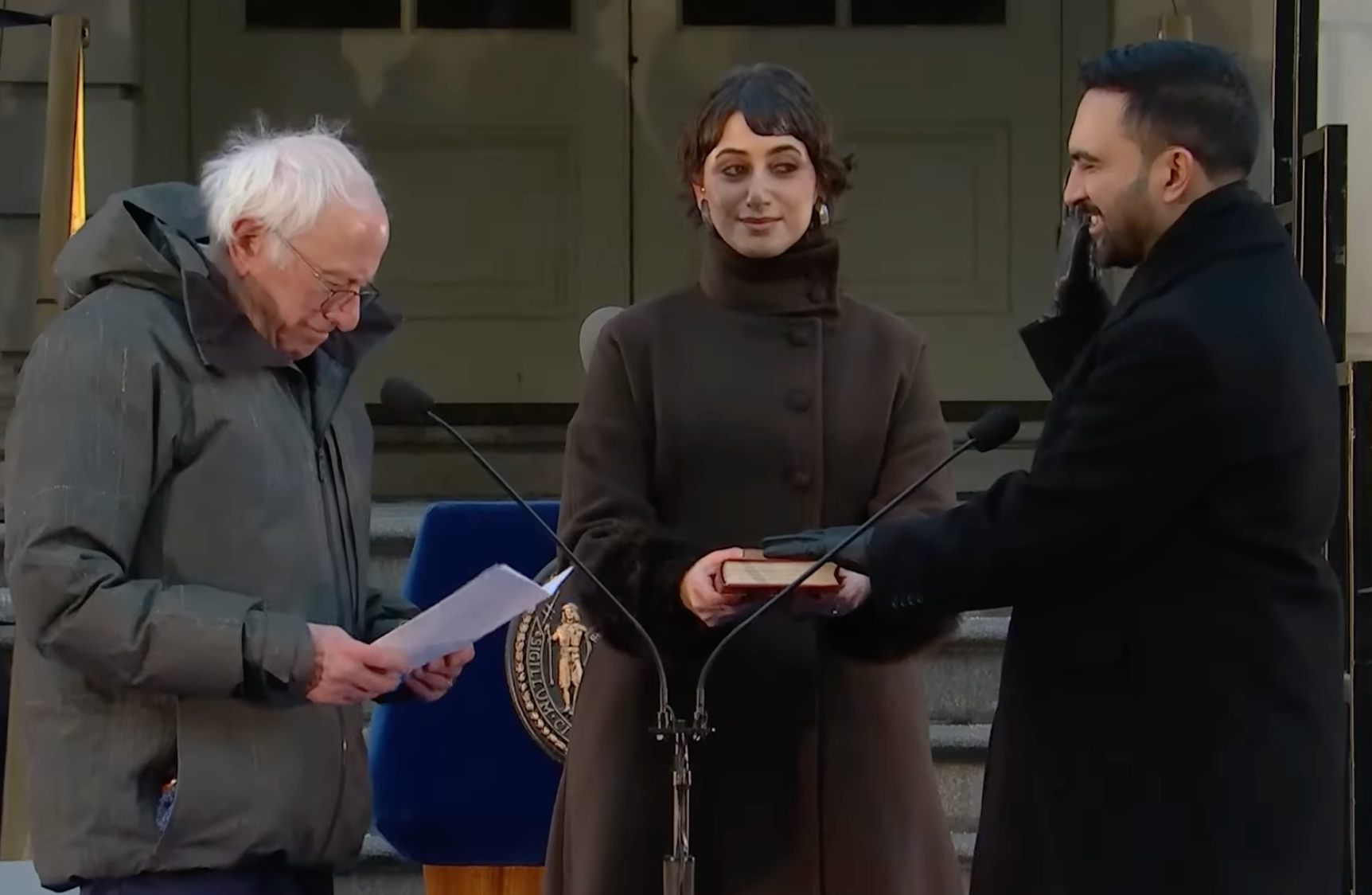
I was at home, putting my son to sleep, when I told my wife Mamdani had won.
“Al-ḥamdu lillāh,” (thank God) she said, and immediately texted her family.
She has never thanked God for another candidate before. Why thank God for Mamdani?
Start with how the community reads his more inconvenient statements. When Mamdani signals support for LGBTQ initiatives — which both my wife and I agree with — the most common response from more conservative Muslims is dismissal of the literal reading. He has to say that. That's politics. His statements are treated as constraints rather than confessions, outputs of a political environment that requires certain performances from anyone running for office. The words are not taken as a window into who he is. They are taken as the cost of entry.
That generosity is made possible by something prior: the community’s sense of whose side he is on. He is understood, especially among younger Muslims and immigrant families, as one of us—not as a matter of background, but of accountability. The question is not where he comes from, but who he answers to.
Imam Khalid Latif, who canvassed for Mamdani, put it this way: “He left no stone unturned on the idea that we belong, and his election is something that is a testament to that.” What Latif is naming is the feeling of being seen as a legitimate inhabitant of power rather than a visitor to it.
Even skeptical supporters stayed within that frame. “He does the promises, this is the most important thing — it’s not only because he’s the first Muslim… we just want him to do what he promised about freezing the rents,” said Walid Ali, who voted for him. The question was never whether he believed the right things. It was whether he would deliver for the right people.
What he chooses to lead with seals the reading. Mamdani centers affordability: housing, cost of living, economic justice for working-class New Yorkers. That alignment with what Muslim voters actually foreground (71% cited cost of living as a major concern in the ISPU's 2023 American Muslim Poll) means the social issues that might otherwise generate tension get pushed to the background. They don't disappear. They just don't define him. Mamdani seemed to understand this instinctively. At a Bronx mosque press conference, he said: "I have sought to be the candidate fighting for every single New Yorker, not simply the Muslim candidate." Universal before particular. That framing is precisely what earns strategic rather than moral interpretation.
Then there is the question of what he is understood to represent. Mamdani is treated as a politician who is Muslim—not a representative of Islam itself. He is a political actor operating in a political system. That freedom to be seen as an individual rather than a symbol provides a margin that, as the Omar and Tlaib sections will show, is distributed very unevenly.
And finally, Palestine. This is where his credibility is, for many in the community, almost startling in an American politician. He has described Gaza as a genocide, supported BDS throughout his adult life, co-founded his college's Students for Justice in Palestine chapter, and said repeatedly and without hedging that the Palestinian cause is "central to my identity." These are positions that are mainstream within conservative Muslim circles.
When his opponents in the mayoral race tried to use that against him the Muslim community read those attacks as confirming. Here was a candidate who was willing to pay a serious political price for not walking his position back. That kind of exposure generates the kind of trust you extend to someone who has skin in the game.
The pride I felt when he won was not about affordability, and it was not, if I am honest, primarily about Palestine either — those are positions I can evaluate coolly, and on some I land differently than he does. It was something more primitive than policy. It was the feeling of watching someone refuse to diminish themselves to win, and winning anyway. In the viral video he released during the campaign, facing a wave of Islamophobic attacks from both parties, Mamdani said: "I will not change who I am, I will not change how I eat, I will not change the faith that I am proud to belong to." My mother didn't know his policies. She sent the video anyway. I understood exactly why.
Ilhan Omar and the Burden of Representation
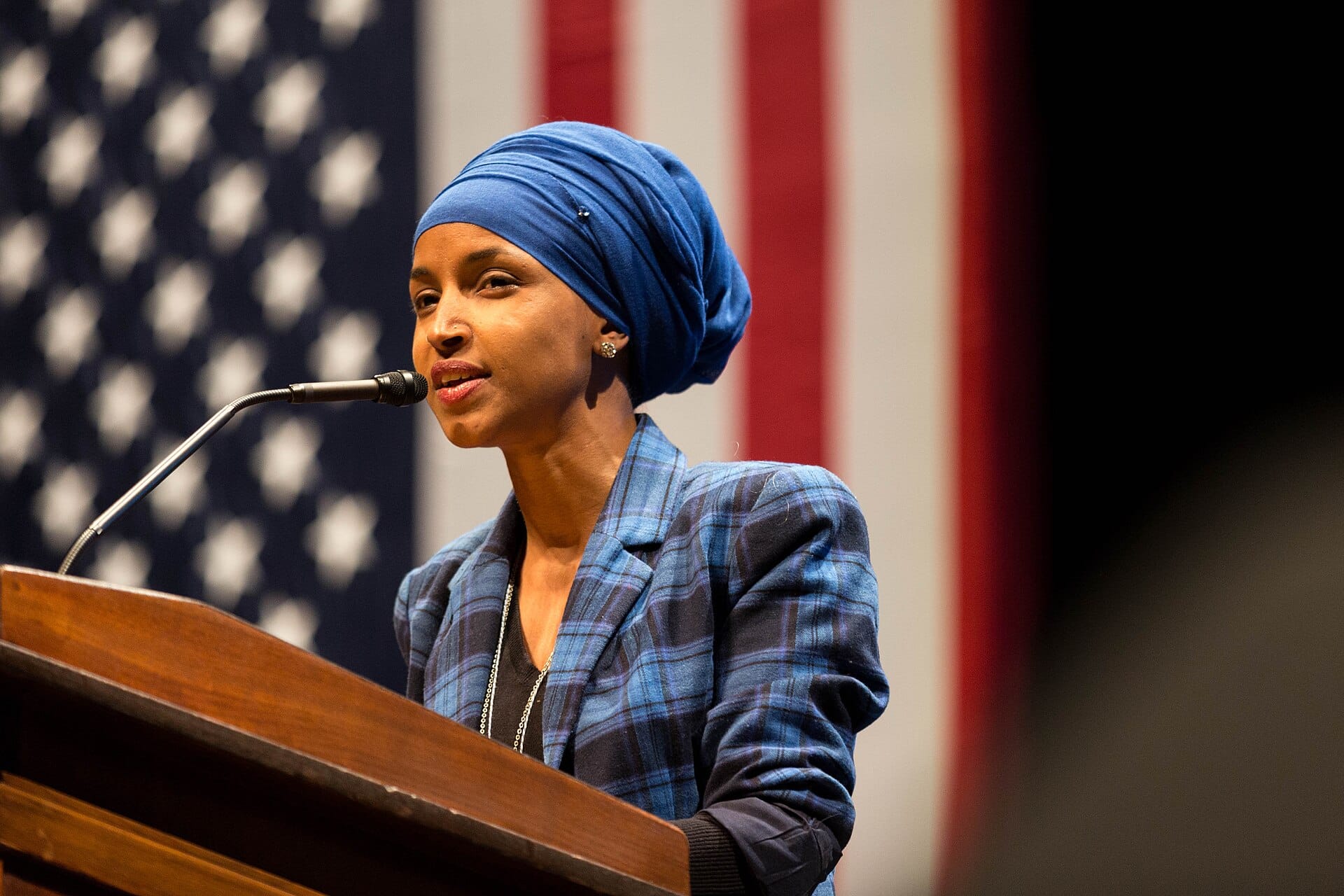
When I hear Ilhan Omar’s name, my first thought is: Islamophobia.
The attacks she’s faced, the bad-faith translations, the removal from the Foreign Affairs Committee, the death threats, the way her name has become a vessel into which a certain kind of American hostility pours itself. My reaction to Omar is not primarily political. It is protective.
That reaction does not translate into active political support. I feel solidarity when she’s attacked. I don’t feel the warmth I felt when Mamdani won. If she lost her seat tomorrow to another progressive Minnesotan—even another Muslim Minnesotan—I would feel very little. If she lost to a MAGA Republican, I would feel something, but that feeling would be about the MAGA Republican, not about Omar.
I protect Muslims as people. I don’t necessarily advocate for Muslim politicians as politicians. Those are different orientations toward the same figure.
The heart of the difference with Mamdani is what Omar is understood to represent—and how that shapes whether her words are read as political necessity or personal conviction.
Omar is forced into symbolic representation in a way Mamdani is not. As Asifa Siraj observed in Sociology Compass, hijab-wearing women in public life are routinely treated as representatives of Islam rather than as individuals navigating a system. Omar cannot simply be a person making political calculations. She is evaluated as Islam making a statement. Once a politician becomes symbolic in that way, strategic interpretation collapses. People don’t say she has to say that about someone who is understood to be confessing what Islam believes. The mode shifts from strategic to moral—and under moral interpretation, every statement is scrutinized as a confession of faith.
Her register compounds it. Omar speaks in the language of solidarity across every issue. On LGBTQ rights: “hate and bigotry should have no place in America.” On Islamophobia: “I’m tired of it, and every single Muslim in this country should be tired of it.” On Palestine, on race, on immigration — always the same register: we must. That consistency is what gives her critics the raw material for the reading they want to apply. When your default mode is moral declaration, every position you hold reads as conviction. Mamdani can describe a rent freeze as a policy mechanism and leave his inner life unread. Omar does not give the conservative community that distance. Everything she says sounds like a statement of who she is.
Omar is also Black. As Su’ad Abdul Khabeer documents in Muslim Cool, Black Muslim women navigate layered expectations of representation and respectability that compound the scrutiny already applied to Muslim women in public roles. To represent Islam while being a Black woman in America is to carry additional vulnerabilities to the charge of representing incorrectly.
Her Palestine record makes the dynamic even harder to justify. She has been more outspoken on Gaza than almost any member of Congress, was removed from the Foreign Affairs Committee partly because of it, and has paid sustained political costs for refusing to soften her position. By the logic of the system, this should generate the same trust it generates for Mamdani and Tlaib. It largely doesn't. The symbolic burden of representing Islam absorbs the Palestine signal — her position becomes one item in a long ledger of statements she must answer for rather than the defining axis of her identity.
The question of who she is accountable to runs against her as well. Where Mamdani is read as navigating a system, Omar is read as having been changed by one—as having moved away from the community rather than remaining inside it.
It is worth insisting on this: Omar gets it from both sides—and both sides, for all their differences, are reacting to the same thing. Republicans attack her because she is a visibly Muslim woman who refuses to be quiet. The Muslim community criticizes her because she is a visibly Muslim woman who refuses to perform the “right kind” of Islam. The external critics want her to stop being so Muslim. The internal critics want her to be Muslim differently. What they share is the premise that her public presence is a problem to be managed—that she is representing something larger than herself and doing it wrong.
The asymmetry between Omar and Mamdani is explained by what the system has made them mean. A man navigating power. A woman representing Islam. The community that operates this system bears responsibility for what it costs her.
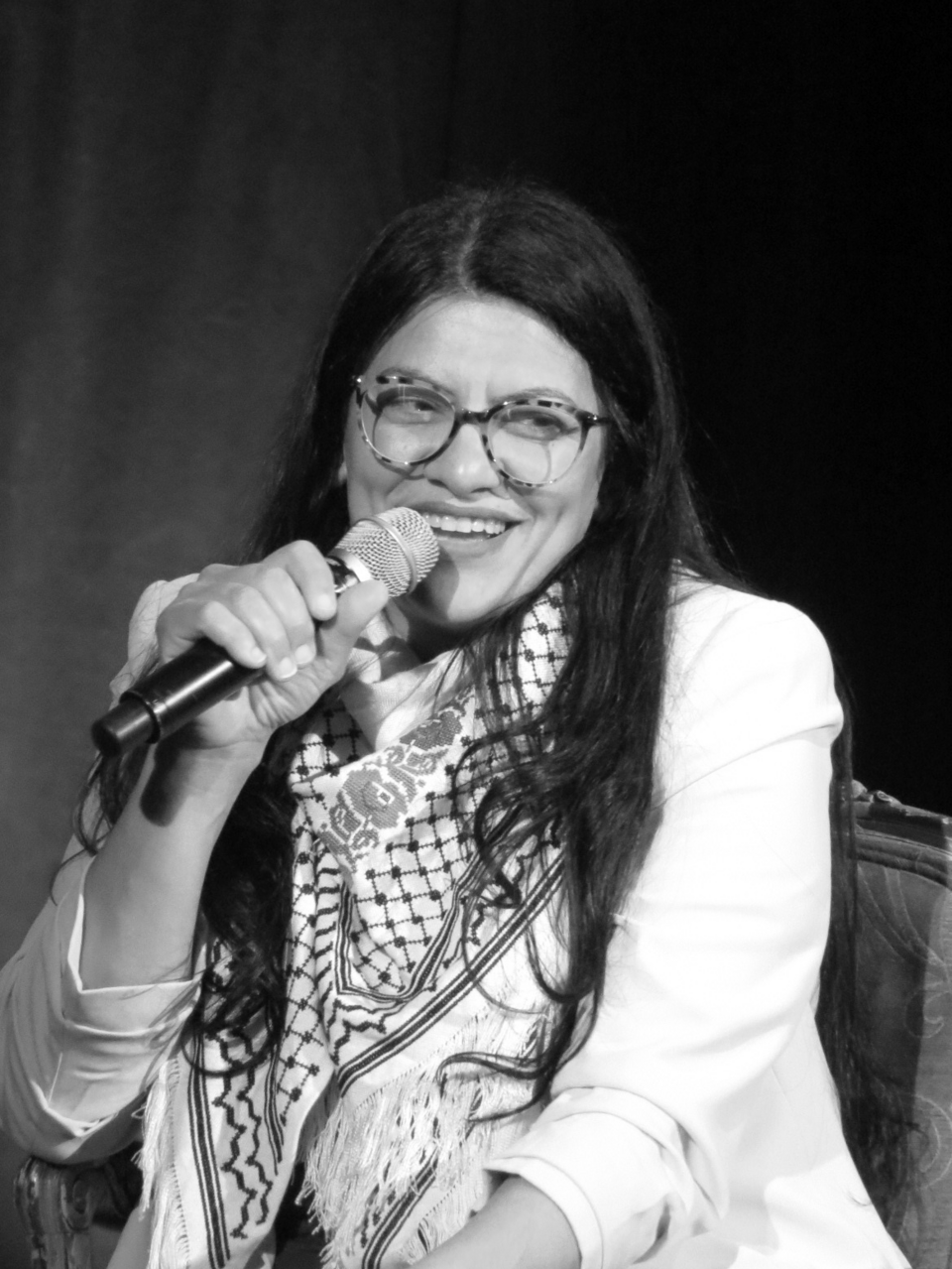
Rashida Tlaib and the Power of Mission
When I hear Rashida Tlaib’s name, I think of Palestine.
Her grandmother in the West Bank, her family, the wound she carries as a fact of her biography.
That specificity is everything.
Tlaib and Omar are, in structural terms, comparable figures: both visible Muslim women in Congress, both willing to take politically costly positions, both subject to significant external attack. But the conservative community’s reactions to them are almost mirror images of each other. Omar is watched with unease. Tlaib is proudly celebrated.
The difference is what symbolic representation does when the symbol is Palestine rather than Islam.
Some symbols constrain; others authorize. Omar represents Islam broadly—a contested, symbolically overloaded category in which every statement must carry the weight of the whole tradition. Tlaib represents Palestine—a more specific, more emotionally unified cause that the community has largely consecrated as sacred. The expectations attached to representing Islam are burdens: she can always represent it wrong. The expectations attached to representing Palestine are sources of authority: her biography gives her the right to speak that others cannot claim.
When the House voted to censure her in November 2023, the community’s response was fury. CAIR-Michigan stood alongside her immediately. A Tlaib supporter in Dearborn put it plainly: “She never steps back. She’s fierce, and what she says is always strong. I applaud her for that.” Tlaib herself framed the censure on the House floor as testimony: “I am the only Palestinian American serving in Congress, and my perspective is needed here now more than ever.” The community heard that as a family member’s refusal to be erased.
When Tlaib uses the language of moral urgency, it lands as witness rather than ideology—because the moral content in question is Palestinian suffering, which sits at the top of the community’s hierarchy of concerns. Moral interpretation, applied to the right cause, produces protection rather than condemnation.
My reaction to Tlaib is respect, but distance. Palestine matters to me as a policy issue, but it is not the axis my political identity rotates around, which means Tlaib's particular form of authority doesn't fully land for me the way it does for much of the community. I respect what she does, but I don't feel it as intensely.
The contrast with my Mamdani reaction is instructive, and a little hard to explain. What I responded to in Mamdani was something more diffuse than any single cause. It was the feeling of belonging itself — of seeing someone who carries the same identity I carry and was taken seriously. Tlaib has always had that in Dearborn. Mamdani had it on what became a national stage. Maybe that's the difference. Or maybe I'm just rationalizing why one Muslim politician moved me and another didn't, and the honest answer is that I don't fully know.
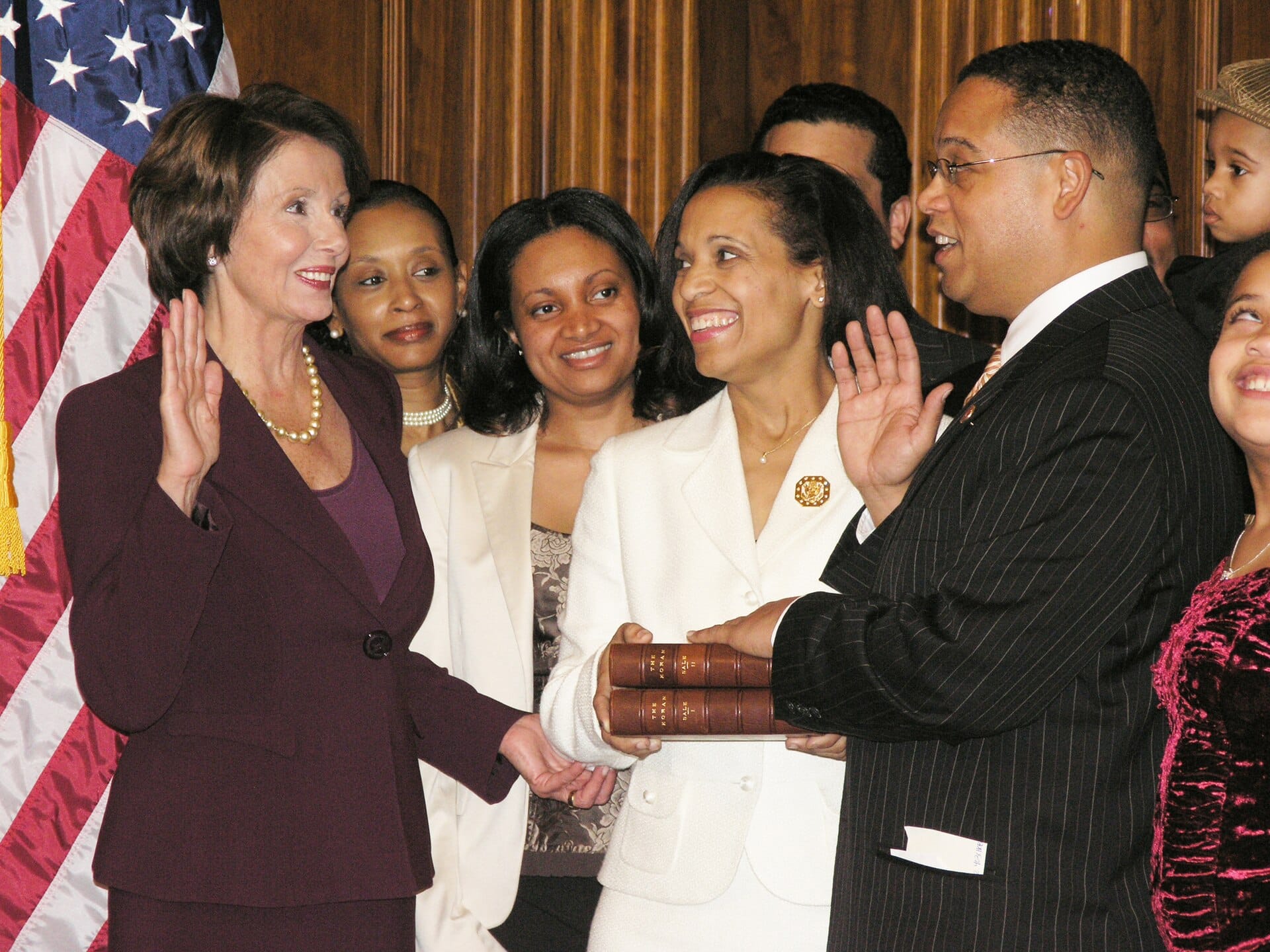
Keith Ellison and the Price of Entry
When I hear Keith Ellison’s name, I think: first Muslim in Congress. Warm, historical, and emotionally thin.
In 2006, his win was genuinely significant. His election “amounted to something of a political awakening among Muslims tired of being vilified since the attacks of Sept. 11, 2001,” as press coverage noted. Many Muslims viewed it as a counterbalance to years of hostile political coverage. I remember the feeling. Not pride exactly—more like relief.
He opened the door, but he didn’t define what comes through it.
Spend a few minutes discussing politics with a certain kind of Muslim, and the contrast becomes clear in how Ellison is spoken about compared to Mamdani or Tlaib. He comes up the way someone’s accomplished older relative comes up—with a pride that is dutiful rather than electric. Someone who did what needed to be done in a different era and has since moved into a different institutional role. You wouldn’t say anything against him. But you wouldn’t rally for him either.
Today, his name generates neither Mamdani’s warmth, nor Omar’s tension, nor Tlaib’s protectiveness. He is accepted—but not claimed.
Success moved him in a direction that reduced attachment — the opposite of what symbolic firsts are supposed to do. At a 2024 Democratic outreach event, Ellison tried to bridge the gap between Muslim voters and the Harris campaign: "Kamala Harris is not the president of the United States. She cannot decide for President Biden." This is the language of a man managing a community's political participation from a slight distance—not from inside it. The closer a politician moves to the center of institutional power, the further they move from the center of the community.
His political profile—civil rights, legal work, party leadership, the George Floyd prosecution—is genuinely substantial. But the conservative community's hierarchy doesn't work that way. Domestic accomplishments, however serious, don't generate the same attachment as a clear stance on Palestine. Ellison's positioning there is generally aligned with progressive critiques but perceived by some as insufficiently forceful. In the community's accounting, that registers as a weak signal. Neutrality weakens attachment, even when the underlying record doesn't deserve neutrality.
However, there is a harder version of this observation. Ellison's Palestine positioning is not actually neutral — it is generally aligned with progressive critiques, and during the Gaza crisis he was one of the few establishment Democrats willing to publicly acknowledge the community's pain. The issue is not that he is indifferent. The issue is that his care reads as political rather than biographical. He does not carry the diasporic proximity that the community, often without acknowledging it, treats as a prerequisite for genuine credibility on Palestine. Omar has the same problem.
My reaction to Ellison is probably the most honest version of how I'd like to think I react to all of them, and also the one that most closely tracks how I actually differ from the community. I give more weight to his domestic record than most Muslim voters do. I don't need Palestine to be the primary signal. Respectful acknowledgment, evaluation of record, low emotional charge: that is how I'd prefer to operate. The problem is that Mamdani revealed that this is not how I actually operate across the board.
A Unified Model
These are not four separate stories. They are four ways the same system produces judgment—including in me.
The two interpretive modes do not distribute evenly. Mamdani receives strategic interpretation—generous, earned, active. Omar receives moral interpretation—and pays for it. Tlaib receives moral interpretation too, but the moral content aligns with what the community valorizes, so the reading produces protection rather than condemnation. Ellison receives strategic interpretation, but flat and expected rather than warm and sustained.
Beneath the filters sits a hidden hierarchy of concerns. Palestine and foreign policy justice occupy the top position, functioning as primary moral signals. Economic issues occupy a secondary but important tier. Social issues are the most contested—they can be negotiated, backgrounded, forgiven, or condemned depending on how they interact with the other filters. A candidate can fail on social issues and retain community support if they pass the Palestine test; the reverse is rarely true.
But the Palestine test is not purely a policy test. It is also, if you look at who passes it and who doesn't, partly a biography test. Mamdani and Tlaib's Palestine positions read as who they are. Omar and Ellison's read as something they said.
Part of this is the symbolic burden already described. But part of it is that they are Black. The Palestine filter as applied in Muslim communities carries an implicit assumption of Arab or South Asian “connection” to the region. Black Muslims, regardless of their actual records, are often read as allies to Palestinian suffering rather than as people with personal skin in the game. That distinction is never stated. It operates silently. And it means Omar can hold the same position as Tlaib and receive a fraction of the credit. That is an asymmetry worth sitting with — particularly for a community that understands better than most what it feels like to be judged by categories rather than by record.
The system also does not treat women uniformly or fairly. Omar’s symbolic weight is a burden because she represents Islam—broad, pressured, liable to be gotten wrong. Tlaib’s symbolic weight is authority because she represents Palestine—specific, consecrated, impossible to fake. The asymmetry between them is one the community has not fully reckoned with.
One place where the system shows its logic most clearly: André Carson, the Indiana congressman who has served quietly and without controversy for nearly two decades, generates almost no community conversation at all. He is Muslim. He is in Congress. He has not made Palestine central. He has not become symbolic. The system’s silence about him is a verdict. To be legible to this interpretive framework, a politician must either occupy a symbolic role or foreground the right causes. Carson does neither, and the community’s indifference reveals what the system actually rewards: a particular kind of political identity that can be read and claimed.
Interpretation here is collective. What looks like scattered individual judgment is, in aggregate, a distributed act of meaning-making. The community is its own interpretive authority. And I am a member of that community, even when I think I’m not.
What I Was Actually Trying to Figure Out
Return to the sidewalk outside the mosque in Queens. The heat is still there. The cars are still double-parked. People are moving toward them now, conversations trailing off.
"I don't agree with everything."
"But he's good for us."
"At least he speaks about Palestine."
For most of my adult life, I have looked at conversations like this with impatience. Shallow. Identity-driven. Not policy-serious. I preferred the conversations I had with my wife.
What I've come to think is that the impatience was partly right and partly a failure of attention.
What looks like inconsistency is actually an informal method for holding together identity and political reality without forcing them into full alignment. This is not, I suspect, unique to Muslim Americans. It may be what minority communities do when the available politics can't quite hold everything they are: they develop informal conventions for managing the distance, for deciding which disagreements are disqualifying and which can be set aside. The sidewalk conversation looks shallow from the outside. From the inside, it is a set of tacit rules for surviving a system that wasn't built with you in mind.
But the system does not work evenly. Omar pays a cost that Mamdani does not. The community has not fully reckoned with what it costs the people—particularly the women—who end up carrying a symbolic representation they didn't ask for. That asymmetry deserves to be named.
It began, for me, with a simpler and more uncomfortable question: why did I feel pride when Zohran Mamdani won a mayoral race in a city I don't live in, for a candidate whose politics I mostly oppose?
I tell myself a particular story about who I am politically. Issue-based, not identity-based. Cross-partisan, not tribal. And then: pride.
The pride came from somewhere specific. From the feeling of seeing a version of a self you hadn't known could occupy a particular space—a demonstration that the identity I carry doesn't have to be managed or muted to move through the world with power. It's a belonging reaction. And belonging operates in me whether or not I endorse it as a principle.
My aunt in Egypt sent a video. I wrote an essay. Different register, same underlying wiring.
I don't go to the mosque as often as I should. I don't have social media. I vote across party lines. But when a Muslim man won the New York City mayoral race, I felt proud and my wife thanked God. What I eventually understood was this: not that he won, but that we did. That the us in "he's good for us" turned out to include me, even though I'd spent years telling myself I'd left that conversation behind.





.jpg?ref=texani.org)