
Reading the Future in Someone Else's Past
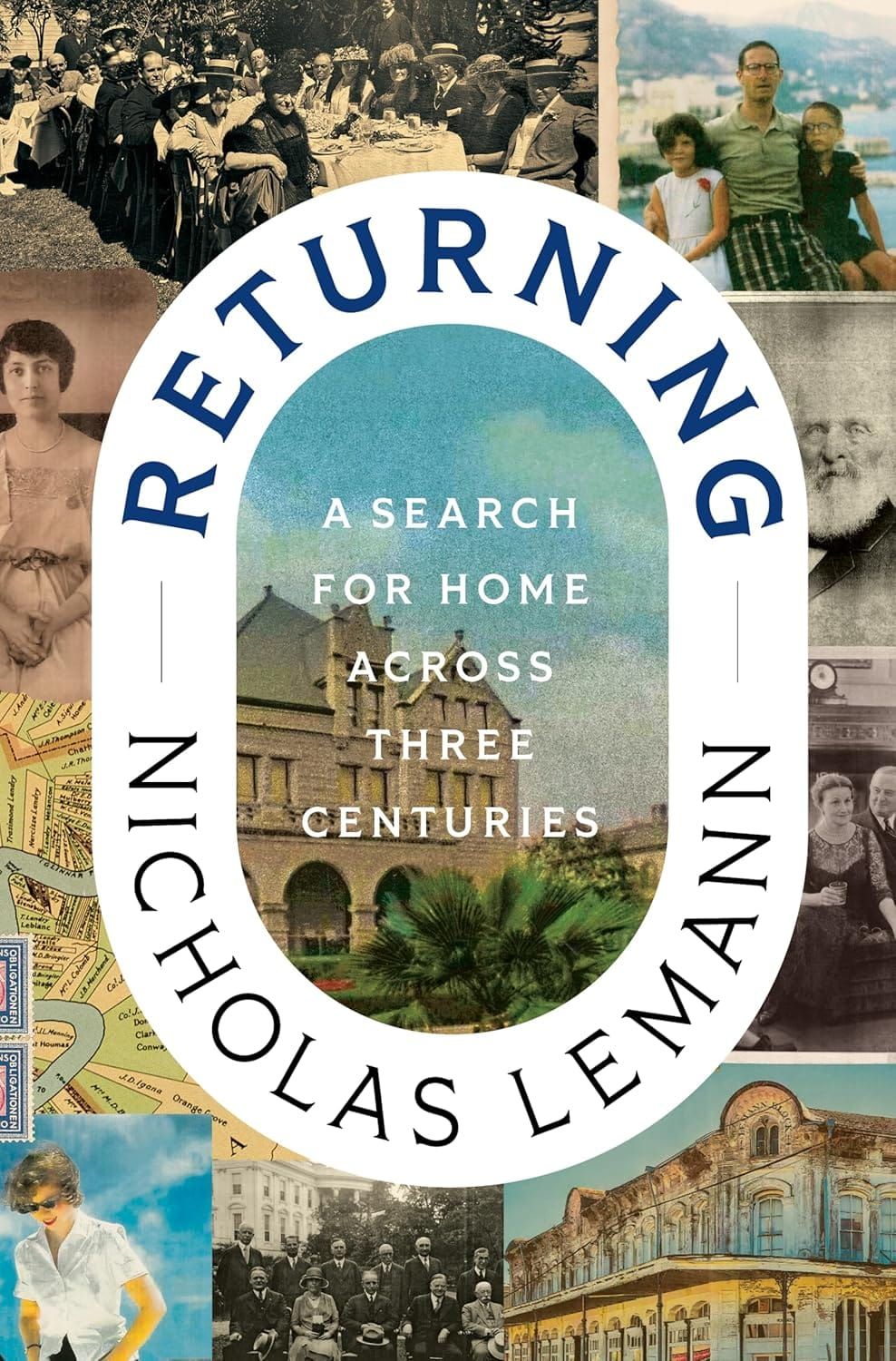
Reflections on Returning: A Search for Home Across Three Centuries by Nicholas Lemann.
Introduction
I found the book by accident, half-distracted. My wife was sitting in the chair in our bedroom putting our son to sleep. I was lying on the bed reading on my phone, which is what I do now in the hours between being a father and being anything else. A New Yorker excerpt from Nicholas Lemann's Returning: A Search for Home Across Three Centuries appeared in my feed, and something in the first few paragraphs drew me in. I read the whole thing not realizing that it was only an excerpt. I had to get the full book, so I ordered it immediately. Then I waited a month, which felt unbearably long. When it arrived, I finished it in four days.
I had expected a family history. The book is, in one sense, exactly that: five generations of a German-Jewish family arriving in Louisiana in the 1830s, making their way through the plantation economy, the Civil War, Reconstruction, Harvard, New Orleans society, and finally to a tentative, deliberately constructed Jewish life in contemporary New York. It is a beautifully written book, and I picked it up the way you pick up a story about someone else's world, expecting to observe it from the outside, to find it interesting, perhaps instructive, and ultimately contained.
It did not feel contained. It felt immediate in a way I did not anticipate — the way a doctor's chart feels immediate when you realize it describes your own condition. I kept reading with the sensation that the tense was wrong. This was not a story in the past tense. It was a story in the present.
The moment I can point to: Lemann describes his father's generation, the fourth in America, as having achieved a kind of Jewishness that “entailed no particularity in how we conceived of ourselves and how we lived.” A minimal identity. Jewishness as background radiation — present in the air, detectable if you looked, but not determining anything. Not shaping the day. Then his description of his own upbringing: no bar mitzvah, no Hanukkah candles lit, no Yiddish, no delicatessen. Christmas celebrated enthusiastically. The son of a people who had decided that the most dangerous thing about their identity was its visibility.
The Christmas tree question struck a nerve. It surfaces in Muslim communities regularly now, framed with the language of cultural participation — “we're just celebrating with our neighbors, it's not religious, our kids would feel left out.” And then there's the “Ramadan tree,” which some Muslims have invented as a counter-gesture, as if the issue with Christmas trees is that they lack an Islamic equivalent. The question underneath both of these isn't really about trees. It's about where you draw the line, and whether there's an Islamic self that can still draw it after enough lines have been moved.
Since having my son, I think in generations in a way I did not before. When I am with him — watching him learn to speak — I am aware that I am one point in a chain. The question of what he will inherit is the most concrete thought in my mind these days. When I read Lemann's book, I was reading it as reconnaissance.
Returning is a story about Jews, but that is not all it is. It is a story about what America does to a people — about the mechanism by which a community arrives carrying its whole world, its law, its dietary codes, its sense of what is owed to God, and across several generations deposits that world into something lighter, more negotiable, and finally optional. The names change. The specific pressures change. The direction does not.
I am a second-generation Muslim. My mother teaches Qur'an. My father's relationship with religion was inconsistent when I was young and has deepened as he has aged. I grew up inside the full system — prayer, fasting, halal, the Qur'an — but I grew up also inside America, which has its own gravity, and the two things existed together in my life in a tension I could not always name. I read Lemann's book as someone already inside the same story, at an earlier chapter.
There is a version of Muslim self-understanding in America that resists this comparison. Islam is too strong, too globally connected, too theologically grounded; what happened to Jewish communities won't happen to us. Every assimilating religious community in American history has believed some version of this. The belief is a symptom of early-stage assimilation, when the process is underway but not yet visible from the inside. I no longer find the belief reassuring. Not because I think Islam is weak, but because I think America is very strong, and specifically strong in the ways most corrosive to religious practice: it is comfortable, it rewards conformity, it makes distinction costly in the thousands of small daily ways that accumulate into something irreversible before anyone has made a single dramatic decision. No religious or ethic group has been exempt from this.
Muslims in America are not deciding whether to enter this process. They are already inside it.
I closed the book and sat with the thought for a while. I had started reading a family history; without quite realizing it, I was actually reading forward.
The Story — Five Generations
Across roughly 190 years — from the 1830s to the present — five generations of a single family traverse what turns out to be a recognizable American arc. To understand what the process does to a community, you have to watch it unfold in sequence, because no single generation looks dramatic from the inside. Only from a distance does the cumulative movement become visible.
Jacob Lemann arrives in Louisiana in 1836, a German Jew, illiterate in English, in a country that has just banned the transatlantic slave trade — a fact that intensified the domestic slave market and made Louisiana sugar country, where Jacob settles, one of the most economically dynamic and morally catastrophic places in antebellum America. By 1850, the region has more than 1,500 planters and nearly 140,000 enslaved people, accounting for 25 percent of world sugar production. Jacob enters this world as a small-scale merchant and lender, doing what his forebears had done in France and Germany, providing credit to mid-level planters. He marries Marie Berthelot, a Cajun, also illiterate in English.
Early credit records tell the story of his success. In January 1848, a merchant report describes him as “Jew, one of the best of his kind. In business 10 or 12 years. Deals fairly, pays promptly, has real estate and Negroes.” Another report from the same period is less charitable: “Can't give him much of a character as he is a Jew.” But by December 1851 he is “a keen shrewd business man.” Over fifteen years, the records track his transformation: from suspicious foreigner to legible economic actor. America has received him on the basis of function, not origin. He is accepted insofar as he is useful.
He also participates in the slavery economy in ways that cannot be softened. “Usually he had bought the Black people whom he was selling at a public auction after somebody had defaulted on taxes, or from a widow whose husband had recently died, and their bodies were conveyed along with a piece of land.” Lemann is honest about this and about his own implication in it: there is a direct causal connection, he writes, between Jacob's involvement in slavery and the life Lemann is able to live today. What strikes me reading this is not only the moral weight but the structural clarity: Jacob's survival and success required moral compromise, and he made it without recorded hesitation. The American opportunity demanded accommodation. He accommodated. Every subsequent generation would make different versions of the same trade.
His religious life bends correspondingly. No minyan in Donaldsonville. Kosher nearly impossible in sugar country. The Sabbath unobservable in the rhythm of plantation commerce. Yet he did not abandon Judaism; the identity persisted and even reasserted itself. In 1852, in New York, Marie converts formally before a court of three rabbis, emerging as Miriam, a Jewish woman. Jacob also funded the construction of a synagogue in Essenheim, his home village in Germany, in 1857 — a gift across the Atlantic to the Jewish life he had left behind. The contradiction is the first iteration of a pattern: assimilation and reconstruction occurring simultaneously, the community dissolving in one direction while being rebuilt in another.
The Civil War destroys the world Jacob entered. The 1861 sugar crop is the largest in Louisiana history, but by 1864 it has collapsed to almost nothing — emancipation ended not just enslaved labor but the collateral system built on enslaved bodies, and the credit economy that Jacob had mastered went with it. He survives by reading which way the war will go and positioning himself with the Union forces. Eventually he comes to own a plantation of his own—Palo Alto. However, the world he had originally built himself into is gone.
Bernard Lemann, born in the early 1840s, is sent north in 1855 — at age fourteen, to a Jewish religious boarding school in New York run by Samuel Myer Isaacs, a rabbi who understood the question precisely: how do you preserve Jewish religious life against the erosion that American mobility would inevitably produce? Jacob's decision to send his firstborn son north ahead of the family's own move is the first deliberate institutional intervention in the story — a shift from letting the environment shape identity to actively organizing against it. It is the birth of strategy.
Bernard gets two educations simultaneously. He attends the secular Collegiate School alongside Isaacs's religious institution, learning Torah and George Eliot at the same time, synagogue and opera, Sabbath observance and international travel. He comes of age in the 1850s and 1860s, the Civil War and Reconstruction reshaping the South while he moves freely through New York and then Liverpool and the European cities that were becoming newly available to Jews. His notebook survives, filled with gorgeous compositions as if he is taking inventory of the wider world now opening to him. When he encounters Bishop Colenso's theological arguments challenging the divine authorship of the Torah, he records them with “an almost unnatural calm, never giving his own opinion” — as if he understood that dispassion was the price of admission to the new worlds he was entering. He finds Colenso’s arguments “very strong,” without ever abandoning Jewish observance.
In 1858, the kidnapping of Edgardo Mortara — a Jewish boy seized by the Catholic Church — produces Bernard's first act of public Jewish solidarity: he attends a Broadway protest meeting to demand the boy's return. Jewish identity is becoming self-conscious, political, transnational; it is no longer simply assumed. In 1870, at a Purim ball in New Orleans, he meets Harriet Friedheim, born in the Rhine Valley and raised in New Orleans from the age of three. Together they have ten children; four go to Harvard.
By Reconstruction, the synthesis is stable but not permanent. He pays the Freedmen's Bureau tax, participates in biracial politics, and then, when Reconstruction ends and Jim Crow succeeds, accommodates. “They attended to business.” Jacob's moral compromise was slavery; Bernard's is the post-Reconstruction racial order. The specific compromises change across generations; the structure of accommodation remains.
Pop — Montefore Mordecai Lemann, born in Donaldsonville in 1884 — comes of age as elite America’s doors are opening and quietly narrowing again. Intellectually precocious, he enters Tulane at fourteen, earns a Harvard BA in 1903 and a Harvard Law degree in 1906, serves in World War One, and returns to build a prominent legal career in New Orleans. His reach extends nationally: close friend of Justice Felix Frankfurter, acquainted with Herbert Lehman, active in Roosevelt-era Washington. He co-founds Dillard University and serves as a trustee for more than forty years.
He attends temple only once a year, on Yom Kippur, and admits to close friends that he is no longer sure he believes in God. Integration takes on a particular form here: religion recedes into ritual, belief fades almost to nothing, yet identity and institutional ties endure.
The opportunities available to him are real, but they are not secure. When the New Orleans country club was founded in 1914, Pop was among its founding members. At some point afterward, it adopted a policy excluding Jews. He remained the sole Jewish member, protected only by inheritance. This is what conditional acceptance looks like in practice: inclusion that lasts only as long as the rules permit it—and the rules can change without your consent
In 1939, when Hitler is in power, Pop travels to Washington to testify before Congress in favor of a bill that would have admitted 20,000 German-Jewish children to the United States. Eleanor Roosevelt publicly endorses it. Franklin Roosevelt declines to take a position. The bill never comes to a vote. That same spring, the ocean liner St. Louis departs Hamburg carrying more than nine hundred German Jews with Cuban visas; Cuba refuses to let it dock; the ship sails to Miami, where passengers cable the White House from within sight of the harbor; they are turned away. Many of them die in the Holocaust. Pop's influence, his court access, his decades of careful cultivation — none of it is enough. The limits of assimilation reveal themselves in the hardest possible way: the doors you have managed to open for yourself do not open for your people.
Father — Thomas Berthelot Lemann, born in 1926, Harvard Law 1952 — arrives at the moment when Jewish acceptance in America becomes broad enough that distinctiveness begins to feel counterproductive. Harvard still has a Jewish quota when Father is there in the 1940s. By the time Nicholas enters in the early 1970s, the university is reportedly one-third Jewish; the institutional breakthrough is complete. Father's response is to try to complete the personal journey — to become not just integrated but indistinguishable.
His method is subtraction. Stop the Jewish education. Celebrate Christmas. Avoid the kippah — at his wedding to Nicholas's mother he spots the basket of skullcaps set out for the men and hides it. He will hide it again at Nicholas's first wedding, until Nicholas's second wedding to Judith overwhelms his engineering with sheer institutional force. Father is not hostile to Jewishness. He is allergic to its friction. He wants a Jewishness that “entailed no particularity in how we conceived of ourselves and how we lived” — an identity as ambient and undemanding as the air in a room, present without requiring anything.
There is a letter from 1946 — Father writing home while still in military service from World War Two — that Lemann finds remarkable. Father reports that he has been reading the Old and New Testaments, the Qur'an, and writers on religion from across traditions, speaking with Orthodox Jews and Christian Scientists and members of “most other Western faiths.” He writes that religion is “a big one for me” and that he will be thinking and talking about it when he gets back. This is a Father who might have taken a different path. Something closed after that. “His passion in life wasn't searching, it was protecting what was familiar.” The man who came home from the war was not the man who wrote that letter. The gates he built were also walls against himself.
Nicholas Lemann — born in 1954, Harvard BA 1976 — grows up never having been to a bar mitzvah, never having lit Hanukkah candles, never having eaten a bagel or heard anyone say oy. The foods of his childhood are gumbo and jambalaya, "triply treyf, because they use pork, shellfish, and butter all in the same dish." What his father bequeathed him is the lightest possible version of an identity: the label without the content.
And yet it reasserts itself as a mysterious pull, arriving uninvited. “Anything that was demonstrably Jewish — a book, a movie, a restaurant — drew my interest.“ When his first wife’s father suggests that their son not be circumcised, Nicholas is “nearly knocked over by an overwhelming wave of resistance that [he] hadn't expected. No!” He hadn't read the covenant with Abraham. He wasn't consciously committed to it. But something his father's subtraction project had not reached moved in him. He builds back: meets Judith, his second wife, and together they raise children in Jewish day schools and camps with the full institutional apparatus of serious Jewish life.
In 2004, the last Jew in Donaldsonville — Irv Birnbaum, who had tended the Bikur Cholim cemetery for decades — dies. The Lemanns who stayed in Donaldsonville and married locally became Catholic; the Lemanns who left for New Orleans remained Jews because leaving meant entering a community that could sustain the identity. What preserved one branch and not the other was the presence or absence of structure, including marriage within the community.
Across five generations, the line from Jacob in sugar country in the 1830s to Nicholas rebuilding in New York in the 2020s describes a complete arc: strength, synthesis, integration, near-disappearance, and fragile return. The inheritance changes with each generation, sometimes diminishing in the process. What finally returns is something new, built from the ruins of what the process left behind.
Assimilation is a Timeline
It is tempting to read the Lemann story as one family’s particular path through American life. But what unfolds across these generations is too regular to be accidental. It has the quality of a law rather than a biography.
Assimilation is not a decision. It is a process that unfolds across time, as each generation inherits less than the one before it and substitutes something else in its place. The substitutions feel like choices but their cumulative direction is not chosen. Nobody decides to have their grandchildren light Christmas trees. They make a long series of reasonable adjustments, and the Christmas tree is where the adjustments eventually land.
Each stage has an incentive that makes it feel rational from the inside. Jacob's is survival: the American offer is too significant to decline on grounds of religious inconvenience, so religion bends to economic reality. He doesn't ask what it means to be American. He asks how to make a life. Bernard's is mobility: managing Jewish distinctiveness is the price of access to the wider world, so the skills he develops to hold identity carefully are the skills his descendants use to thin it. Pop's is belonging: elite institutions are accessible now, and the price of entry is minimizing whatever marks you as particular, even as the country club and the refugee bill teach him that belonging is conditional and the conditions are set by someone else. Father's is normalcy: Jewish acceptance has become broad enough that distinctiveness feels not just unnecessary but a self-imposed obstacle, and nothing dramatic happens as he removes it. Nicholas's is longing: the absence his father created becomes, unexpectedly, desire.
But the displacement is not simply cultural pressure. It is infrastructure. America does not assimilate communities by persuading them that their traditions are wrong. It assimilates them by making those traditions structurally inconvenient. The five daily prayers conflict with standard work schedules; prayer rooms in offices are rare and uncomfortable to request. The Friday prayer falls during a workday. Halal food is available but obtaining it requires deliberate effort — it is the extra step, not the default option. The marriage market, for a Muslim trying to marry within the tradition, is thin outside of major cities and organized community. Everywhere the American system presents a frictionless secular path and a friction-laden religious one, not through conscious hostility but through the accumulated architecture of a society built around other assumptions. Each individual friction is small. The system of frictions is total. You do not have to be hostile to a religion to erode it. You only have to make everything else slightly easier.
I map myself onto this timeline without difficulty. I am Bernard: second-generation, educated, living in two worlds simultaneously, capable of holding both. My parents' Islam is their default setting. My Islam is deliberate, which means I could choose otherwise, which means my children will choose in a different context than I did. My son is likely to be Pop, at best, if I do nothing in particular. The question is what I will do, whether that will be enough, and whether my decisions will survive me.
Who Gets Accepted?
Assimilation is class-stratified. It does not unfold evenly across a minority community; it sorts people by visibility, accelerates for those who can achieve respectability, and creates a hierarchy within the group. What determines the pace of acceptance is visibility.
The German Jews who arrived before 1880 had achieved something conditional: access to certain institutions, a reputation for respectability, and a fragile but real place in American civic life. Then the Eastern European Jews began arriving — two and a half million between 1880 and 1920, poor, observant, Yiddish-speaking, concentrated in exactly the kinds of visible urban slums that made the native-born Protestant uncomfortable. The reaction of established German-Jewish community was not solidarity. It was management: the Galveston Plan to redirect immigrants toward less conspicuous cities, the funded institutions aimed at steering Jewish newcomers toward academic respectability, all organized around the same logic — the problem is the Jews who trigger antisemitism, and the solution is to control those Jews. The hierarchy imposed from outside was reproduced on the inside. The respectable Jew and the embarrassing one. The problem is always the “other” Jews.
Edgar Stern — Pop's close friend, a wealthy New Orleans philanthropist — visits the Jewish quarter of Warsaw in 1936 and writes home that he was filled with “disgust, shame, horror that any Jews could sink so low,” watches Hasidic men at prayer and calls them “merely primitive fanatics,” and then goes to Palestine to find Jews who are “clean-shaven, healthy, proud, secular” — and feels relief. Here are Jews worth being proud of. The Jewish question, solved elsewhere, in a different kind of Jew.
I read that letter and recognized the feeling immediately. Not about Jews, but about Muslims. I grew up around professional, educated Muslims — doctors, engineers, academics — and when I encountered other classes of Muslims, in Egypt, in Mecca and Medina, in certain mosques in American cities, I felt something I am not proud of but would be dishonest to deny. Embarrassment. A desire to clarify that I am not that, that there is a difference. I have softened the edges of Islam in professional settings, preemptively addressed what I imagine makes non-Muslims uncomfortable, distanced myself from other Muslims publicly, implied that their practices or their politics were the reason “people hate Muslims” — as if the problem were the Muslims and not the hatred.
This was the German-Jewish move, and it has the same structural consequence: elite Muslims are specifically pushed toward dilution. The spaces educated Muslims are now entering reward precisely the kind of abstracted, de-embodied religion that can be discussed as a heritage but never practiced in public. Observant working-class Muslims pray in break rooms without apology. Professional Muslims learn, quickly, that practice must be managed — disclosed selectively, never allowed to interrupt the rhythm of a secular institution. Upward mobility trains you to hold your religion the way you hold any identity that might make colleagues uncomfortable: lightly, with maximum deniability. The observant poor are embarrassing not because of what they believe but because of what they do — because their embodied practice makes the project of respectable assimilation visible and therefore harder. Visibility is the problem. Practice is visible.
But the German Jews learned — in the worst possible way, by the late 1930s — that the internal hierarchies do not hold. “We were all simply Jews.” The external gaze does not honor the categories the minority has constructed for itself. During the Holocaust, the distinctions collapsed. You are either inside or outside, and no amount of respectability determines which side you are on.
The lesson is available now, before the crisis that will make it undeniable. The question for Muslims is not which of us will be accepted. It is what we will have given up about our solidarity and our willingness to be visibly different in pursuit of an acceptability that was always someone else's to grant or revoke.
Can Islam Survive Weakening?
Assimilation does not begin by erasing identity. It begins by making it easier to live without it.
The first thing to disappear is practice, not belief. That narrowing — from what you do to what you merely hold — is where the deepest structural difference between Judaism and Islam lives, and the reason the Muslim situation is more precarious than most American Muslims seem willing to acknowledge.
Lemann traces the Jewish case through Reform Judaism, which emerged in nineteenth-century Germany and became the dominant mode among American German Jews. Its project was specific: remove the elements of Judaism that caused friction with the surrounding Protestant majority. The dietary laws. The Hebrew. The particularist theology of chosenness. The tribal overtones. Make Judaism legible and respectable by stripping out whatever made it strange. “It would be unthinkable to accept Jews as they were,” Lemann writes, “so we would have to be reformed, made more normal.” The logic was coherent: if difference causes exclusion, reduce difference; if ritual creates friction, eliminate ritual.
In the short term, the project worked — greater integration, less tension, more social acceptance. In the long term, substance drained out. “If you try to demystify and deritualize any religion, with the aim of making it completely normal and rational and up-to-date and unproblematic, then it winds up losing its hold on people.” The Reform movement in America, by the generation of Nicholas's father, had produced an identity with nearly no content. Lemann arrives at a devastating summary: “Our quest to classify Jews as a religion, not a race, had wound up exactly reversed: all race (though renounceable as an identity) and no religion.”
And yet Jewish identity survived this weakening. Even in Nicholas's generation, even after the bar mitzvah was not held and the candles were not lit and Christmas was celebrated with enthusiasm, something remained. The identity reasserted itself, not as practice or belief or knowledge, but as a pull. Judaism could survive its own dilution because it rests on a dual structure: it is simultaneously a religion and a people. When the religious structure weakens, the peoplehood structure carries the identity. Collective memory, historical narrative, external labeling — antisemitism itself, paradoxically, holding the group together even when everything internal has thinned. As Lemann puts it: “It's the idea that, no matter what the circumstances, being Jewish has a way of pushing itself to the fore.”
The dangerous inference, and I think many Muslims have drawn it implicitly, is that all religions work this way — that you can thin a tradition and what remains will still pull someone back. Start with the obvious counterexample: cultural Muslims exist in large numbers, in Turkey, Bosnia, Iran, and America. They identify as Muslim, feel Muslim, orient themselves culturally and politically as Muslims, while praying rarely or not at all. Doesn't this suggest a low-intensity equilibrium?
What it actually suggests is a transitional state. What persists in these cases is not Islam. It is Muslim ethnicity — the cultural inheritance of populations that were once Islamic, carrying the name and some of the forms without the animating content. These identities persist for one generation, sometimes two, but they do not reproduce themselves without practice, especially in minority contexts. The grandchildren of secular Muslims in America do not inherit a low-intensity Islam. They inherit a diminishing residue until in the third or fourth generation it is simply ancestry, present on a form somewhere, not present in a life. The label attenuates. The practice, having been abandoned, leaves nothing to return to.
The distinction that matters is between nominal Muslim identity and functional Islam — between carrying the name and practicing the thing. Judaism, because of its peoplehood structure, can carry identity without practice across multiple generations and still produce a Nicholas Lemann. Nominal Muslim identity cannot do this. When I look at the children of non-practicing Muslims I know, they are not Muslims-in-waiting. They are ex-Muslims who haven't explicitly left because there was nothing to leave from. The tradition has become ancestry, and ancestry does not produce prayer.
Why? Because Islam is a practice-constituted tradition: not a set of beliefs optionally expressed through practice, but a way of life in which practice is the thing itself. The five daily prayers are the mechanism by which a Muslim orientation toward God is maintained and transmitted — remove them and the orientation does not survive in some purer interior form, it fades. Ramadan is not a symbol of discipline; it is discipline, embodied for twenty-nine or thirty days, physically remembered in the body afterward. Eating halal is not a cultural marker; it is a daily act of self-positioning that keeps the question of who you are alive at every meal. My own experience confirms this: prayer has been stable across years when much else fluctuated, not because I have been heroically consistent but because the Dhuhr in the middle of a workday is inconvenient enough to require active decision, and active decision repeated daily builds a kind of muscle that passive belief never does. Remove the inconvenience — make Islam entirely frictionless — and you have not made it easier to practice. You have made it easier to forget.
Judaism survived its own dilution because it carries identity through peoplehood. Christianity survived its dilution in the West because it was the majority culture for so long that its forms are now embedded in the surrounding environment independently of any individual's practice. Islam has neither of these backstops in America. It was never the majority culture, so its survival has always depended on active transmission. And active transmission requires active practice.
The implication for Muslim America is uncomfortable. There is no stable low-intensity Muslim identity waiting on the other side of dilution, the way there appears to be a stable low-intensity Jewish identity. If Islamic practice weakens across generations what remains will most likely be ethnicity: a cultural attachment to whatever original location one’s ancestors came from without religious substance. The Islam will not have thinned. It will have gone.
I may be wrong about this. The history of religion is full of surprises, and any argument about what will happen to a tradition three generations from now deserves some humility. But if I am wrong, it will not be because the pressure was weak or the process was slow. It will be because Muslims built something strong enough to hold. That is a different kind of confidence than the one that says it cannot happen to us. One is a bet on the tradition's inherent strength. The other is a bet on what we actually do.
There is one counterargument I take seriously: that global connectivity changes the calculus for Muslims in ways it did not for earlier immigrants. American Muslims are not cut off from the Muslim world the way German Jews were eventually cut off from Germany. Islamic learning is a click away. Qur’anic content floods the internet. The ummah is, in some sense, always present. Doesn't this create a floor beneath the assimilation process — a constant refreshing of identity from outside that prevents the kind of complete drift that happened to the Lemanns?
Perhaps. But I think this confuses availability with formation. The tradition is available to anyone with a phone. What it cannot do, through a screen, is structure daily life, enforce community, create social cost of exit, or produce the embodied repetition that transmits religion across generations. Availability without structure produces consumers of religious content, not practitioners of a religious life. If anything, the ease of digital access makes it easier to feel Muslim without doing anything Islam requires — to receive the emotional solidarity of the global ummah while drifting, locally, away from its demands. Global connectivity is not a substitute for the institutions that transmit practice.
A sharper version of the same objection: Islam historically functioned as a civilization, not just a religion. Muslims have been a global people — bound by law, language, pilgrimage, a shared intellectual tradition. Isn't that a peoplehood structure, analogous to Judaism's? Doesn't that provide the same identity-carrying capacity?
In theory, perhaps. In practice, the Muslim peoplehood structure depends entirely on the embedded institutions of a society organized around Islam — the call to prayer shaping the day, Islamic law structuring contracts and family life, the Sufi order as the center of community, Arabic as the language of prayer. In a Muslim-majority area, that structure is the water you swim in. In America, it must be deliberately constructed against the grain of everything around it, which means it functions not as a background condition but as an active project. The moment the project stops, the structure dissolves. Jewish peoplehood, by contrast, is carried by memory, heredity, and the external pressure of antisemitism — all of which operate regardless of what any individual Jew does. You cannot opt out of being seen as Jewish the way you can opt out of being Muslim. That asymmetry is everything.
What Sustains a Community?
If religion cannot sustain itself once its practices weaken, then something must ensure that they stay strong. Communities do not survive because people feel connected. They survive because they build structures that make connection unavoidable.
The Jewish continuity, the non-German one, that Lemann documents was engineered, generation by generation, in response to the erosion that was always threatening. What made those structures work is worth examining precisely.
The first is endogamy, marrying within the community (which includes converts). This sounds like a cultural preference, but it was structural: the social world organized itself in ways that made out-marriage costly and in-marriage easy. Judith's mother could say, with genuine wonder, “How would you meet someone who wasn't Jewish?” — not because she was parochial, but because the entire architecture of her social life had been built so that meeting someone who wasn't Jewish required active effort. Almost every Lemann in this history married other Jews, regardless of their level of practice. Endogamy is the single most powerful transmission mechanism a religious community has. It ensures that the next generation is raised in a household where the tradition is present in daily life, where both parents reinforce the same practices, where the community is not competing with a partner's different background. When endogamy breaks down, religious transmission becomes statistically improbable across two or three generations.
The second was creating a pipeline — a sequence of mutually reinforcing institutions that kept children inside the community's orbit from birth through adulthood. Day school leads to Jewish summer camp then to Israel programs, Jewish college organizations, Jewish professional networks, and Jewish marriage. Each stage is explicitly designed to increase the probability of the next. Even Judith's family, not wealthy, navigated versions of this pipeline so thoroughly that the question of Jewish identity never became a question. It was simply the water she swam in.
The third was economic interdependence. The German-Jewish credit networks, and later the Eastern European Jewish economic ecosystems where Jews hired Jews because major employers wouldn't, made the community's orbit costly to leave. When your livelihood depends on your community, your community is not optional.
The fourth, subtler, was to create social cost of exit. Not showing up to Shabbat dinner was noticed. Not appearing at the synagogue was noted. The community's density meant that absence was visible and legible as a statement. This is not coercion; it is the normal social physics of a dense community, where participation is the default and absence requires explanation. In a dispersed community where no one expects you, absence is invisible. You can quietly drift without anyone, including yourself, registering that a drift has occurred.
Now: what do American Muslims have? No endogamy enforcement — Muslim communities are too socially dispersed and ethnically fragmented, to make in-marriage the structural default rather than a personal aspiration. No pipeline — Islamic schools exist but are inconsistent, lack prestige, and connect to nothing downstream; there is no Muslim equivalent of the day school to camp to college organization sequence that keeps young Jews inside the community's orbit through early adulthood, the critical period when identity consolidates or dissolves. No economic interdependence — no Muslim credit networks, no professional ecosystems where Muslims hire Muslims because the outside world won't, no structural cost to leaving the community's orbit. And no social cost of exit — Muslim communities are too thin and too dispersed to make absence visible. You can be Muslim entirely alone, which means you can stop being Muslim without anyone noticing.
My own relationship to Muslim institutions is telling. The infrastructure is there, imperfect but present. My problem is that I don't want to use it. I don't want to send my son to an Islamic school when the secular schools around us are much better. I don't want to go to a mosque where I can't sit next to my wife. I want my children to grow up confident and fluent in the mainstream world, and I tell myself that we can transmit Islam within that world without retreating into separate institutions. This is precisely what Father believed about being Jewish. He was wrong, and I'm not sure I'm right. The institutions I find aesthetically off-putting, socially awkward, or culturally foreign are the same institutions that, for the families who used them seriously, produced the pipeline. My avoidance of them is a version of the same move Father made when he hid the kippot — preferring a version of the religion that doesn't require anything visibly separate.
Muslims in America have built communities. They have not built systems. A community is people who share something. A system is something that transmits that sharing to people who weren't there for the beginning of it. Without the dense interlocking architecture each generation encounters the American world a little more nakedly than the last.
Boundaries That Persist
If religion weakens and institutions fail to sustain it, the expectation would be clean: difference dissolves. But this is not what happens. Even at the peak of integration the difference does not go away. It changes form.
Lemann’s father’s generation had removed every marker, practice, and signal of difference, and yet they were still known as Jews. The social antisemitism of the clubs and krewes. The pennies rolled down the school aisle past Nicholas's desk. The marriage-license clerk who pulls Dominique aside to ask if she is really sure she wants to marry a Jew. The identity he tried to make weightless remained fixed in place by people who never agreed to lift it.
Boundaries move rather than disappear. In the early stages of assimilation they are external — law, explicit discrimination. As integration proceeds they become internal — dietary laws, prayers, marriage.
For me, this has been clarifying. I never seriously considered marrying outside of Islam — not because I forbade myself, but because it never presented itself as a live possibility, even during periods when my practice was minimal. The boundary was in me, below the level of choice. The food is the same. The prayers draw a line around the day that I maintain even when inconvenient. These are the texture of my life. Every refusal of non-halal food is an act of self-positioning. Every prayer interrupts the secular day in a way that says: something else structures this time.
My deepest anxiety is not about myself. It is about my son. I can maintain these boundaries because I have the accumulated weight of training myself to do them. He will have a different formation. Whether the boundaries I hold will be the boundaries he holds, or whether they will be the boundaries he knows exist but doesn't feel, or whether they will be the boundaries his children have never encountered — I can’t know.
What You Become Over Time
There is a pattern in the Lemann story that goes beyond conditional access or deferred belonging. By the time you arrive, the world has already moved. The values you calibrated yourself to can become, over time, the wrong position—not because you failed, but because the ground shifted beneath you.
Lemann captures this most painfully through Julian Feibelman, the New Orleans Reform rabbi who presided over Temple Sinai during much of the twentieth century. Feibelman spent his career constructing a careful position: a universalist, anti-particularist Jewishness that insisted Jews were a religion, not a people, and that the appropriate Jewish response to the American world was integration, not separatism. He fought Zionism, argued against Jewish nationalism, and believed that the path forward for Jews was to be accepted as full citizens of wherever they lived. This was a sincere position, widely held among German-Jewish Reform leaders in the early to mid-twentieth century.
And then the world changed around him. The Holocaust, the founding of Israel, and the rapid progress of Eastern European Jews out of the slums transformed the atmosphere of American Jewish life in ways that made Feibelman's entire framework seem not just outdated but complicit. The Jews he had thought of as the embarrassing other — the particularist, Yiddish-speaking, tribally observant Eastern Europeans — had by the 1950s and 60s become the mainstream. Their children and grandchildren were leading Jewish organizations, building synagogues, and asserting a Jewish identity that was unabashedly particular. By 1967, after the Six-Day War, even formerly anti-Zionist German Jews were no longer worried about coming across as too Jewish. Feibelman had won his way into a world that was quietly becoming unrecognizable to him.
The end is almost too ironic: in his old age, Feibelman is invited to lecture at Hebrew Union College, the institution that had launched his career as a rabbi. He accepts eagerly, but the students protest his invitation. The ambient prejudices at Hebrew Union College have reversed: a generation earlier, Zionists couldn't speak there; now anti-Zionists can't. The invitation is withdrawn. “Like so many people who are the product of a strong and particular set of circumstances that feel as if they will last forever, but don't,” Lemann writes, Feibelman “ended his life bewildered by a world that had abandoned most of what he held dear.”
What strikes me about Feibelman is the specific shape of his failure. He succeeded on the terms available to him. The problem is that worlds do not hold still. You spend decades calibrating yourself to a set of conditions, absorbing the costs of that calibration and then the conditions shift, and what you have calibrated yourself to no longer exists. You are left holding a version of yourself that was shaped for a world that has moved on.
I think about this when I consider what is being built right now by Muslims entering elite American institutions. There is a version of Muslim professional success that is available in the current moment: fluent, non-threatening, legible to the mainstream, Islam held as a private orientation rather than a public demand. This version is genuinely achievable. I know people who have achieved it and I have moved toward it myself. The question the Lemann story asks is: what happens when the world moves again? The mainstream is not stable. The terms of acceptance are not fixed. What is legible and unthreatening today may be irrelevant tomorrow, and the person who calibrated themselves to today's terms may find, like Feibelman, that the door they worked so hard to pass through has closed behind them — while a different door, to a different version of their tradition, opened somewhere they weren't looking.
This is not an argument against participating in elite institutions. It is an argument about what you hold onto while you do. Joseph, in Lemann's reading of the Torah, is the model: he adapts to the conditions of Pharaoh's court without forgetting who he is or where he comes from, and when he has power he uses it to serve his people. He does not become Egyptian. The court minority that preserves nothing has nothing left to offer when those terms change. And they always change.
The Torah, characteristically, refuses to let anything feel settled. Lemann reflects on a story from the Book of Numbers: some Israelite men begin forming relationships with Moabite women and, through them, start worshipping other gods. God responds with a plague and commands Moses to publicly punish the leaders responsible. Before Moses can act, a priest named Pinchas takes matters into his own hands, killing one such couple with a spear. God approves, the plague stops after killing thousands, and the episode ends with a call for war.
By any modern standard, the story is disturbing: violence, collective punishment, a zealot praised. Lemann asks the obvious question—how does this fit into a moral life? His answer is not to justify it, but to step back. If a text that has shaped people over thousands of years contains things that now seem wrong, then some of what seems right to us now will not last. “The standards of any moment can later become abhorrent. Everything deserves reexamination.”
"Back Home"
Every assimilating community carries with it the idea of a place it came from, and might in some sense still belong to. The idea serves a function: it provides an alternative identity, a reference point outside the present. But over time, the idea diverges from the reality. Eventually, the confidence the idea provides prevents the accurate assessment of where you actually stand.
For the Lemanns, the origin was Germany. Even after decades in Louisiana, the attachment persisted: Jacob writes in German rendered in Hebrew characters; he probably thought in German. Bernard visits Germany on his 1861 European trip and finds Jews thriving as Jews. When Nicholas grows up in New Orleans decades after the Holocaust, “wisps of sentimentality about Germany clung to the life of our household: German wines at the dinner table, German words sprinkled into our conversations.”
The Germany they held onto was an idea — a projection of what they needed Germany to be — that diverged from the actual Germany with increasing speed through the 1920s and 1930s. They misjudged their position by anchoring their identity to something that had become a fiction.
For most American Muslims of my generation, the “Muslim world” is not a place we actually live in. It is an idea we inherited — one we feel emotionally connected to, whose crises we experience as our own, but which most of us encounter primarily through screens and family stories rather than daily life. This is not nothing; the connection is real. But it functions more as an anchor than a community — a way of maintaining a sense of who we are when the local structures that once reinforced that identity are thin or absent. The less the ummah exists as a lived reality, the more intensely it exists as an idea. That intensification is itself a sign of pressure, not strength. The Islam practiced around us is already shaped more by American conditions than most of us acknowledge—more individualized, more anxious, more self-conscious than Islam practiced inside a society organized around it. The next generation will inherit that American Islam and, having known nothing else, will assume this is what Islam has always been.
The danger is not losing the idea of “back home.” It is holding onto it long enough to misjudge where you actually are.
The Nature of Return
The thing that surprised me most about the book, despite the title, is the return. That Nicholas Lemann, raised without a bar mitzvah, without Hanukkah candles, who grew up eating gumbo at Christmas, ends up with Friday night Sabbath dinners, a religiously observant wife, and children in Jewish day schools. That the gates his father closed, he reopened.
There was a period of my own life — roughly the years between college and meeting my wife — when my relationship with Islam was thin. Not absent: I prayed, I fasted, I maintained the outward structure. But the intellectual and emotional engagement was minimal. I had inherited the practice without inheriting the ongoing interrogation of why the practice mattered, what Islam was asking of me beyond its checklist of obligations.
Meeting my wife began something. She had thought harder about Islam than I had. Our early conversations were the first times I had spoken about religion with someone who took it as seriously as a subject as I was beginning to want to take it. It felt less like returning to something I had always had and more like discovering something I hadn't known I was missing. The word Nicholas uses is “returning” — but his book reveals, quietly, that what he returns to is not what he lost. He returns to something he builds.
A few years ago, I began wearing a small necklace with the name "Muhammad" ﷺ in Arabic script. It was the first outwardly Islamic thing I had ever done primarily for myself rather than out of habit or expectation. Most people who see it have no idea what it says. It is not, in any practical sense, a public declaration. A non-Muslim passing me on the street sees jewelry, not a statement. I knew this when I bought it. I didn't care about being noticed. I wanted to remind myself, in a small way, that I am Muslim, that this is something I am choosing to be, that the choice is worth marking on my body even if no one else can read the marking.
This is, of course, a choice only available to me because I am a man. A Muslim woman who chooses to wear the hijab does not get to decide whether her Islam is legible on the street. She has already made the declaration, or rather, the declaration has been made for her by anyone who looks. The necklace I can remove. The visibility she carries is not optional in the same way, and neither is what comes with it — the stares, the assumptions, the periodic hostility, but also the accountability, the daily reiteration of who she is. I wish I had that confidence in my Islam, but the truth is that I do not — at least not yet.
But what makes return possible? Nicholas's case offers a model worth thinking through carefully. Return required, first, that something had survived the thinning — a residual identity: the circumcision moment, the antisemitism at school, the pull toward Jewish culture and community that his father's project had not managed to erase. Without that residual, there would have been nothing to pull him back, no hook for the longing to catch on. Second, return required institutional availability: a Jewish community dense enough to provide the structure within which a rebuilt life could be sustained. Third, return required a specific kind of relationship. You cannot rebuild a religious life alone. Judith, who carried more of the tradition and could transmit what he lacked, was integral. The tradition requires a partner who takes it as seriously as you do, and in Nicholas's case, one who is willing to lead the reconstruction.
For any future Muslim return to be possible, all three conditions must be in place. The vulnerability here, compared to the Jewish case, is the one I've already argued: if Islamic practice is what carries the identity, and practice has weakened, then the residual that would make return possible may not exist in sufficient form. Nicholas returned because something remained — enough of Jewishness, somehow, survived his father's project. Whether something analogous would remain for the children of non-practicing Muslims is more uncertain. Return is possible only if someone, in the generation before it, did not stop.
What Will Remain?
I started reading a book about a Jewish family in Louisiana. I am finishing writing about my son.
He is young enough now that the question of what he will inherit is still mostly in my hands. But it will be in his hands soon — in the habits that precede choice, the practices that make certain things feel natural and their absence feel like loss. What I can give him is the structuring of life around something that makes demands on our time and attention.
What I am afraid of losing is the substance: the prayer that structures the day, the fasting that anchors the year, the Qur'an as a living thing rather than an artifact, the particular orientation toward justice and toward God that Islam, when practiced, produces in a person. Whether those things survive depends on what I actually do — how seriously I take the institutions I privately disdain, how willing I am to build something thicker than my own private practice, how honest I am about the cost of leaving this to sentiment and individual conviction in a culture that will steadily, pleasantly, completely erode both.
My son is learning words right now, adding them one by one. He has learned “I'm done,” the word “no,” the word “dad.” He has not yet learned the word for God. I know he will. What I don’t know is whether, by the time he is old enough to choose or reject what that word points to, there will be enough structure around it to make the choice real — or whether he will inherit only the word itself, the content having quietly departed somewhere in the space between my generation and his.