
World’s Best Brownie
Beyond “is gelatin halal?” What does it mean for a thing to be itself? My journey with brownies, gelatin, and Impossible pork.

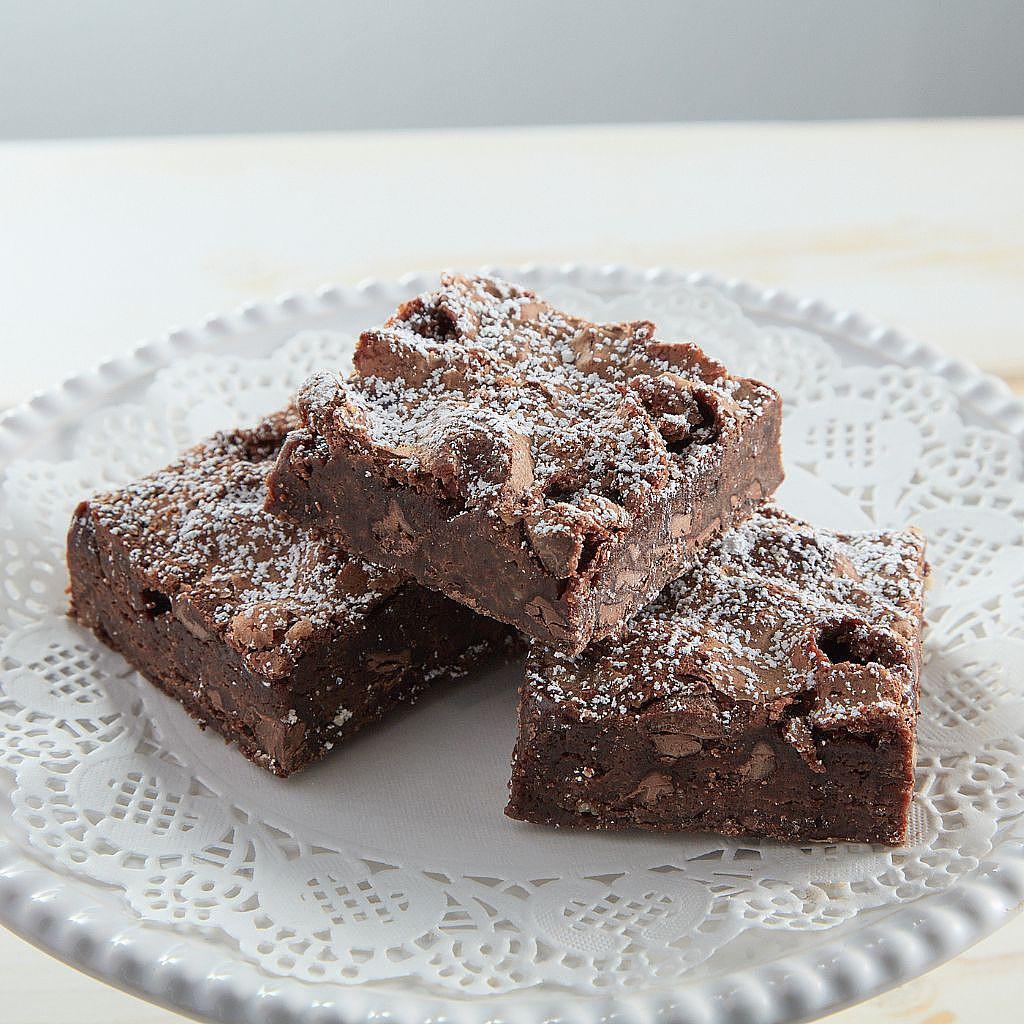
The Brownie
There is a dessert place in Houston called Dessert Gallery, and they make what they call the World’s Best Brownie. I have eaten enough brownies in my life to tell you that this particular brownie lives up to its name. It is the best brownie in the world. It was the first place outside our home (not counting the pediatrician’s office) that we took our newborn. We go on a regular basis. My wife and I have an inside joke, a signal between us, specifically associated with Dessert Gallery. I won’t explain the signal. But its existence, tells you something about what the place means to us.
My order never changes. One World’s Best Brownie. Most of the time this transaction is completely uneventful. But sometimes, as I’m about to pay, the person behind the counter leans in slightly and says: “It has marshmallow in it.”
The last time this happened, I had a dozen Ramadan-themed cookies on the counter as I ordered my brownie. The look on their face when they said it was the look of someone delivering mildly bad news to a person they were trying to help. I know exactly what they were doing. They saw the Ramadan cookies and they saw me and they put the pieces together: Muslim. Muslims don’t eat pork. And marshmallows, they rightly understood, contain gelatin. And gelatin, in most of the world’s supply, comes from pig skin.
They were right about almost everything. I am Muslim. I don’t eat pork. But I ordered the brownie anyway, thanked them for the heads up, and took my seat.
This never fails to ignite a passionate discussion between me and my wife.
The whole thing comes down to one pesky ingredient. Gelatin. Odorless, tasteless, completely invisible in the foods it inhabits — you would never know it was there until you bite into something and feel the particular texture that makes gummies, marshmallows, and Jell-O delicious. Just writing about it makes my mouth water, which is its own kind of problem. Because gelatin is also, depending on who you ask, either a prohibited pig product or something that left the pig so far behind in its manufacturing process that it can no longer be meaningfully called pork.
This question is not just a domestic dispute between me and my wife, though it certainly is that too. It sits at the intersection of two of the oldest religious dietary traditions in the world, both now embedded in American society, both actively negotiating what it means to live by ancient prohibitions in a modern food system.
Flesh of the Swine
The pig has been prohibited to both Jews and Muslims for a very long time, though the two traditions arrived at this prohibition differently.
In the Torah, the prohibition appears in relatively brief form. Leviticus 11 and Deuteronomy 14 enumerate the criteria for permitted animals — cloven hooves, chewing the cud — and note that the pig, though it has cloven hooves, does not chew the cud and is therefore forbidden. One verse, essentially. But what happened over the three thousand years that followed that single verse is remarkable. The pig became, for Jewish communities, the defining symbol of what they would not do. It became the boundary around which Jewish identity crystallized under pressure, persecution, exile, and diaspora.
By the time the Quran was revealed in seventh century Arabia — a society where Jewish communities were neighbors and interlocutors, and the refusal to eat pork was already a recognizable Jewish marker — the prohibition appears multiple times (Qur’an, 2:173, 5:3, 6:145, 16:115). Each passage centers on the “flesh of the swine” (Laḥm al-khinzīr). The Arabic phrase, in its classical usage, refers to the full edible animal — the thing you eat at a table. It is a word with weight and specificity. It does not obviously reach across three thousand years of culinary technology to land on a denatured protein powder extracted from pig skin through industrial chemical processing. But we’ll get back to that.
The point is that by the time the Islamic prohibition was articulated, it was entering a world where refusing pork already placed you in a particular community with a particular history.
Pork as Boundary
And that history matters enormously to understand why this debate is so charged.
On our honeymoon, my wife and I went to Spain. It is a beautiful country, one I would visit again. But walking through markets and old city centers, you cannot escape the Iberian ham. It hangs in doorways, in shop windows, in restaurants. It is everywhere, celebrated, cured, named by region the way France names its wines. And standing there as a Muslim couple we felt something that I didn’t entirely expect: the weight of history.
What is now a celebrated culinary tradition was, for centuries, also a tool used against both Muslims and Jews. The Spanish Inquisition required forced converts to Christianity to demonstrate their sincerity by eating pork. These conversos, as they were called, were watched to see whether they would eat it. Archival records describe officials compelling Moriscos (crypto-Muslims) to put bacon in their cooking pots on meat days and eat the food cooked with it — a mandate paired, in the same documents, with requirements to drink wine and adopt Christian dress. The pig became a weapon of forced assimilation, an instrument of humiliation and erasure. When inquisitors forced someone to eat pork, they understood, intuitively, what researchers would later document scientifically: that forcing someone to consume something they find defiling is not simply a dietary insult. It is a violation of the self. The pig was effective as a tool of persecution precisely because of what refusing pork meant to those communities.
The tactic did not stay in early modern Spain. In the trial record of the International Criminal Tribunal for the former Yugoslavia, a Muslim religious figure held in a Bosnian detention camp is described being forced by prison guards to eat pork — a deliberate assault on religious identity under conditions of total custodial control. In more recent decades, pig imagery has migrated into other forms of Islamophobic expression: posters depicting the Prophet ﷺ as a pig placed in Hebron and prosecuted under Israeli law; pig graffiti at mosques; a commercial venture in Idaho that marketed ammunition coated with pork as a Muslim deterrent under the slogan “Peace Through Pork,” premised on the fantasy that a pig-tainted bullet could imperil a Muslim’s salvation. In 2025, pig heads were left at multiple mosques in the Paris region, continuing a pattern in which pig remains function as a portable pollution insult targeting Muslim communal space.
If my children ever came to me one day and said they wanted to eat pork, I would take them to Spain. I would walk them past the Iberian ham and show them the artifacts of history hanging in every restaurant. Not to frighten them or guilt them into observance. But so they could feel that a dietary quirk has at certain moments in history been the very line between who you are and who you are being forced to become. Pork was never just about the pig.
So when I order my brownie, I am not operating in a vacuum. I am operating inside this history, this community, this identity. And the specific ingredient that puts me in tension with all of that is gelatin.
From Pig to Powder
It starts with animal skins or bones — most commonly, in global production, pig skin. These materials are largely composed of collagen, a structural protein arranged in tightly wound triple-helix fibers that give connective tissue its strength. After cleaning and degreasing, the raw material undergoes chemical pretreatment. Depending on the method, it is soaked in dilute acid (Type A gelatin) or in alkaline lime solutions (Type B gelatin). This can last from hours to several weeks. The purpose is chemical alteration: the acid or alkali breaks cross-links within the collagen fibers and partially hydrolyzes peptide bonds, unraveling the rigid triple-helix structure. During this phase, the material is caustic, chemically reactive, and entirely inedible.
Once pretreatment is complete, the material is washed, neutralized, and heated in water, which extracts the loosened collagen chains into solution. This is gelatin — long, partially fragmented polypeptide chains derived from collagen, no longer organized as tissue, no longer biologically functional as connective structure.
The liquid is filtered, sterilized, concentrated, and dried into sheets or powder. Only at this final stage does it become edible. Chemically, the process does not reduce collagen to individual amino acids; it destroys its higher-order structure and yields denatured protein chains that behave as an entirely new material, one with the distinct physical property of forming gels when cooled.
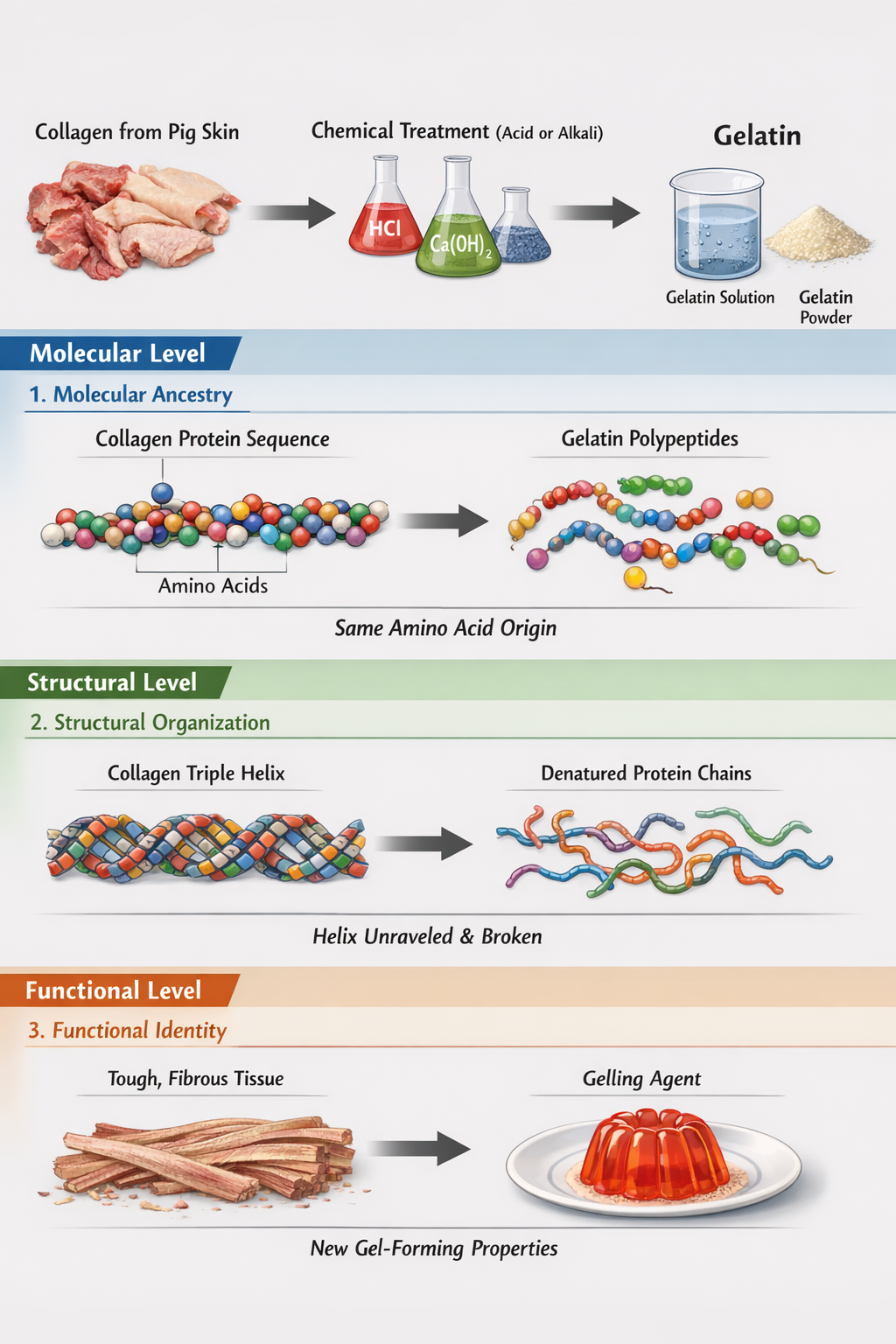
So the question is: is that still pork?
The Law of Transformation
Islamic law has a concept for this: transformation (istihālah). Impure substances that undergo a transformation so complete that their prior legal identity no longer applies. The classical examples are instructive. Wine becomes vinegar — and vinegar, though it came from wine, is permitted. Animal hides are tanned — and though the raw hide of a prohibited animal is impure, once tanned into leather, many scholars permit its use.
The principle is that when a substance changes so fundamentally that it becomes something new, the ruling changes with it.
The permissive position on gelatin applies this principle directly. Sheikh Mustafa al-Zarqā, one of the most respected Syrian jurists of the twentieth century, argued that gelatin from pork undergoes complete transformation (istihālah tāmmah). The original biological characteristics are destroyed. The resulting material no longer resembles pork in form or function. He rejected the idea that traceable molecular ancestry determines legal identity. What matters, in his view, is functional properties, perceptible characteristics, and the social recognition of substances.
Yusuf al-Qaradawi, one of the most influential scholars of his generation, reached a similar conclusion. The material becomes, in the language of classical jurists, something that is unfit even for a dog during processing — and when something has lost its legal identity so completely, its prior ruling lapses.
The majority position, represented most authoritatively by the International Islamic Fiqh Academy of the Organization of Islamic Cooperation, disagrees. Their argument is that gelatin does not constitute complete transformation. The protein chains remain chemically identifiable. Mass spectrometry can trace the amino acid sequences back to the pig. The transformation is a partial modification, not a total conversion into a new substance. Furthermore, the inedibility during processing is temporary — the whole point of the process is to restore edibility — so it cannot be counted as a genuine lapse of legal status. And crucially, most contemporary jurists consider pork to be intrinsically impure (najāsah ʿayniyyah), not merely contingently prohibited. A substance that is intrinsically impure does not change its status through partial alteration.
This is the dominant global halal certification position today.
A Parallel Debate
In Jewish law, the discussion maps onto similar terrain with its own nuances. The lenient position, associated most prominently with the Sephardic rabbi Ovadia Yosef, holds that the chemical treatment so fundamentally alters the substance that the resulting gelatin constitutes a new entity (panim chadashot) and the original pig status does not carry over. This relies on the principle of substantial transformation (ishtanah), a close cousin to the Islamic law version.
The stringent position, associated with Ashkenazi authorities like Aharon Kotler, counters that since gelatin is specifically manufactured to return to an edible state and serve as a food ingredient, the transformation is technical but not legally decisive. The original prohibition is not erased simply because chemistry altered the structure.
In practice, the Orthodox Union and major American kosher certifying bodies do not certify pork-derived gelatin, and kosher gelatin in the American market comes from kosher-slaughtered beef, fish, or plant-based alternatives.
In Israel, however, the landscape is more complex: the official Chief Rabbinate permits it for 'Regular' (non-Mehadrin) certification, largely following the Sephardic leniency. While Mehadrin (stringent) certifications prohibit it categorically. Gelatin remains a living reality on Israeli grocery shelves, where products are often marked as permissible specifically for those who rely on the lenient ruling.
The debate, in other words, lands in almost exactly the same place as its Islamic counterpart — divided, unresolved, and organized around the same underlying question of whether transformation is deep enough to sever the legal identity of what something once was.
What Makes a Thing Itself?
The difficulty has a root that goes back to the oldest problems in philosophy.
What makes something the same thing? And when does change make it a different thing?
The ancient Greeks posed what we now call the Ship of Theseus: if you replace every plank of a ship, one by one, is it still the same ship? Most people feel uneasy saying yes by the end, but they can’t identify the moment it became something different. The gelatin question has precisely the same structure. At what point in the transformation from pig tissue to white powder did it stop being pig?
Aristotle gave the most influential classical answer. He said every physical thing is composed of two principles: the raw matter (hyle) it is made of, and form (morphe), the organization and function that makes the thing what it is. A dead hand, Aristotle argued, is not really a hand. It has the matter, but it has lost the form that made it a hand. It merely shares the name. Applied to gelatin, the scholars who accept transformation are being implicitly Aristotelian. They argue that the form, meaning its structural organization, biological function, and material identity, has disappeared. What remains is matter that has undergone transformation and taken on a new form. In the most rigorous sense, it is a genuinely new substance.
The majority position tracks a different tradition, closer to what we might call biological essentialism. What something is is determined by what it came from and what it is made of at the fundamental level. This is why a perfect synthetic diamond is considered a real diamond. The majority scholars are saying the causal chain back to the pig is unbroken. The molecules are pig-derived. The amino acid sequences are pig sequences. The identity follows the lineage, not the current form.
Both of these frameworks are tracking something real. The Aristotelian is right that we don’t normally say a thing’s identity is just its atoms — a living cell and a dead cell have the same atoms moments apart, and we still call them different things. The essentialist is also right that origin and molecular constitution aren’t irrelevant — we treat them as meaningful in medicine, in law, in ethics, and in everyday life constantly. A poison that has been chemically neutralized is different from the original poison, but we’d still want to know it was there.
The problem is that both intuitions are correct in different contexts, and there is no neutral meta-principle that tells us which one should dominate in any given case.
Religious Law has always had to answer questions that pure philosophy leaves open. And legal identity is never purely chemical or biological. It is normative. It depends on what purposes the classification is meant to serve.
There is something worth saying about the prohibition itself that tends to get lost when the debate turns jurisprudential. The Torah and the Quran do not explain why pork is forbidden. They simply forbid it. Leviticus lists the criteria and notes that the pig fails. The Quran says the flesh of swine is prohibited and moves on. Neither text offers a rationale. The prohibition is a suprarational ruling, one whose observance is an act of worship precisely because it cannot be grounded in a reason you could independently verify and apply.
This matters for the gelatin debate because if the prohibition had a stated rationale, we could ask whether gelatin falls under it and reason our way to an answer. But it doesn't. The permissive scholars assume the prohibition is about consuming the pig in a recognizable, material sense. The stricter scholars assume it is about categorical separation from a prohibited substance regardless of form. Both are plausible. Neither can be confirmed by going back to the text because the text is silent.
The prohibition on pork in both Islam and Judaism was not primarily about chemistry. It was about boundaries, holiness, discipline, and communal identity. When you ask whether gelatin violates that prohibition, you are really asking: does consuming gelatin undermine the purposes the prohibition was meant to serve?
That’s a much harder question. And I’m not sure either side has fully answered it.
The Elephant
Here is where I want to be honest about something, because I think the legal and philosophical debate, as sophisticated as it is, only tells part of the story of why my wife and I disagree about the brownie.
Jonathan Haidt, in The Righteous Mind, argues that moral judgment does not begin with careful reasoning. It begins with fast, automatic intuitions. He demonstrates this with what he calls harmless taboo violations — scenarios carefully constructed so that no one is harmed, yet almost everyone feels an immediate flash of disgust and wants to say the action is wrong. When pressed to explain why having sex with a dead chicken before eating it is disgusting, people often can’t produce a coherent justification. They immediately insist the action is wrong but cannot say exactly why. He calls this moral dumbfounding: the feeling comes first, and the reasoning struggles to catch up.
His metaphor for the moral mind is a rider on an elephant. The rider is conscious reasoning; the elephant is the vast, largely automatic processes that actually drive judgment and behavior. The rider often believes he is in control, but mostly, he is offering justifications for directions the elephant has already decided to go.
When I think about my wife and the brownie, I think about the elephant. She doesn’t know the OIC Fiqh Academy’s resolution. She hasn’t read al-Zarqā. What she has is a feeling: there is pork in that, and I don’t eat pork. The feeling is doing the work, not the analysis. And when I order the brownie anyway, the look on her face is not the look of someone applying jurisprudential principles. It is something older and more immediate than that.
In a separate paper, Haidt documents what he calls the “laws of sympathetic magic,” two intuitions that operate below the level of conscious reasoning. The first is the law of contagion: once two things have been in contact, something essential passes between them that persists even after all physical traces are gone. The contact happened. The essence transferred. No amount of acid treatment or filtration or molecular transformation undoes that history at the level of felt experience. Think of people feeling uncomfortable sleeping in the same bed that someone died in.
The second is the law of similarity: things that resemble each other in some properties are felt to be fundamentally similar, even identical. This is why people refuse to eat chocolate fudge shaped like feces even knowing perfectly well it’s just chocolate.
The law of similarity explains something revealing about my own position: I will not eat Impossible Pork.
Impossible Pork is a plant-based product. It contains no pig by any chemical or legal measure. And yet the idea of eating it is, to me, almost as scandalous as eating actual pork. The Orthodox Union and the major halal certifying bodies won’t certify it — they understand that their communities won’t accept it, and that the certification would undermine trust even if the product is technically permissible. And I agree with them, which is strange, because if my position on gelatin is that the pig has been so thoroughly transformed as to be a genuinely new substance, then Impossible Pork should be the easiest call in the world. It didn’t start as pig at all. But it looks like pork, carries the name, and occupies the cultural and social space of pork, and my gut says no before my legal reasoning gets involved.
Impossible Pork is my feces shaped chocolate fudge. The similarity to the prohibited thing triggers the rejection. Which means my aversion has almost nothing to do with pig chemistry and almost everything to do with what pork represents.
Consider that most Muslims don’t find mocktails offensive. It mimics the appearance, the name, and the social occasion of an alcoholic drink, yet people order them without a second thought. The similarity triggers no rejection. This tells you something important: the disgust response is not a general feature of religious prohibition. It is specific to pork.
I think about this and where I draw my own lines. Taking pepperoni off pizza is too close to eating pork — the grease is still there. On the other hand, removing salami from a sandwich is apparently fine for me but not for my wife, who wouldn’t eat the sandwich at all. The Mongolian grill, where the surface has been wiped down but was also cooking someone’s pork dish twenty minutes ago, is fine for both of us, but not okay for my mother. These aren’t positions I arrived at through careful legal reasoning. They are the places where I have quietly drawn lines, and the lines map less onto Islamic law and more onto what I feel disgust with and what I don’t.
I don’t think that makes me a bad Muslim. But I think I should be honest that it’s happening.
Formation
Haidt makes another point that I find important here. The full disgust response, including contamination sensitivity, doesn't fully develop until age five to seven, and it must be trained by local rules and meanings. Children don't arrive with pre-installed disgust categories. The categories are taught.
My mother went back and forth about halal/zabiha meat when I was growing up. She never imposed it on me when she would eat it. I grew up eating non-zabiha without much internal conflict. I loved Chick-fil-A. Still do — their chicken nuggets with barbecue sauce are the finest in fast food, and I will argue this with anyone. I ate them happily until I stopped a few years ago.
Unlike me, my wife had a more consistent formation around halal meat, which she ate consistently for her whole life. Our different reactions to the brownie are not about one of us being a better Muslim. They reflect different training, formation, and calibration of the disgust system that religion has always engaged with, even before psychology had words for it.
This is also why I want to be honest about what this essay will and will not accomplish. If you were raised in a household where the gelatin question was never a question — where the answer was simply no, where your mother checked labels and your aunts compared certifications and the entire social world you grew up in treated pork derivatives as a clear boundary — then nothing I have written here is likely to move you. Not because you haven't thought about it carefully, but because the disgust isn't coming from your reasoning. It was laid down earlier, deeper, and more durably than that. The elephant was trained before you were old enough to read a fatwa.
The reverse is also true, and this is where I have to be honest about myself. I never acquired that disgust fully. When I think about the gelatin in my brownie, I don’t feel disgust—I feel hungry. I don’t feel what my wife feels. And I have noticed, over the years of our marriage, that I can’t simply decide to feel it. The formation that produces that response had to happen at a particular time in a particular environment, and my version of that environment was looser. Something was not fully installed.
This is not a complaint. But it means I should be careful not to mistake my relative ease with the brownie for superior reasoning. It might just be that my elephant was trained differently. My wife's hesitation is not about Islamic law. It is the output of a system that was formed with more consistency than mine. The tradition and the practice she was raised in did something real to her, something that cannot be undone by reading permissive positions.
I asked a convert to Islam whether pork disgusted them. They told me that it didn't. They grew up eating bacon, pepperoni, pulled pork and that it was just normal food. They don't have the instinctive "that's gross" reaction of someone raised Muslim. What they described years after their conversion was not disgust but a kind of reclassification. It doesn't register as food anymore. If they see bacon now, the thought isn't appetizing — it's just "that's not for me." But they were honest: strip away the religious rule and the habit, and there is no deep gut-level revulsion. It's obedience and identity more than visceral rejection.
What religion does, in part, is build the elephant. It does this through repetition, community, childhood formation, and the slow accumulation of small daily acts of differentiation. The dietary laws in both Islam and Judaism have always worked this way — not primarily as intellectual propositions to be evaluated, but as practices that, when followed consistently from an early age, produce a particular kind of person with a particular set of intuitions. The law is trying to build something in you that eventually runs on its own. If it was built in you, it runs. If it wasn't, you can approach it consciously, deliberately, imperfectly.
After my wife and I moved to a different state and found ourselves living across the street from a halal meat store, something shifted in me. COVID had already pushed us toward cooking at home more. And since we started dating, I had been cooking with halal meat to accommodate her. The proximity made it easy. And then it became a different kind of commitment — not just about law but about identity and intentionality.
We think of halal eating now in two registers: identity, because we are Muslim and happy to keep money in the community and to support institutions that represent our presence in this society; and what I might call mindful consumption, because we aspire eventually toward vegetarianism, and eating zabiha makes meat less available to us, adds friction, and makes us thoughtful about when and why we choose it. We like the difficulty. The difficulty feels like it means something.
But the brownie doesn't fit neatly into that framework either, which is why it keeps coming up.
Market power
There is a political economy to all of this that I don't want to ignore.
In the early 2000s, Skittles contained gelatin. A coalition of Muslim and Jewish consumers, along with other consumer groups, pressured Mars to remove it. Mars did. Skittles are now kosher and generally considered halal. The same consumers who had been excluded from a product became a market, and the market responded. This was not a small thing. It required organized, sustained pressure from communities who understood that their dietary practices had commercial weight — and who were willing to use that weight. The Orthodox Union symbol (that small U in a circle) appears on an enormous range of products because kosher certification opens doors to Jewish consumers and, by cultural association, to others who use it as a quality or purity signal.
The halal market has followed a similar trajectory, though the infrastructure is newer and still expanding. Walk into a Walmart in Houston and you will find halal chicken. Whole Foods carries halal lamb. The halal meat section in a mainstream grocery store — unthinkable in most American cities a generation ago — is now routine. This is not because companies became more enlightened. It is because the Muslim population grew, halal-observant Muslims communicated their preferences through their purchasing decisions, and the market eventually did what markets do.
These are real achievements. They represent a community saying: we are here, we are numerous, our practices deserve accommodation, and we have purchasing power to make that argument concrete. The question it raises for me personally is whether I am opting out of that project when I order the world's best brownie. There is a version of my choice that looks like free riding — benefiting from the community's presence and coherence while quietly making individual exceptions that the community's advocacy cannot quite accommodate.
The free-rider framing stings a little, and I think it should. There is something real in it. The Muslim woman who won’t touch gelatin, who checks every label, who has never ordered the brownie — her consistency is what gives the community’s advocacy its weight. My individual exception is possible in part because of her collective practice. I benefit from that without fully reciprocating it.
But I’ve also come to think that the wrestling is not nothing. What I owe the tradition may not be perfect compliance. It may be exactly this: taking it seriously enough to actually feel the weight of the choice. The guilt is not a failure of practice. It might be a form of it.
The Brownie Again
The cashier at Dessert Gallery, with that look of concern on their face, is doing something kind. They see someone who looks like they might care, and they want to make sure that person has the information they need. They are acting out of consideration, and I appreciate it every time.
But here is what they don’t know: I already know about the gelatin. I have studied the Islamic law opinions. I have thought about the Ship of Theseus and about Aristotle’s hylomorphism and about what my reaction to Impossible Pork reveals about the nature of my own commitments. I have had this argument with my wife more times than I can count, and I know we will have it again, and I love her for caring. When she came home one day with Chick-fil-A nuggets, I knew I had influenced her, and I felt a complicated pride — proud that she had expanded her practice, but not enough to eat the nuggets myself, because I eat halal meat now. And her relationship to my brownie is similar. It is not something she would personally eat, but it is not like eating bacon. There are gradations here. The tradition is not a single switch that is either on or off.
I order the World’s Best Brownie because I have concluded, based on my reading and my reasoning, that the transformation is sufficient. I order it because I am a Muslim who takes his tradition seriously enough to actually think about these questions rather than simply deferring in all directions. And I order it because it is the best brownie in the world, and Dessert Gallery is a place that means something to my family.
But I will not eat Impossible Pork.
The scholars are arguing about molecules. My wife and I are arguing about the elephant.