
Theatre and the Muslim Imagination
I've been sitting in the same theatre for years, never hearing “Salam.” So I went looking: Cairo, Karbala, Indonesia, Pakistan, Los Angeles. We were always on stage.

The Missing Greeting
There is a ritual that happens before every play at the Alley Theatre. The audience settles in their seats — a murmur of coats being removed, playbills being opened and not quite read, a small negotiation about armrests. Then the lights begin to drop, and over the speakers — just before the stage comes alive — comes the loop.
Welcome. Bienvenidos. Nǐ hǎo. Bonjour...
The voices cycle through more than a dozen greetings in different languages, each one a brief signal: you are included, whoever you are, in whatever language your welcome comes. There is something genuinely nice about it. Someone at the theatre thought about this and made a decision that belonging should be announced, not assumed.
And then the final line settles over the darkening house: "Welcome to the Alley Theatre, where everyone is truly welcome.” I sit with my wife and think: almost. Because there is a greeting that is missing. One that more than a billion people on earth use as casually as we use hi or welcome: Salam.
My wife and I have been members of the Alley for years. I didn't notice the absence immediately. My wife did, and, as usual, she pointed it out. “Why don’t they say Salam?” she whispered as the actors walked onto the stage for our first play. “Not sure. Let’s watch,” I whispered back, afraid of disturbing the performance.
I don’t usually notice these omissions, but the more I thought about it and the more plays I attended where I didn’t hear it, the more it started to bother me.
The Alley is not a hostile place. If anything, the care that produced that multilingual greeting loop is evidence of an institution actively trying to be thoughtful about who it welcomes. The absence of Salam is not a door slammed; it is more like a blind spot. The kind that forms from building a vision of universality that doesn't quite make it all the way around the world.
My wife and I are, most nights, among the youngest people in the theatre. We are often the only people who visibly appear Muslim. I scan the doner list in the programs the way you scan for familiar names in a new city, and the names I would recognize are not there. None of our Muslim friends attend theatre regularly. This is not a complaint about them; I say it because it points to something real. Theatre-going, as a habit, as a cultural inheritance, did not travel with most Muslim families into American life the way it traveled with Jewish immigrant families.
My mother says she went to the theatre in Egypt when she was young, and when she says it there's something nostalgic and slightly distant in her voice, as though she is describing an old vacation. She hasn't shown much interest in theatre since coming here.
This is the puzzle underneath the missing greeting. If theatre existed in Islamic cultures as my mother's memory suggests, why do so many Muslims today feel so peripheral to it?
When I was in middle school, our mosque hosted a stand-up comedy show in the prayer hall. I remember the particular excitement of this, the novelty of chairs arranged in rows facing a microphone, which happened to be in the direction of the qibla. I also remember that there was controversy. Some community members felt the prayer hall was not the right space for entertainment. A place of worship should be reserved for worship. The imam, Shaykh Umer Esmail, pushed back. He cited a tradition that the Prophet ﷺ and his wife ʿĀʾisha once watched Abyssinian performers demonstrating spear play and athletic feats inside the mosque in Medina. That performance, Shaykh Umer argued, was precedent enough.
I did not know what to do with this memory for a long time. I love stand up comedy, but this was the only time that I went to a comedy show in a mosque. After I started noticing the missing greeting at the Alley, it kept surfacing, because both point toward something similar: a gap between what Islamic cultures have actually contained and what they are imagined to contain.
Theatre has always been part of the Islamic experience. Sometimes formally, in courts and on stages. Sometimes informally, in mosques and marketplaces. Sometimes in ways that aren't recognized as theatre anymore.
Ritual drama is theatre. Communal lamentation performed before an audience that shouts back is theatre. Satirical puppet shows filling a street in medieval Cairo are theatre. These forms, among others, did what theatre has always done at its best: they held a mirror to society, provoked laughter and grief, questioned power, and gave communities a way to see themselves.
The Alley may have overlooked the word Salam. But historically, performance was never absent from Muslim societies. What follows is a small cross section of that history, moving from a Cairo street corner to a Los Angeles living room, with several stops along the way.
Before stage lights. Before microphones, velvet seats, and the audio loop. There was another stage. A candlelit puppet screen stretched between wooden poles in a Cairo street. An audience gathered in the warm evening air — merchants, children, students, people who had just come from prayer. Behind the screen, leather puppets moved across the glow of a single lamp. A playwright named Ibn Dāniyāl had looked at the city around him — chaotic, cosmopolitan, funny, corrupt, alive — and decided to put all of it on stage.
The Puppet Screen
Picture Cairo in the late thirteenth century, on a Ramadan evening. The fast has broken. The markets, which stay open late during the holy month, are lit with oil lamps and loud with the particular post-iftar energy of a city that has been patient all day and is now releasing itself into the night. Families spill into streets. Merchants haggle without urgency. Children run between adult legs. The air smells of food and smoke and the Nile.
And somewhere in the middle of this is a white screen stretched between wooden poles, luminous against the dark.
Behind it, a single performer crouches over leather puppets and a flickering lamp, his hands moving with the quick, practiced articulation of someone who has done this so many times that the puppets feel like extensions of his fingers. In front of the screen, the audience gathers. People sit on the ground. Children push toward the front. Adults lean back and joke with their neighbors. A merchant pauses on his way somewhere and stays. Everyone understands what is about to happen.
This is the shadow play (khayāl al-ẓill). And it is one of the oldest recorded theatrical forms in the Islamic world.
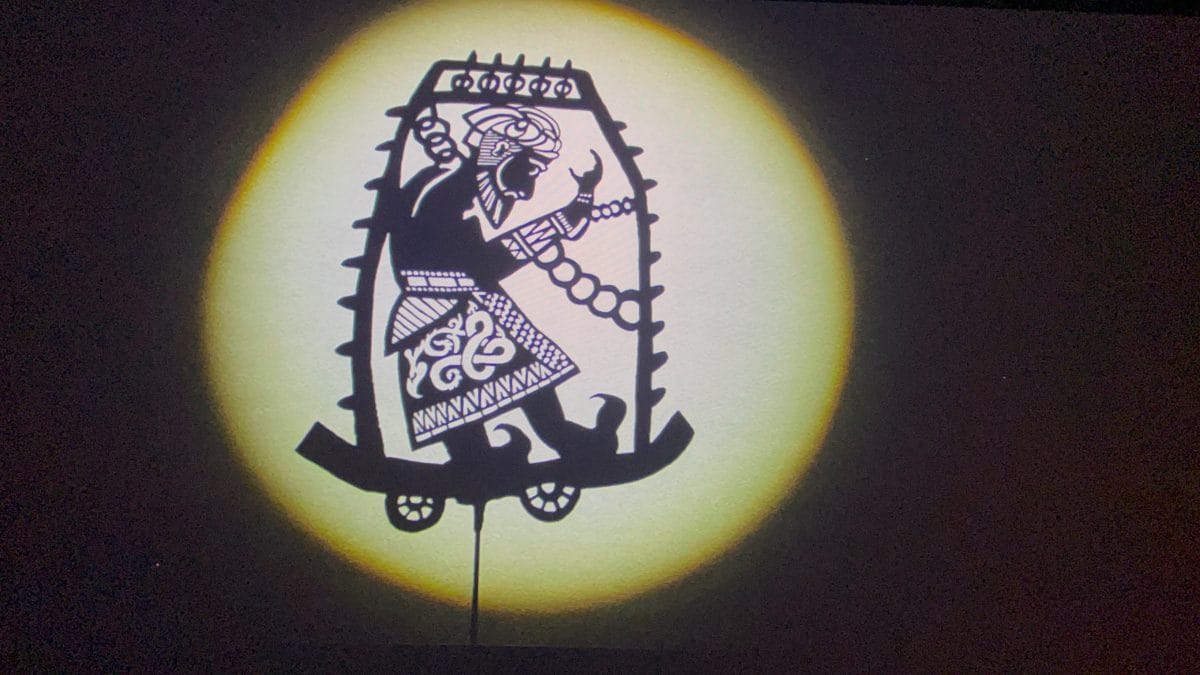
Shadow theatre had been popular in Cairo since at least the tenth century. We know this partly because one of its earliest documented mentions comes from the writings of Ibn al-Haytham, the great mathematician and physicist who lived in Cairo and whose work on optics was foundational to later science. That such a figure would mention shadow theatre in passing tells you something about how embedded it was in the texture of urban life. This was not a courtly entertainment for elites. It was popular, sometimes crude, often loud. The performances drew on mythology, folklore, comic stock characters, and political satire. They were the kind of thing you watched in the street, not in a hall.
The plays tended toward certain reliable patterns: battles between heroes and monsters, legends of famous figures, comic misadventures involving familiar social types. They were entertaining precisely because they relied on shared recognitions that the audience already knew. But by the thirteenth century, something was beginning to wear. A puppet master approached a physician and poet named Ibn Dāniyāl with a request: the old scripts weren't working anymore. Audiences had seen the same stories too many times. Could he write something new?
Ibn Dāniyāl's answer was radical. Instead of retreating further into myth and legend, he turned the camera around. He would make plays about Cairo itself. The city would become its own subject matter.
The result was three shadow plays that combined refined poetic Arabic with street slang and deliberate obscenity, mocked everyone from princes and scholars to religious figures and ordinary Cairenes, and presented the city's real social life with a directness no official literary form would have permitted.
To understand why this was possible, you have to understand something about Cairo in the Mamluk period. The city was one of the largest in the world — a center of trade, scholarship, and religious life. It was also a place where the formal moral world of official Islam and the actual chaotic life of a cosmopolitan metropolis existed in a productive, sometimes hypocritical tension. The scholars were real, and so were the brothels. The mosques were real, and so were the drinking parties. Cairo contained all of these things simultaneously, and the people who lived there knew it, even when official discourse pretended otherwise.
Ibn Dāniyāl had lived among the city's street life and knew its characters from the inside. Like all great satirists, he understood that the funniest and sharpest social critique comes from within, from someone who loves it well enough to mock it mercilessly.
His first shadow play is called The Shadow Spirit (Ṭayf al-Khayāl). At the center of it is a character named Prince Wiṣāl. The name is already a joke: wiṣāl means "mating," and the character is defined almost entirely by sexual appetite. He has lived a life of spectacular excess, and now, suddenly, he wants to reform and become respectable. He decides that the solution to his moral problems is marriage, so he hires a marriage broker to find him a bride.
Before the search begins, Prince Wiṣāl addresses the audience to explain his intentions. The speech that follows mixes religious language and crude sexual desire with a combination that is deliberately, absurdly out of place. He speaks of the woman he hopes to find like a love poet, comparing her to the sun and the crescent moon among young women, and then immediately mentions that upon seeing her he was moved to unbutton his trousers. He invokes God's protection over her dark hair. He notes that marriage will protect him from committing sins and from hellfire on the judgment day. Then, he closes by observing, with complete sincerity, that nothing is more urgently worth pursuing than relief from the pain of his sexual frustration.
The audience laughed. The humor works because everyone recognizes the hypocrisy. Prince Wiṣāl has not reformed. He has given his appetites a socially acceptable costume and called it virtue. The religious language is performance, not piety.
The play's most famous scene is the wedding. Prince Wiṣāl arrives mounted on a fine horse, surrounded by candles and musicians, with the traditional Egyptian zaffah procession in full display. The bride arrives veiled. Everyone expects beauty. Wiṣāl lifts the veil. The play describes what he finds with merciless comic excess: she brays like a donkey, her teeth are like a crocodile's, she smells like an outdoor lavatory. The prince faints. The audience roars.
But the joke is not really about ugliness. What Prince Wiṣāl wants is not moral reform. He is really after the social status of reformed behavior without the inconvenience of actually changing. The grotesque bride is simply life refusing to cooperate with the performance and calling him out. The audience laughs because they recognize the type. The characters on the puppet screen are not strangers. They are neighbors.
This use of theatre as moral critique developed across the Islamic word in forms as varied as the cultures that produced them. Some of these traditions mocked elites. Some commemorated tragedy. Some questioned power in ways that governments found threatening.
One of the most powerful of these traditions in a ritual space of mourning — a drama of martyrdom and injustice that would become one of the most emotionally charged theatrical forms in the world.
Theatre of Martyrdom
Not all performance in the Islamic world was comic. Some of it was built around grief. The most powerful of these is taʿziyeh, and to understand it, you have to begin in the desert, in the year 680 CE, near a town called Karbala.
After the death of the Prophet ﷺ, the question of who would lead the Muslim community became one of history's most consequential disputes. The early decades of Islamic history are marked by political violence, contested succession, and the formation of rival understandings of what legitimate authority looks like. By the time the Umayyad ruler Yazid ibn Muʿāwiya came to power, the wounds of that early history had not healed. Yazid demanded allegiance from Ḥusayn — the son of ʿAlī and grandson of the Prophet ﷺ, a figure whose claim to leadership was, for many Muslims, both moral and genealogical.
Ḥusayn refused.
For many Muslims, especially Shīʿa Muslims, that refusal is the heart of the matter. Ḥusayn did not have a large army or the support of political institutions. He had a small group of family members and companions, and the conviction that Yazid represented the transformation of Islam from a moral community into an imperial power.
He traveled toward Iraq to gather support. Near Karbala, his group was intercepted by Yazid's imperial army. They were denied access to water. They waited, in thirst, for days. And then, on the tenth of Muḥarram, Ḥusayn and nearly all his companions were massacred.
As Islam developed, the death of Ḥusayn became a symbol of the resistance of conscience to power, the refusal of the righteous to submit to tyranny, and the cost of standing on the right side.
Every year, on Ashura, this story is remembered. For Shīʿa Muslims in particular, this remembrance is deeply embedded in communal identity. Karbala is history that is felt. When Shīʿa Muslims mourn Ḥusayn, they are mourning something that happened more than thirteen centuries ago with an immediacy that is hard to explain to someone outside the tradition and immediately recognizable to anyone inside it.
Over centuries, the mourning rituals surrounding Karbala evolved into theatrical reenactment. The word taʿziyeh literally means "consolation" or "condolence." It began as procession and lamentation in the early centuries of Islam, expanded into public dramatic commemoration by the tenth century under the Buyid dynasty, and developed into structured theatrical performance by the sixteenth under the Safavids, who made Shīʿism the state religion of Iran. By the eighteenth century it had become a fully formed dramatic tradition.
Clip from a taʿziyeh performance in Iran.
Taʿziyeh is traditionally performed in a space called a tekyeh — a purpose-built arena, often circular or square, with the stage in the center and the audience surrounding it on all sides. The architecture is a statement. There is no separation between the world of the performance and the world of the audience. You are not sitting in darkness watching illuminated figures on a distant platform. You are gathered around the stage in the same way that people gathered around a speaker in a marketplace, or around a fire at night. The performance is among you.
The theatrical conventions of taʿziyeh are symbolic rather than realistic. A bowl of water represents the Euphrates River. A character circling the stage represents a long journey. Color announces moral status immediately: the family of the Prophet ﷺ wears green or white; the forces of Yazid wear red. Characters on the righteous side sing their lines in classical Persian melodic modes while the villains speak in harsh prose.
The emotional center of any taʿziyeh performance is the same, regardless of the variations in staging or regional style. The stage represents the battlefield of Karbala on the final day. Ḥusayn's companions are dead. His family watches from the tents. He stands nearly alone.
The actor portraying Ḥusayn steps forward. He raises his voice to address the surrounding audience, his words carrying across the arena in the formal Arabic of the original tradition:
"Hal min nāṣir yansurunā?"
Is there anyone who will help us?
The line echoes in the arena. It is the question that Ḥusayn cried on the field of Karbala — a call for aid that, historically, no one answered. And something unusual happens. The audience does not remain silent. People cry. Some shout responses. Some beat their chests in mourning. Some rise from their seats. The boundary between performance and participation dissolves in a way that has few equivalents in American theatre. The audience is not watching history. They are responding to it.
That question is the heart of taʿziyeh, and it has never been merely historical. The story of Karbala is treated as a moral question for every generation. If injustice appears again, will you remain silent? Or will you stand with Ḥusayn?
This is why taʿziyeh has carried political significance in different periods and contexts. The story becomes a frame through which contemporary rulers and contemporary injustices can be examined. The viewers are being invited to ask: who is Yazid today? Who is being besieged? Who is refusing to yield power to the righteous?
In 2010, UNESCO recognized taʿziyeh as Intangible Cultural Heritage. Today the tradition continues in Iran, Iraq, South Asia, and in immigrant communities in Europe and North America. The elementary school children at the mosque next to our house put on a taʿziyeh for Āshūrāʾ every year.
Both the shadow theatre of Cairo and the taʿziyeh used performance to make visible what official discourse preferred to keep invisible or settled. But in the nineteenth century, a new form of theatre emerged — one that moved from puppet screens and ritual arenas into modern urban stages, and into the middle of a new political crisis.
One of its pioneers was a Jewish Egyptian satirist who called himself "the man with glasses.”
The Vernacular Stage
Yaqub Sanu (Yaʿqūb Ṣannūʿ) (1839–1912), who sometimes went by the name James Sanua, was born in Cairo and educated in Italy, where he encountered European theatre and absorbed its conventions. When he returned to Egypt, he began experimenting with theatre in Arabic, which was at that time an almost entirely untested idea for modern drama. The Cairo Opera House had opened in 1869, part of Khedive Ismail's ambitious modernization project, but most performances there were European productions performed for an elite audience. The theatre was, in every sense, not for ordinary Egyptians.
Sanu's idea was radical: create theatre for ordinary Egyptians, in the language they actually speak.
Most literary works in Arabic used classical Arabic (fuṣḥā), the language of the Qur'an and formal speech. But everyday Egyptians speak the colloquial dialect (ʿāmmiyya), and the gap between them is not merely stylistic. It is social. To insist that theatre be performed in classical Arabic was, however unintentionally, to insist that ordinary Egyptians were not its audience. Sanu refused this. The plays he wrote in colloquial Egyptian were enormously popular and a direct provocation: real life, he was saying, happens in the language people actually speak.
This linguistic argument was also a political one.
By the 1870s, Egypt was in financial crisis. Khedive Ismail had borrowed heavily from European banks, European creditors had gained increasing control over Egyptian finances, and Egyptians increasingly felt their country being sold out from under them. An independent political consciousness was forming. Sanu's theatre became its voice. His characters would regularly mock the pretentious officials who adopted European mannerisms while the country's sovereignty eroded. One of his plays stages a debate about whether theatre must use classical Arabic; the joke is that the bureaucrat's insistence on linguistic correctness is itself a kind of mask for his incompetence.
What Sanu was suggesting was that Egypt's ruling class was performing an imitation of Europe rather than actually governing Egypt. The modernization project was, in some fundamental sense, theatre — and not everyone got to play a role.
What makes Sanu especially interesting is who he imagined his audience to be. In the introduction to his play The Molière of Egypt, he addresses his readers and viewers as: "My dear brothers—the Believer [Muslim], the Israelite [Jew], and the Christian—who are as dear to my heart as my own children."
This was a remarkable thing to write in the 1870s. He defined being Egyptian by geography and shared social experience, by the fact of living together and having the same bureaucrats making the same decisions about your life. His theatre imagined Egypt as a civic nation, not one defined by religion or ethnicity.
He is credited with coining the phrase “Egypt for the Egyptians” (Miṣr li-l-Miṣriyyīn). The ʿUrabi Revolt of 1879, in which Egyptians rose against both the Khedive and European financial control, drew directly on this civic language. Britain crushed the revolt and occupied Egypt for the next seventy years. But the phrase survived the defeat. The generation that eventually won independence was still using Sanu’s language.
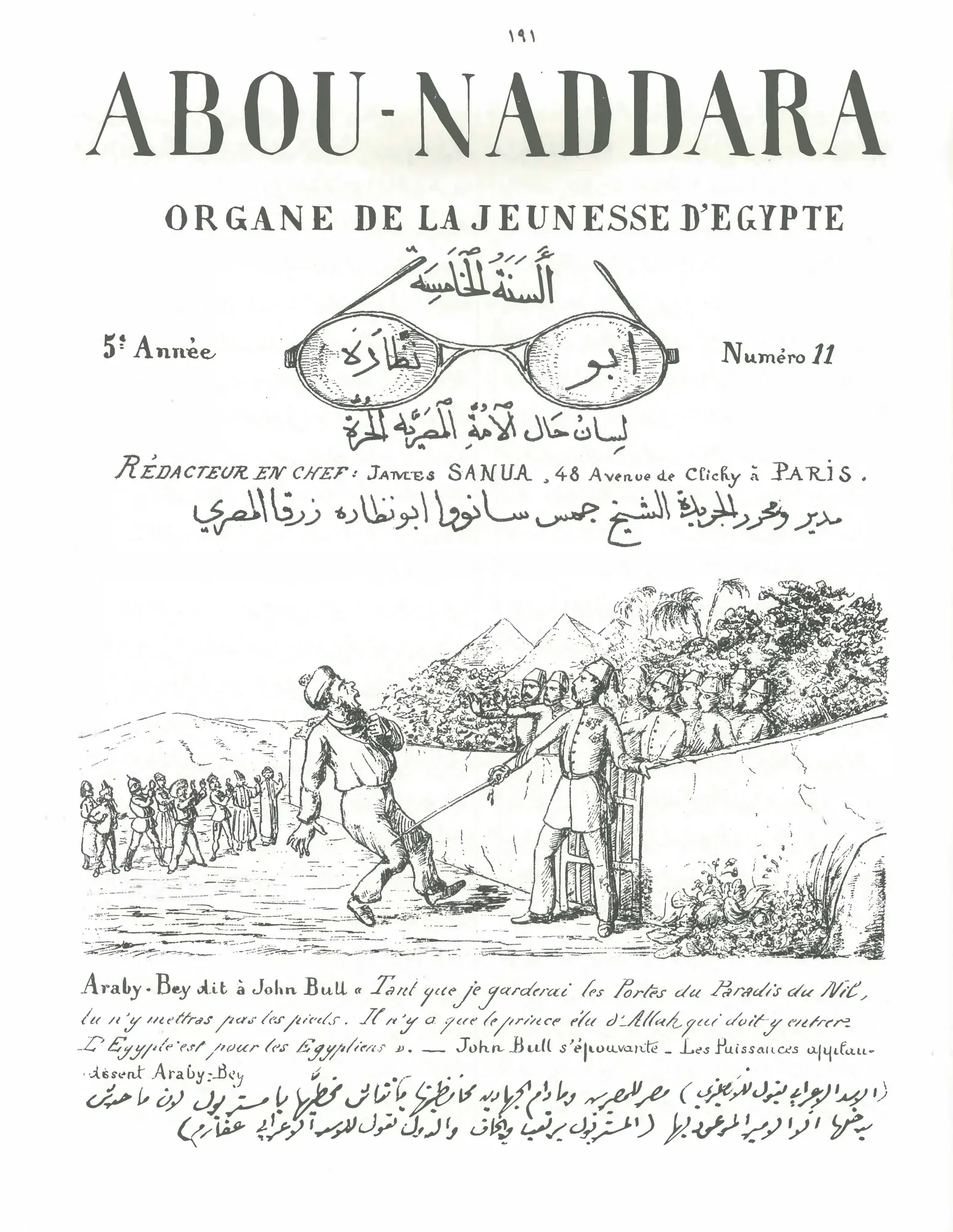
That a Jewish Egyptian was one of the earliest architects of Egyptian national identity is a complexity worth sitting with. It complicates any simple story about religion and nationalism, about who belongs to a culture and who gets to speak for it. Sanu was not Egyptian despite his Jewish identity; he was Egyptian because being Egyptian was not tied to a specific ethnicity or religion.
When his satire became too pointed and the ruling Khedive found himself too clearly recognizable in the characters being mocked, Sanu expanded his operation. He founded a satirical newspaper called Abu Naddara Zarqa, "The Man with the Blue Glasses." The paper became famous for its political cartoons mocking government corruption, foreign influence, and the ruling elite. It circulated widely, often secretly. Many historians consider it one of the earliest examples of modern political satire in the Arab world.
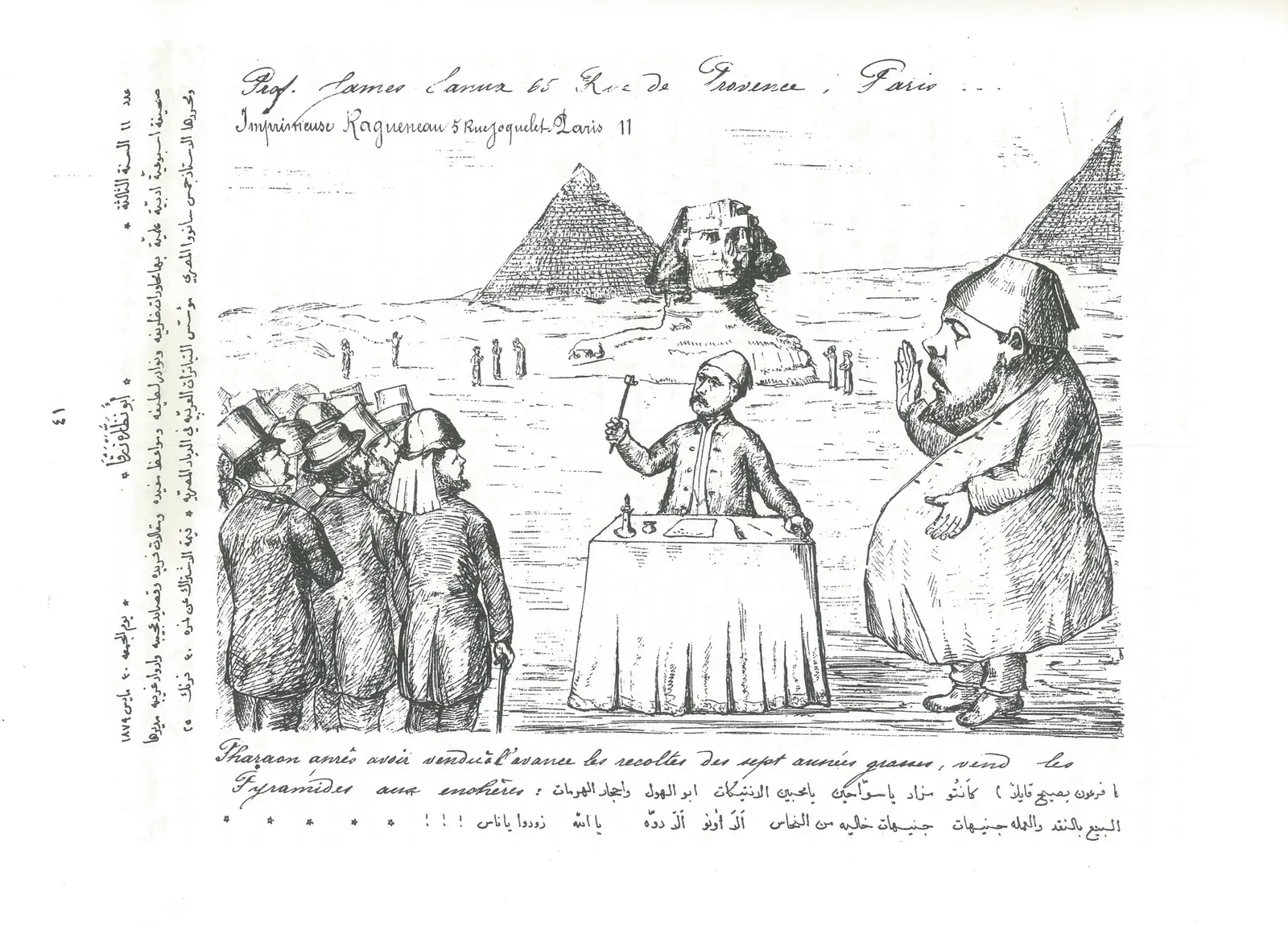
Eventually, the satire proved too dangerous. Khedive Ismail expelled Sanu from Egypt. He moved to Paris, where he continued publishing Abu Naddara in exile, still mocking the same targets from a greater distance. Despite the exile, his influence remained. He had demonstrated that the stage could be a platform for political critique and national imagination. He had shown that theatre could help a people understand who they were and who they wanted to be.
What Sanu did in Egypt, others continued doing halfway across the world. One of them was a poet and playwright in Indonesia who turned traditional shadow-puppet structure into a vehicle for confronting modern dictatorship.
The Politics of "Development"
W.S. Rendra (1935–2009) was one of Indonesia's greatest literary and theatrical figures. Playwright, poet, actor, public intellectual, he did it all. Born into a Javanese Catholic family, he converted to Islam later in life. He once called himself a "dweller in the wind": the theatre person who is simultaneously inside society and slightly outside it, free enough to tell the truth because the wind doesn't belong to any fixed address. After studying in the United States and returning to Indonesia in 1967, he founded Bengkel Teater (Theatre Workshop), drawing deeply on Javanese folk forms, including the shadow-puppet tradition whose moral and narrative structures shaped everything he made.
The play that matters here is The Struggle of the Naga Tribe, written in the early 1970s under Suharto’s New Order regime—a government that presented itself as orderly, developmental, and modern while keeping peasants out of politics, branding dissent as subversion, and selling off the country’s land and labor to foreign capital. Because of his work, Rendra was denied performance permits, monitored, and in 1978 arrested for allegedly spreading hostility toward the government.
The play pits the self-sufficient Naga Tribe, rooted, communal, and spiritually integrated, against the kingdom of Astinam, which is obsessed with "development." The conflict begins when Astinam proposes building a mine that would effectively dispossess the Naga of their territory. When the Minister of Mines explains that the Naga's sacred sites will be "upgraded" for public enjoyment, Abisavam, the Naga leader, understands immediately. “Upgraded” means tourist objects. The Minister insists authenticity will be preserved. Abisavam replies: "Rubbish! The integrity of such a ritual is always lost. Only its dramatic element is retained. You don't really like our culture. You want to put our culture in a museum." The Minister protests that it is precisely because he values their culture so highly.
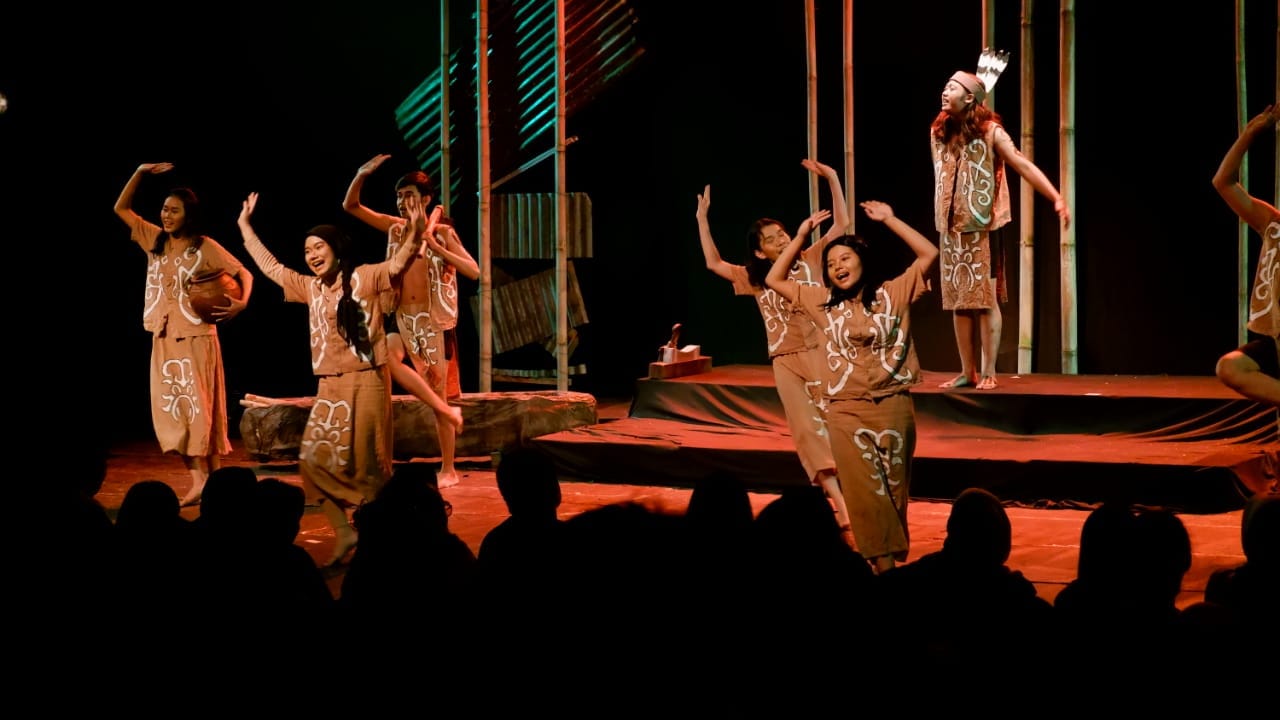
The play never says "Suharto." It gives the audience the fictional queen, the parliament, foreign investors, and the Naga tribe. The references were unmistakable — and the government understood too, which is why Rendra was imprisoned.
The play ends without a clean victory. The mine is effectively abandoned as its costs mount. But the Naga village remains defiant. The ending doesn't celebrate a final triumph. It insists that resistance must continue — that the struggle is not over when one battle ends.
Rendra's enemy spoke the language of development and order. The next playwright's enemy spoke the language of God.
Two Visions of Islam
In Pakistan, the stage becomes a place to ask a dangerous question: what happens when Islam is no longer treated as a path toward justice and moral struggle, but as a legal instrument for punishing, excluding, and humiliating others? That question sits at the center of Shahid Nadeem's work.
Nadeem is Pakistan's most important contemporary playwright, and the long-time leading figure behind Ajoka Theatre, an institution that has, for decades, insisted that art has a moral responsibility.
He was born in 1947, the year of Partition, which means his entire life has been coextensive with the life of Pakistan. He came of age in Lahore, was active in student politics in the late 1960s, and was imprisoned multiple times by military regimes because of his activism. In the 1980s, under a particularly suffocating period of political repression, he went into exile in London, where he began writing plays for Ajoka, the company founded by his late wife Madeeha Gauhar.
His work consistently addresses religious extremism, women's oppression, minority persecution, and the betrayal of Pakistan's own plural cultural inheritance. It does so not from the position of a secular liberal who wants to abolish religion from public life, but from within a tradition that takes Islam seriously.
Nadeem's theatre repeatedly turns to Sufi figures and spiritual traditions as a rival moral vision of Islam: musical, open, searching, humanistic, and historically rooted.
To understand why Nadeem writes what he writes, you have to understand the Zia-ul-Haq era in Pakistan.
General Zia seized power in a coup in 1977 and sought political legitimacy through a program of “Islamization.” The Hudood Ordinances of 1979 imposed punishments in the name of Islamic law, with effects that fell with particular cruelty on women. Among other things, under these laws a woman who reported rape but could not produce four witnesses could herself be charged with adultery.
Under Zia, the arts were treated as morally suspect. Music and dance were restricted. Female television anchors were required to cover their heads. Songs were censored. The state supported a more rigid, legalistic religious culture. The public space of subcontinent culture narrowed Pakistan.
For people like Nadeem, theatre had to move into semi-underground spaces — private homes, backyards, venues where performances could happen without attracting the kind of official attention that could shut them down. This matters thematically: in Pakistan, theatre survives by refusing to surrender the public moral language to the state. It insists on continuing to speak, even if it has to whisper.
I want to be clear about the argument Nadeem is making in his work, because it is easy to misunderstand it. He is not making the argument that religion should be private, or that secular modernity is the answer to Islamic extremism. He is making an argument about which version of Islam should define public life.
On one side of this argument: coercion, legalism, and the reduction of religious life to a catalogue of prohibitions and punishments. On the other: humility, plurality, and the recognition that God exceeds every narrow formula. This is not a conflict between Islam and its critics. It is a conflict inside Islam, between people who are all claiming the tradition.
That conflict is what his play Dara dramatizes, through one of the most painful episodes in Mughal history.
Dara is set in seventeenth-century Mughal India, during the war of succession among the sons of Shah Jahan. The two central brothers represent two competing visions of empire, Islam, and what it means to be human in public.
Dara Shikoh, the eldest son and designated heir, is a Sufi intellectual, a translator and seeker. He is interested in what different religious traditions share, what they point toward in common. He imagines his empire as plural, layered, and generous. He translated Hindu sacred texts into Persian, wrote philosophical works exploring the connections between Islamic mysticism and Hindu thought, and moved through the world with an intellectual curiosity that his enemies found threatening and his supporters found inspiring.
Aurangzeb, his brother, is different in almost every way. Disciplined, militarily capable, austere, and increasingly associated with a stricter, more punitive understanding of Islamic practice. He is not simply a villain, but he becomes the vehicle for a kind of religiosity that Nadeem's play puts on trial.
In the succession struggle, Dara loses a decisive battle and Aurangzeb consolidates power, imprisons his father, and defeats his rivals. Then, instead of simply executing Dara as a political rival, he stages something more damaging: a public trial for apostasy.
The trial is the ideological center of the play. The Prosecutor wants to establish that Dara's spiritual openness is apostasy. Dara keeps turning the argument back to the Qur'an itself: "There is no obligation in religion." We reach for God because we want to, he says, not because courts compel us. Dara is arguing that God is not property. The genius of the play is that he makes this argument from the Qur'an, not against it. The Prosecutor is trying to claim the text. Dara is claiming it back.
The exchange that lands hardest involves revelation and context. Dara tells the Prosecutor: "Of course the Quran is the word of God, because it comes from that place which is the heart of the world. But as a document, it is also bound up with the specifics of the time and place from whence it sprang." And then: "The Arab desert is not a Mughal city."
He is not denying revelation. He is insisting on it. But he is saying that divine truth reaches different societies differently — that God is "lively in his endeavours to touch us," reaching through time and across latitudes. The Prosecutor calls this sampling the gamut of religions like a bee in spring. Dara replies: "Prosecutor, at the centre of every blossom is honey, the rest, frankly, is ritual."
That line makes rigid legalists uncomfortable because it relocates moral authority. If the honey is the same regardless of the blossom, then no particular institution can claim final ownership of God.
The sharpest exchange names it directly. "You take these religious tenets as if they were sticks to beat us with," Dara tells the Prosecutor. He argues that the Prophet ﷺ was responsive to the circumstances surrounding him, yet his words have been seized as "immovable truths, frozen." The Prosecutor says: “it is law.” Dara replies: "It was not offered up as such." And then: "The mullahs use its words like weapons, to chastise, berate and murder, which is not what they were intended for."
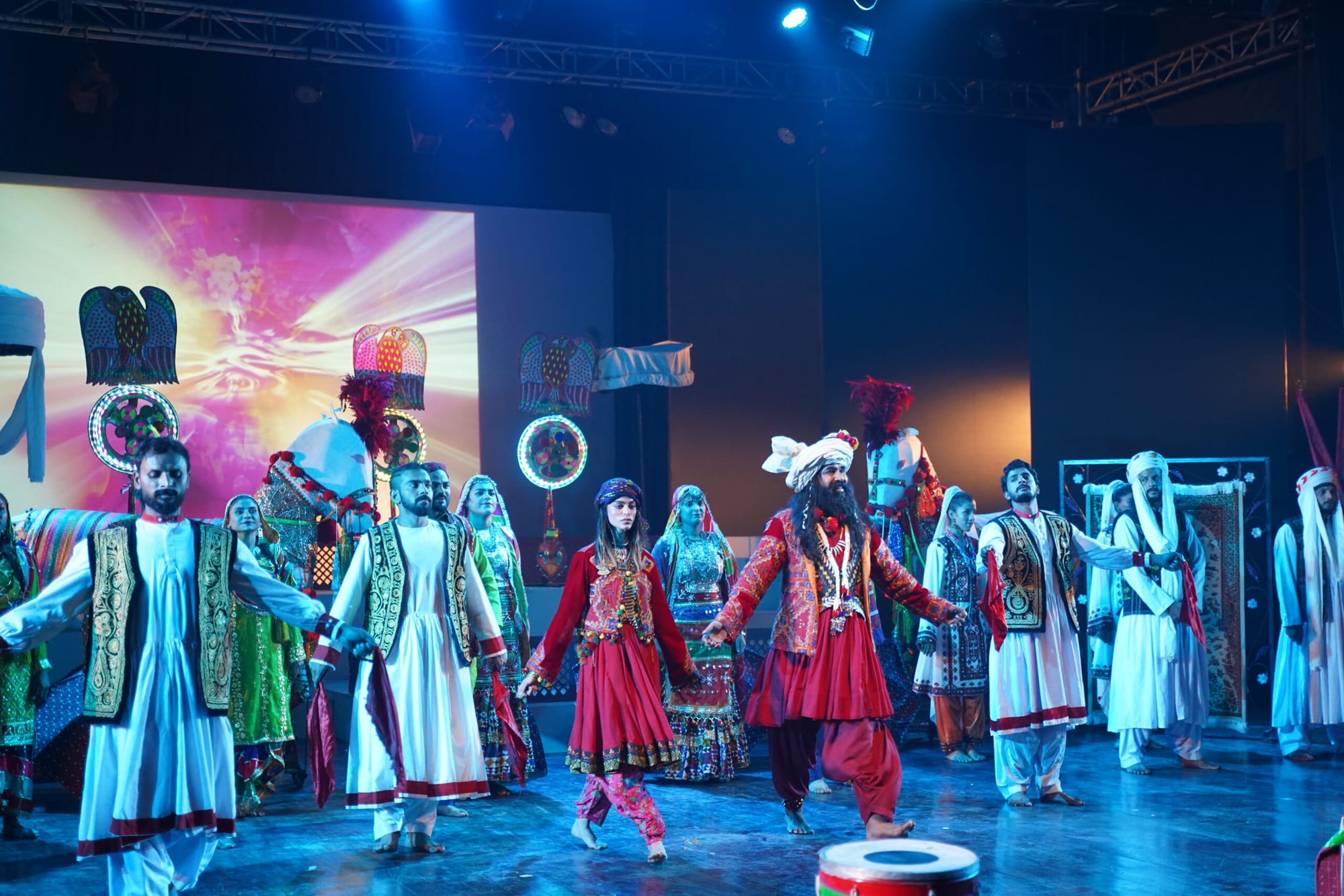
This is the line that connects Mughal India to modern Pakistan’s Hudood laws, blasphemy accusations, and state-backed piety deployed against women, minorities, and dissenters. What Nadeem is dramatizing is a pattern that repeats in every period: the moment when interpretation starts pretending to be final law. Dara is not a relativist. He is radically theocentric. Which is precisely why the court cannot contain him.
What Nadeem is arguing through this play is that there are two rival ways of inhabiting Islam, and that the difference between them is the difference between mercy and violence.
He is also making a historical argument: the Sufi-inflected, plural, intellectually open Islam that Dara represents is not a foreign import. It is not a liberal revision of a tradition that used to be something else. It is part of the region's own history — centuries old, indigenous, rooted in the same land as the people who now want to pretend it never existed.
Aurangzeb and Dara are still with us. The trial never really ended.
If Dara shows how theatre can put religious coercion itself on trial, the next step in this history is different in almost every way: it moves from Muslim-majority societies to immigrant ones, where theatre becomes a space not only for critiquing the state, but for negotiating belonging, suspicion, and identity in a new country.
But before arriving at the Muslim stage in America, we have to see what happens when another minority immigrant community decides that theatre is how it will make itself legible to a new country.
A Second Synagogue
Once you move to immigrant societies, the issue is no longer only how to resist power or how to challenge religious coercion. It becomes something more personal and in some ways more difficult: how to preserve a world that is disappearing.
That is exactly what Yiddish theatre did for Jewish immigrants in America. And the story of what it accomplished is essential context to understanding what Muslim theatre in America would need to look like, and where it would come from.
Yiddish theatre had roots in Europe, where it developed through the nineteenth century. The form took on a new life in the United States with the mass immigration of Eastern European Jews at the turn of the twentieth century. Yiddish had long been treated as a lesser language in Europe, a vernacular, not the language of serious culture. In immigrant America, something shifted. New York's Jewish neighborhoods became the site of a cultural renaissance in which newspapers, literature, and theatre thrived alongside each other.
The scale of Yiddish theatre in its peak years is hard to imagine now. Working-class Jewish families who spent their weeks in garment factories still found enough money to spend on theatre. An 1898 account describes Yiddish theatres packed night after night with audiences whose commitment to theatre, relative to their income, exceeded that of elite uptown opera patrons. By the 1920s, New York had multiple Yiddish theatres across Manhattan, Brooklyn, and the Bronx, following audiences as they moved through the city. The theatre let immigrants hear their own language in public, see their social conflicts staged, and rehearse the gap between the old world and the new. It transformed displacement into narrative.
This effort reached a defining moment when Fiddler on the Roof premiered on Broadway in 1964. It was based on Sholem Aleichem's Yiddish stories about Tevye the dairyman, a poor Jewish milkman in the Pale of Settlement of Imperial Russia, written between the 1890s and 1910s. By the time it reached Broadway, those stories had already traveled through decades of cultural transformation — from the Yiddish literary world, through the immigrant community's theatrical life, and into the mainstream of American culture.
The story is set around 1905 in the fictional shtetl of Anatevka. Tevye is trying to hold together family, faith, and dignity in a world changing faster than tradition can absorb. He has five daughters, and the dramatic conflict is that tradition wants one thing for them and they want something else. The three eldest each push further than the last: the first chooses her own husband instead of accepting the matchmaker's choice; the second marries for love across class lines; the third marries outside the faith entirely, a line Tevye cannot cross with her. Meanwhile the political world grows darker, antisemitism increases, and the village is forced into exile.
The show's thesis arrives in its opening number. Without tradition, Tevye says, their lives would be as shaky as a fiddler on the roof. That image captures the precariousness of identity under pressure and the beauty of the tradition being balanced, while acknowledging that the position is unstable.
Anthony Warlow and Company perform the opening number, "Tradition," from Fiddler on the Roof.
What made Fiddler lastingly powerful is not that it universalized Jewish experience into something generic. It did the opposite. It was specific, giving its audience ritual and accent, family conflict and rueful comedy, prayer and poverty, historical violence and music. It staged a whole world. Because it was very specifically Jewish, audiences who were not Jewish could enter it. Specificity, not generality, is what makes minority art legible. The universal is reached through the particular, not around it.
Now, what would it take to get a Muslim Fiddler on the Roof?
It would not be enough to write a play about Islamophobia. It would not be enough to write a play where a Muslim character explains themselves to a suspicious majority — defends their loyalty, argues for their normalcy, demonstrates their harmlessness. That would be a play addressed outward, toward a suspicious audience, rather than inward, toward a community trying to understand itself.
A Muslim Fiddler would need to stage a whole world. It would need to let Muslims appear as people, not a problem — holding together humor, ritual, family argument, class aspiration, love, and historical pressure. It would need to dramatize internal conflict, not just conflict between Muslims and the outside world.
It would also need to trust that Muslim life is dramatic enough on its own. That the aunties and their arguments, the fathers who speak to God, the daughters who break inherited rules, the comedy inside piety, the migration pressure, fracture, and continuity — all of this is sufficient without the intervention of external threat to make it interesting. That trust is the missing ingredient in a lot of contemporary Muslim representation.
The historical comparison is sobering. Jewish immigrant theatre had decades of institutional build-up before Fiddler. Muslim theatre in America largely lacks this infrastructure — not because Muslims don't have stories or dramatic conflicts, but because the conditions that produced Yiddish theatre haven't been replicated. The Muslim American experience is more fragmented, more diverse in origin, and arrived under different historical pressures.
Before a minority community gets its Fiddler on the Roof, it usually gets decades of smaller stages where it learns how to hear itself in public. The question is whether Muslim theatre in America is building those stages now, and who is writing the plays that will allow a wider audience to enter not just a Muslim problem, but a Muslim world.
Before there can be a Muslim Fiddler, there first has to be theatre capable of staging Muslim life as something more than a political headline. This is where Yussef El Guindi enters.
A Muslim Family on Stage
Yussef El Guindi was born in Cairo in 1960 to an Egyptian playwright and journalist, and grew up in a household where public language was already understood to have moral stakes. He moved from Egypt to Britain as a child, then later to the United States, eventually settling in Seattle. Egypt to Britain to America is not a straightforward immigration story. It is a series of dislocations, each requiring a new negotiation between inherited identity and new context, and that condition of permanent in-between animates everything he writes.
His plays combine sharp dialogue and dark humor with intimate domestic tension and social critique. But what distinguishes them is this: they do not present Muslims as flat symbols of victimhood. They present them as families arguing about how to live.
Ten Acrobats in an Amazing Leap of Faith is one of El Guindi's most important works because it turns away from the public interrogation room and into the private living room.
The title is a metaphor for the whole play. Everyone in it is balancing something precarious: faith and skepticism, obedience and freedom, family loyalty and personal truth, sexuality and communal expectation, cultural inheritance and American life. The family is performing constant emotional acrobatics to keep from falling apart.
The play is set in Los Angeles and centers on an Egyptian-American Muslim family: Kamal, the strict father; Mona, the mother; Tawfiq, the older son who has lost his faith; Hamza, the younger son, quieter and more artistic, struggling with his sexuality; and Huwaida, the daughter, navigating feminism, Muslim identity, and pressure toward marriage.
The immediate social drama involves Huwaida's possible engagement to a suitable Muslim man. Kamal sees the engagement as proof that the family has preserved its values in America. But beneath this surface ritual, the family is already fracturing along multiple fault lines.
Tawfiq, privately and then less privately, has stopped believing in God. Huwaida begins to question both the engagement and the role expected of her. And Hamza is pulled between his religious upbringing, his artistic sensitivity, and a sexuality he cannot openly acknowledge within the household.
By the second act, these tensions collide. The engagement collapses. Tawfiq's atheism becomes impossible to hide. Then, Hamza's arrest for a sexual encounter with another man becomes the the event that tears the family's careful performance of coherence apart.
The play ends without reconciliation. No one is fixed. No one is redeemed in a straightforward sense. The family remains together, but carrying the new knowledge about each other that they will have to decide what to do with. That ambiguity is the play's strength. Life does not resolve into lessons.
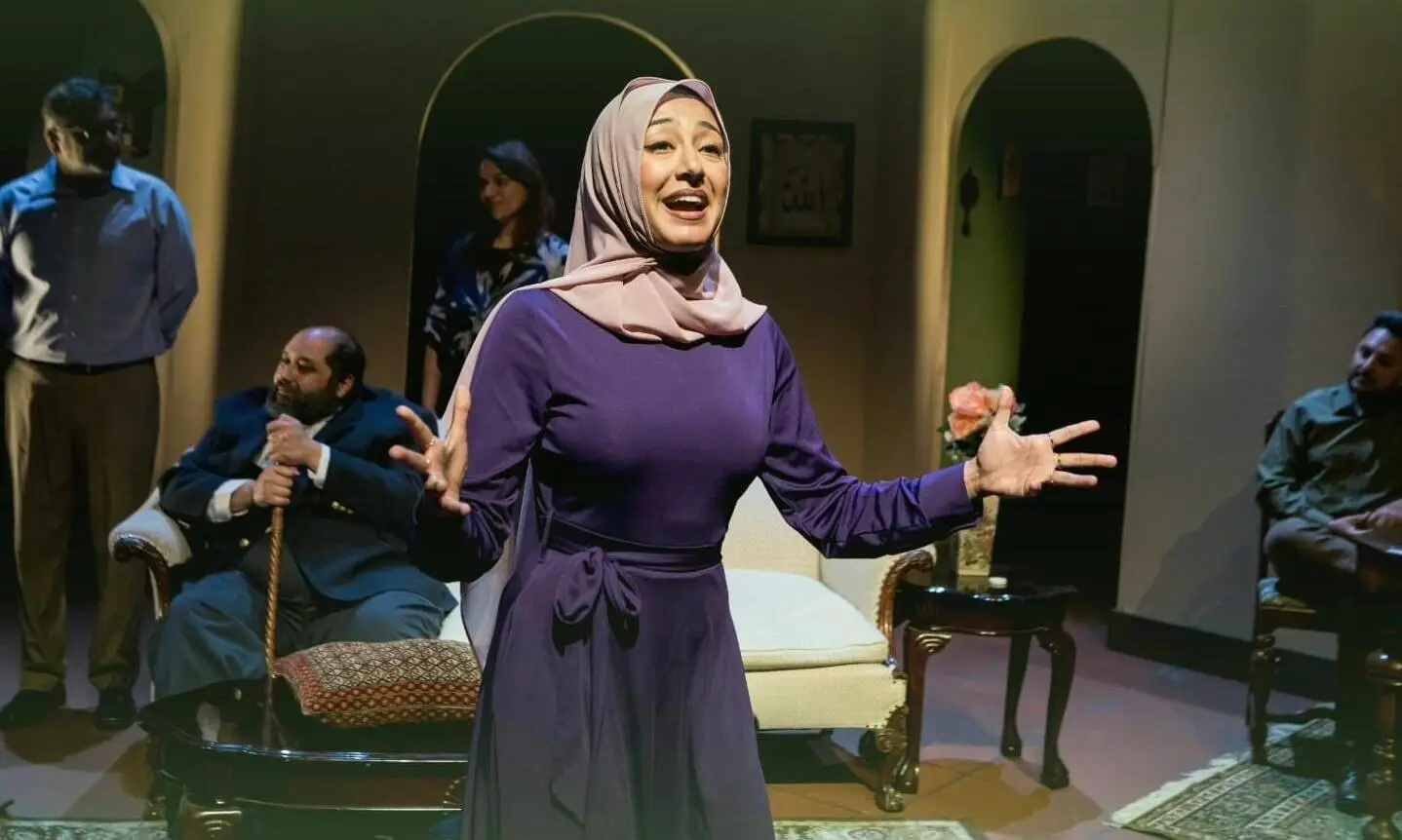
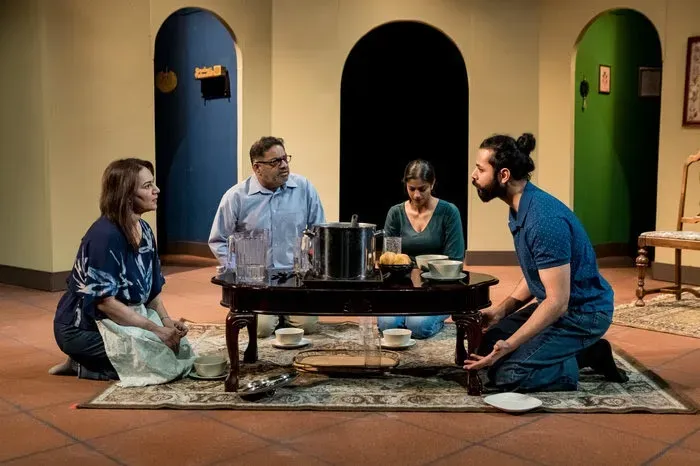
Hamza's storyline is where the play is the most interesting.
In much modern representation, Muslim sexuality appears in one of two ways. It is either erased entirely, as though Muslim communities exist in a world without sexual life, or it is framed as a simple conflict between enlightened liberation and oppressive religion: the young person breaking free from a repressive tradition. El Guindi does something harder and more honest. He stages the question as a family tragedy. Hamza is not a symbol of liberation but a son within a particular household, where love, shame, doctrine, masculinity, and immigrant fear collide all at once.
There is also a theatrical choice worth noting: in the most powerful discussion of Hamza's sexuality, Hamza is not the central speaker. Other family members speak about him, around him, through him. He is the object of communal speech rather than its subject. This is how taboo often works in immigrant families. The person at the center of the crisis becomes the thing that everyone else speaks around, while the person himself is barely present in the conversation that defines them. El Guindi captures this with painful accuracy.
The emotional center of the play is the confrontation between Kamal and Tawfiq after the news about Hamza has arrived.
Kamal catalogues his catastrophes: "This will be in his record. This—stain. This... abomination. This is public record. You know this is public record? For everyone to see. This will spread like wildfire in the community, and back to Egypt. Oh they will love this. We are supplying them with all the drama they need. Switch off your televisions and come see the Fawzi family as they explode. First my son goes insane and becomes an atheist. Then my daughter goes insane and dumps the engagement. And now my other son goes insane and goes fornicating in the bushes..."
Tawfiq starts to name what Hamza is. Kamal stops him. Don't say it. Tawfiq says it anyway. "Ḥarām," Kamal says. Don't drag religion into it. Even religion, he says, would be offended.
Tawfiq says: then it should be struck from the books. It's nobody's affair. Kamal replies: "There is another book and another law, and these you cannot strike out."
Tawfiq asks: says who? Every faith on the planet, Kamal says. Are they all wrong? "Was every faith inspired by ignorance that they should come to the same conclusion?" Tawfiq says yes — they all came from a time when people were made uncomfortable by sex. We've changed. And why would God forbid consenting love between two people?
Kamal says: you call what happened in the bushes love? Tawfiq says: why not, it might have been. Kamal says: this is what it means to live without God. "These are the conclusions you come to."
Tawfiq delivers his line: "I'd rather live without God and have some compassion than have God and use him to punish anything I don't like."
And then Kamal says the line that keeps the scene from being simple: "You don't think I have compassion for my son? You don't think I care for my son? That I would give up my life for him in a second?"
Kamal is angry, ashamed, and doctrinaire. But he is not a cardboard tyrant. He loves Hamza, in his own way. The problem is that he doesn't know how to imagine loving him and affirming him simultaneously. His idea of Islamic law and his love have arrived at a contradiction, and he is not do equipped to navigate it.
The shame is also communal, not merely personal. When Kamal imagines the news spreading through the community and back to Egypt, he is not simply being vain. He is expressing the specific anxiety of the immigrant who knows that his family's private failures will be read as public moral evidence. The immigrant cannot simply have a private disaster. Every disaster is representative.
Tawfiq's sharpest line cuts through this: "I'd rather live without God and have some compassion than have God and use him to punish anything I don't like." El Guindi, like Shahid Nadeem in Pakistan, is using the line to argue that religion can become less a path toward moral truth than a vocabulary for sanctioning injustice.
Is Ten Acrobats in an Amazing Leap of Faith a Muslim Fiddler on the Roof?
No. It does not stage a whole communal world with the breadth, music, and sweep that Fiddler achieves. It is a smaller play, more anxious, less certain of its audience's sympathies. It does not have a musical number about tradition. It has a father saying he would give up his life for the son he can't accept.
However, it does something that a future Muslim theatrical canon would need to do: it stages internal Muslim life as dramatically serious, morally complex, and worthy of sustained attention. It refuses to flatten the family into a lesson or a symbol. It refuses to make Kamal simply wrong, or Tawfiq simply right. It refuses to provide a resolution that lets the audience off the hook. That in itself is a theatrical achievement.
Salam, again
The lights dim before every play at the Alley Theatre, and the ritual begins again.
I know the sequence so well now that I could say it with my eyes closed:
Welcome. Bienvenidos. Nǐ hǎo. Bonjour…
For years I sat in the dark and heard those words land with a quiet incompleteness. The kind of feeling you get when you are in a room full of people who are genuinely glad you're there, and you are glad to be there, yet something small is still slightly off, and you can't quite decide whether it's worth mentioning.
What I traced through this piece was a history of Muslim theatrical presence across more than a thousand years. The Alley Theatre was not hostile to this history. It simply hadn't thought about it.
After more than a dozen plays, I decided to do something about it. Not a campaign. Not a public complaint. Just a note to the creative department: there might be a greeting you're missing.
The response surprised me with its warmth. There was no defensiveness, no discussion of whether it mattered. It simply mattered, and they were ready to act on that. What I hadn't expected was what came next.
They asked me to record the greeting myself. My voice, my pronunciation of an Islamic greeting, entering the room before every performance. One word. One second. But it meant I was no longer just watching.
So now the loop runs differently.
The lights begin to drop. The voices come:
Welcome. Bienvenidos. Nǐ hǎo. Bonjour…
And then: Salam.
"Welcome to the Alley Theatre, where everyone is truly welcome."