
I’m Moving to Bellaire
What does it mean for Muslims to move to high-income neighborhoods that were previously segregated?

The Scan
We were standing in Evelyn's Park in Bellaire, Texas. This was maybe the third or fourth time we'd driven through the neighborhood, the kind of scouting out you do when you're thinking about your family’s future. My wife was pointing at the sidewalks—she has a thing about sidewalks and trash on the side. The park had that particular manicured perfection that signals a high tax base and people who show up to city council meetings.
And then, without deciding to, I did what I always do. I looked around and counted how many Black people are in the park. It’s an automatic thing that I do without consciously registering until later. Any time I enter a room I always become aware of how many Black people are around me. It's a reflex I developed early in life, a kind of environmental scan. The number in Bellaire that afternoon was very small.
My wife didn’t notice. She isn’t as hyper-attuned to race as I am, which I imagine must make life more enjoyable.
"I'm not saying anything is wrong," I said. "I'm just saying I notice."
That's not quite accurate. What I was actually doing was more complicated than noticing. I was asking myself a question I didn't fully understand yet. Something like: What does it mean to want this? The safety, the sidewalks, the Bellaire life—I wanted all of it. We had a kid. I wanted good schools and low crime and neighbors who maintain their property. I wanted the things that Bellaire so obviously, almost offensively, has. But I also knew, in some not-fully-examined way, that when a place looks like that the aesthetics are not accidental. They have history.
This essay is an attempt to wrestle with that history. To actually understand what it means to move somewhere "good" when "good" has a past, when "good" is itself a product of decisions that hurt people, and when you are a second-generation Muslim American who has, quietly and without much drama, begun the process of inheriting the machine.
I want to be clear. I'm not saying Bellaire is doing anything wrong today. I love Bellaire. I'm saying my eyes have learned to read certain absences. And once you learn to read them, you have a choice: look away, or ask where they came from.
Part One: What Was Built Here
The Ranch, The Prairie, The Plan
William Wright Baldwin, acting as president of the South End Land Company, founded Bellaire and Westmoreland Farms after purchasing the 9,449-acre Rice Ranch in 1908. Baldwin was a native of Iowa and nationally known as vice president of the Burlington Railroad. He was not a Texan. He was a railroad man from the Midwest who saw the Houston prairie the way railroad men saw everything: as distance to be bridged, and land to be sold.
Baldwin surveyed the eastern 1,000 acres of the ranch into small truck farms, which he named Westmoreland Farms. He platted Bellaire in the middle of the farms to serve as a highly restricted residential neighborhood and agricultural trading center. The term "highly restricted" is doing a lot of work in that sentence, and I don't think it was accidental in 1908, and I don't think it's accidental now.
It comprised less than two square miles, bounded by First, Palmetto, Sixth (now Ferris) and Jessamine Streets, and was approximately five miles southwest of and across a barren prairie from Houston. That prairie was not just geography. It was buffer. Between Bellaire and Houston's growing, mixed, immigrant-dense urban core, there were miles of open land that served as both a physical separation and a conceptual one. Bellaire was not just away from the city. It was apart from it.
In 1909, W.W. Baldwin connected Westmoreland Farms to Houston downtown by constructing Bellaire Boulevard, a double shelled road running from Richmond Road to the foot of Main Street. An oasis. That's the word in the original promotional material. The vocabulary of marketing is worth paying attention to. An oasis implies a wasteland around it. The road was beautiful. What it connected you to, and what it separated you from, was the actual product.
The South End Land Company advertised nationwide to attract Midwestern farmers and others who were eager to escape harsh winters. Bellaire was promoted as a highly restricted residential neighborhood and agricultural trading center with the conveniences of city living and reliable access to Houston. There it is again: "exclusive."
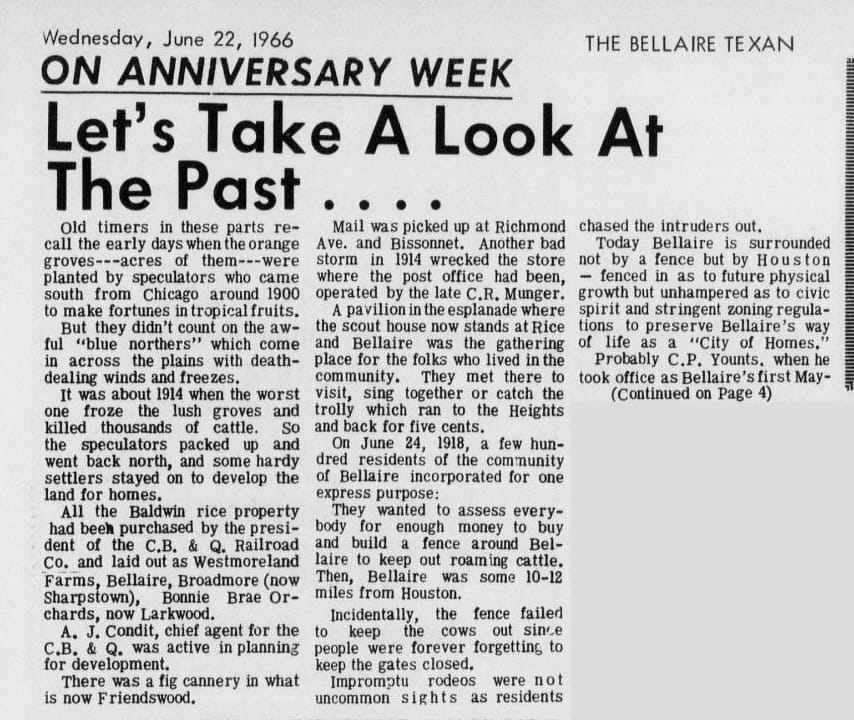
By 1918, Bellaire had about 200 residents and a problem that is, in retrospect, a perfect metaphor for everything that came after: the cattle. Because the surrounding Rice Ranch land was unincorporated open range, local ranchers let their livestock roam freely—which meant that cows wandered through Bellaire's residential streets, trampled gardens, and decorated sidewalks in ways that offended the sensibilities of a community that had come a long way to build something refined. The residents' solution was to incorporate as a city on June 24, 1918—not for any grand civic purpose, but to gain the legal authority to tax themselves and use that money to build a fence around the entire town. Bellaire's first act of self-governance was to “build a wall.”
They also installed gates at the main entrances. The gates failed. People kept forgetting to close them, and the cows simply walked through. Local newspaper accounts describe the resulting "impromptu rodeos," residents chasing livestock out of their yards in their Sunday best. The cattle problem persisted, the archives note, until the area became densely suburban after World War II—at which point the cows had been replaced by something more effective at keeping certain people out.
Houston's expansion after World War II transformed Bellaire into a popular suburb, but geographical growth was halted when Houston annexed the surrounding land in 1948. The following year, Bellaire adopted a home-rule charter with a council-manager government. Under Texas law, "home rule" means a city can do anything the state doesn't explicitly forbid. That is an enormous amount of power for a 3.6 Square mile island. Bellaire used it to establish its own zoning laws, its own police force, and a corporate-style city management structure that was deliberately insulated from the sprawling, sometimes chaotic political machine of 1950s Houston. The "City of Homes" reputation that Bellaire cultivated wasn't just a marketing slogan. It was a governance philosophy.
Think about what that means structurally. Houston grew out and absorbed everything around Bellaire. Bellaire chose to remain an island. And because it cannot grow outward it can only grow up. Larger homes on the same lots. Higher property values. A tax base that sustains itself through intensification. Every tear-down and rebuild, every $1 million renovation, is also a fiscal act. The boundary is a political decision that has been renewed, implicitly, every year since 1949. The boundary says: we are not Houston. We are something else. And we have the legal architecture to stay that way.
Boundaries are policy.
The Deed Restrictions: Exclusion in Paperwork
Before there was zoning, there were deed restrictions. In Houston—which to this day has no formal citywide zoning code—deed restrictions have functioned as zoning by other means. They are private, recorded legal documents that travel with the land when it's sold, enforceable by neighbors and civic associations, capable of regulating everything from the color of your house to who can live in it.
In the early decades of Bellaire's existence, deed restrictions in the neighborhood and across the Houston area commonly included racial covenants like the following:
“None of the lots shown on said plat shall be conveyed, leased, given to or placed in the care of, and no building erected thereon shall be used, owned or occupied by any person other than of the Caucasian Race...Provided, however, that this covenant shall not prevent the occupancy of any such property by domestic servants of a different race or nationality actually employed by the owner or tenant of such property.”
This was the industry standard. The National Association of Real Estate Boards effectively turned it into a professional obligation for realtors to protect what they called “neighborhood character,” a phrase everyone understood to mean racial homogeneity.
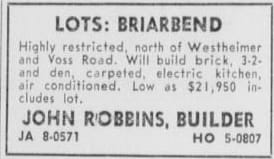
The phrase "highly restricted" appearing in real estate advertisements was a signal—one that buyers, sellers, and realtors of the era understood perfectly. The classified pages of the Bellaire Texan and The Citizen ran ads like these throughout the late 1950s, marketing new developments in and around Bellaire as "highly restricted"—shorthand that told prospective white buyers the neighborhood was protected from Black residents. No further explanation was needed.
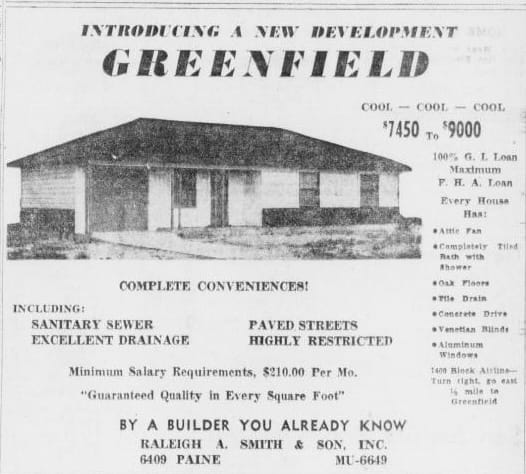
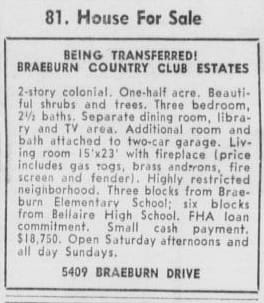
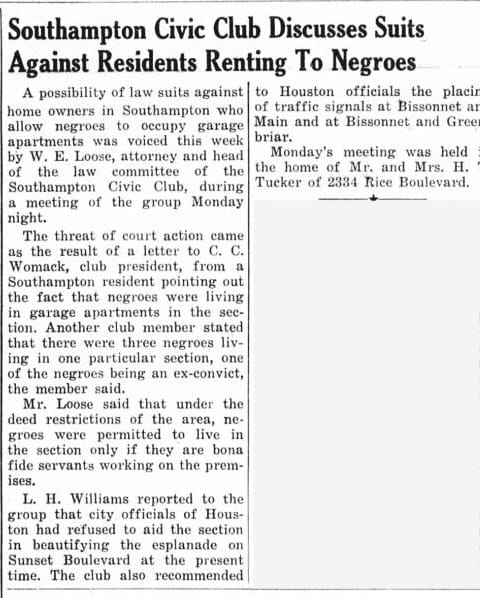
Local civic associations enforced these norms with vigilance. In nearby Rice Village, for example, the Southampton Civic Club in 1947 threatened legal action against residents who were renting their homes to Black tenants in violation of the neighborhood’s deed restrictions.
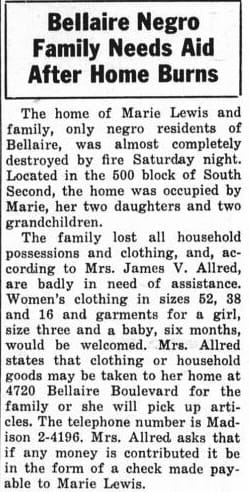
In Bellaire, the only evidence of a Black resident during this time period is Marie Lewis, who lived with her two daughters and two grandchildren until her house burned down in March 1947.
In 1948, the Supreme Court ruled in Shelley v. Kraemer that racially restrictive covenants could not be enforced by courts. Note the precision of that ruling: unenforceable by courts, not erased from the deed. The covenants continued to exist on paper, and the social machinery that had grown up around them continued to function largely as before. You don't need a sign on the door if the mortgage officer never calls you back.
The HOLC Map and the Capital That Followed
In the 1930s, the federal Home Owners' Loan Corporation (HOLC) created color-coded "residential security" maps of American cities. The stated purpose was to assess mortgage lending risk. The actual function was to codify, with federal authority, which neighborhoods were worthy of investment and which were not.
HOLC assigned communities a rating from A through D to designate the level of "risk" in investment. Neighborhoods that were all-white were given an "A" rating, colored green, and denoted as a "best" area for investment. Neighborhoods with Black residents, regardless of their actual physical condition or economic stability, were almost invariably rated D and colored red. That's where we get the term "redlining."
The maps helped depress homeownership rates, property values, and rents while reinforcing patterns of racial segregation that persisted for decades. The effects were not temporary. Eight decades later, 74% of the neighborhoods the HOLC labeled “Hazardous” remain low-to-moderate income, and nearly 64% are still majority-minority neighborhoods.
Houston's present-day segregation is a direct result of redlining and its associated policies. The redlined Second and Third Wards, primarily Hispanic and Black respectively, had freeways rammed through and wrapped around them, walling these communities off from downtown and displacing thousands. The freeways that surround Bellaire today—the ones that make it easy to reach from every direction while somehow remaining quiet enough that we can’t hear them from our houses—were built on the logic of those maps.
Bellaire itself was green on the map, an A-rated investment destination, a place where capital was supposed to flow. And flow it did. The postwar suburban boom delivered to Bellaire exactly what the system promised: federally-backed mortgages for qualified (white) buyers, new schools, new infrastructure, and rising property values that compounded decade over decade.
The Black families who might have participated in that wealth-building moment were being steered elsewhere or denied loans.
This is not ancient history. The children of the people who were excluded in the 1940s and 1950s are alive today. The wealth that compounded in Bellaire during those same decades is still here, embedded in the land value. The beneficiaries didn't have to do anything wrong themselves. The system did it for them, and then it handed them the keys.
Minstrel Shows & Negro Jokes
Here I need to say something uncomfortable, because it requires acknowledging that what I’m describing was not only legal and economic. It was also social and performed.
In the same era that deed restrictions were treated as a kind of neighborhood constitution, Bellaire also had its own rituals of belonging—community entertainments that looked harmless to insiders but functioned as boundary-setting to everyone else. One of those rituals was the minstrel show.
For nearly a century they had been mainstream American entertainment: white performers darkening their faces with burnt cork or greasepaint and performing exaggerated caricatures of Black speech, music, and behavior. Even as national tastes began to change after World War II, minstrel traditions lingered in civic life across the country, repackaged as “variety nights,” charity performances, and community fundraisers.
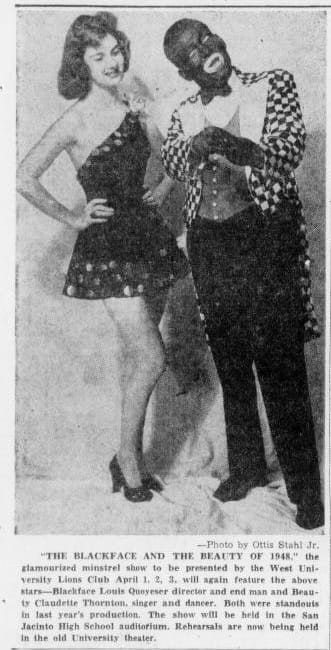
The performance of racial hierarchy in Bellaire did not only happen on stage. It also appeared in the local paper.
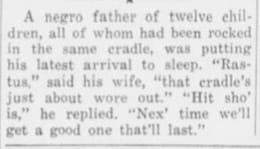
The Southwestern Times, which served Bellaire and the surrounding villages in the 1940s, occasionally ran what were essentially “Negro jokes” tucked among civic announcements and advertisements. One small item printed in 1949 reads:
“A negro father of twelve children, all of whom had been rocked in the same cradle, was putting his latest arrival to sleep. ‘Rastus,’ said his wife, ‘that cradle’s just about wore out.’ ‘‘Hit sho’ is,’ he replied. ‘Nex’ time we’ll get a good one that’ll last.’
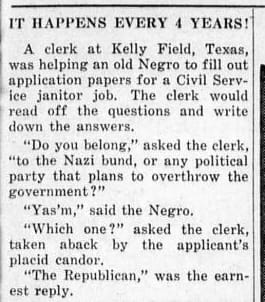
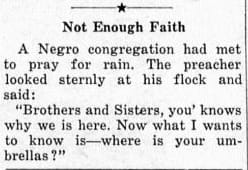
Nothing about these jokes were controversial at the time. They sat alongside notices about building strikes, advertisements for tailor shops, and announcements for kindergarten enrollment. They appeared in the paper the way any other small item might appear.
That lack of controversy is the point.
Segregation is rarely sustained by law alone. It is reinforced through everyday signals about who belongs at the center of community life and who appears only as a caricature on its margins. A minstrel show on the civic calendar and a joke about “Negro congregations” in the local paper may seem trivial in isolation. But when they exist alongside deed restrictions on the books and quiet steering in the housing market, they form part of the same cultural machinery.
A community can tell itself it is simply being traditional, or funny, or innocent. Yet the effect is the same: a social world in which Black people appear mainly as punchlines or costumes, not as neighbors.
When those signals are repeated often enough, the outcome begins to look natural. The neighborhoods stay homogeneous. The parks stay sparse. And decades later someone can walk through a place like Bellaire and feel the absence without immediately knowing the history that produced it.
Today’s Numbers
| Year | Location | Total Pop. | White % | Black % | Asian % | Hispanic % |
|---|---|---|---|---|---|---|
| 1950 | Bellaire | 10,173 | 99.8% | 0.0% | 0.0% | <1.0% |
| Houston | 596,163 | 79.0% | 20.9% | <0.1% | n/a | |
| 1970 | Bellaire | 19,009 | 98.9% | 0.1% | 0.3% | 1.8% |
| Houston | 1,232,802 | 62.4% | 25.7% | 0.4% | 11.3% | |
| 1990 | Bellaire | 13,842 | 92.2% | 0.5% | 4.8% | 4.2% |
| Houston | 1,630,553 | 40.6% | 28.1% | 4.1% | 27.6% | |
| 2010 | Bellaire | 16,855 | 72.6% | 1.6% | 14.1% | 9.5% |
| Houston | 2,099,451 | 25.6% | 23.1% | 6.0% | 43.8% | |
| 2020 | Bellaire | 17,202 | 59.2% | 1.6% | 23.7% | 10.6% |
| Houston | 2,304,580 | 23.7% | 22.1% | 7.2% | 44.0% |
In 1950, Bellaire was 99.8% white. That number is so extreme that it almost stops being a statistic and starts being a design feature. Bellaire was not simply majority white. It was functionally all white.
Twenty years later the divergence had grown sharper. By 1970, Houston's Black population had risen to 25.7%. Bellaire's was 0.1%. Not a gap. A wall.
That wall held through the civil rights era. Through the Fair Housing Act of 1968. Through the enormous demographic transformations that reshaped Houston in the late twentieth century. Houston changed fast. Immigration from Latin America and Asia accelerated dramatically. The oil boom attracted professionals from across the world. By 1990, the city's white population had already fallen below half. Bellaire barely moved. That year, it was still more than 92% white.
Here is where the numbers start to tell a more complicated story, because the demographic change that eventually reached Bellaire did not arrive evenly.
The most dramatic shift has been the rise of Bellaire's Asian population—from effectively zero in 1950 to nearly 24% by 2020. Bellaire sits between two powerful economic anchors: to the west, the commercial corridor of Asiatown; to the east, the Texas Medical Center. Together, they've made Bellaire a natural landing point for a diverse professional class—including a significant and growing South Asian community—even as the city's zoning keeps most of the cultural infrastructure just outside its borders.
But notice what did not change. Bellaire's Black population in 2020 is 1.6 percent. Statistically identical to what it was half a century ago.
The difference between these two stories—Asian integration, Black exclusion—is not random, and it is not about culture or preference. Asian immigration to Houston surged after the 1965 Immigration and Nationality Act opened new pathways for highly educated professionals. Many of those families arrived with the credentials—medical, engineering, academic—that slotted neatly into suburban homeownership. Bellaire, with its strong schools and proximity to the rest of the Houston area, was a natural landing point for people whose primary obstacle had never been wealth. The city has diversified—but along a very specific axis, and I am now a point on this axis.
I grew up in Austin and went to Canyon Vista Middle School. The demographics there were strikingly similar to what Bellaire looks like today: 44.5% Asian, 33.7% white, 14.6% Hispanic, and 1.7% Black. My childhood normal was already a high-achieving, low-Black environment. I didn't notice it then the way I notice it now.
That school was full of kids like me—second-generation South Asian and East Asian and Arab-American children of professionals who had come to America with credentials and built lives in the suburbs. Our parents had navigated the system, found the good zip codes, and chosen the school districts with the high ratings. Moving to Bellaire doesn't feel like a scandal. It feels like a continuation. It feels like the next logical stop on a route that was already being traveled when I was a child.
Which raises the question this essay is really about. We are a professional-class Muslim family. We got the right education. We found the right neighborhood. We can afford to live comfortably. We are doing exactly what dreamers have always done in America. The question is, what do you do when you've made it?
We are not the first group to make this journey. Two generations before us, it was Jewish families who moved up to Bellaire. They faced their own version of this question. One of them, a rabbi named Harry Z. Sky, tried to answer it from a pulpit in a small shack of a synagogue in the late 1950s. It is worth understanding his example.
Part Two: A Rabbi and a Moral Argument
How Jews Got to Bellaire
To understand Bellaire's Jewish community, and why that community matters for the story I'm trying to tell, you need to understand the migration that created it.
For much of the early twentieth century, Houston's Jewish population was concentrated in the Third Ward and Riverside Terrace, neighborhoods that were themselves sites of upward mobility but also of constraint. Jewish Houstonians, like Jews in most American cities, faced their own version of exclusion: restricted clubs, limited access to certain universities, social barriers in the business community, and in some neighborhoods, restrictive covenants that specifically barred Jewish residents alongside Black ones.
The irony is that the same postwar suburban boom that consolidated white advantage in places like Bellaire also opened those suburbs to Jewish families who had previously been kept out of them. The mechanisms of exclusion were selective and hierarchical: Blackness was an absolute bar; Jewishness, by the postwar period, was often an obstacle that could be overcome if your income was high enough and your last name was easy enough to pronounce.
In Bellaire's founding decades, Jewish residents were essentially absent—under 1% of the city, with most Houston Jews still concentrated in the Third Ward and Riverside Terrace. Then the suburbs opened up, and the migration began. By the 1970s the Jewish share had reached somewhere between 4 and 7%. By the 1990s, closer to 10–14%. By 2016, the best available estimate put the Jewish population of the Bellaire-Meyerland-Willow Meadows corridor at 15–17%. You can feel it when you're here. My favorite place to eat breakfast, Bagel Shop Bakery, is not a novelty. It is evidence of seventy years of community-building by a people who arrived and made the place their own.
The story of that migration has a center of gravity: Congregation Brith Shalom. It started with a meeting in September 1954: what do Jewish families in Southwest Houston actually need? A place to pray, a Hebrew school, a community close enough to walk to. By 1955 they had a rented house, a constitution, and a name—Brith Shalom, covenant of peace—and were holding their first High Holy Day services in a Knights of Columbus hall. By March 1956 they had moved into their own building—a prefabricated structure that the members had physically helped to construct. Three years later they had outgrown it. In the fall of 1959 they purchased the First Baptist Church that stood at their current location, and dedicated the building in April 1961.
This is what it looks like when a minority group decides to put down roots. The slow, accumulating presence that turns newcomers into neighbors and neighbors into community. The question I keep returning to is what you do with that presence once you have it?
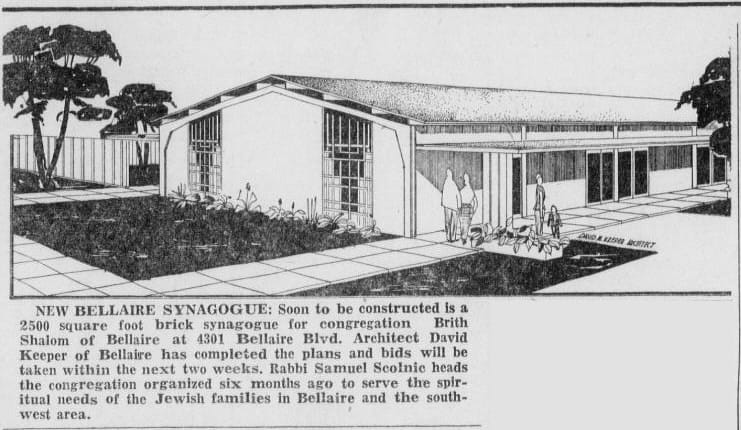
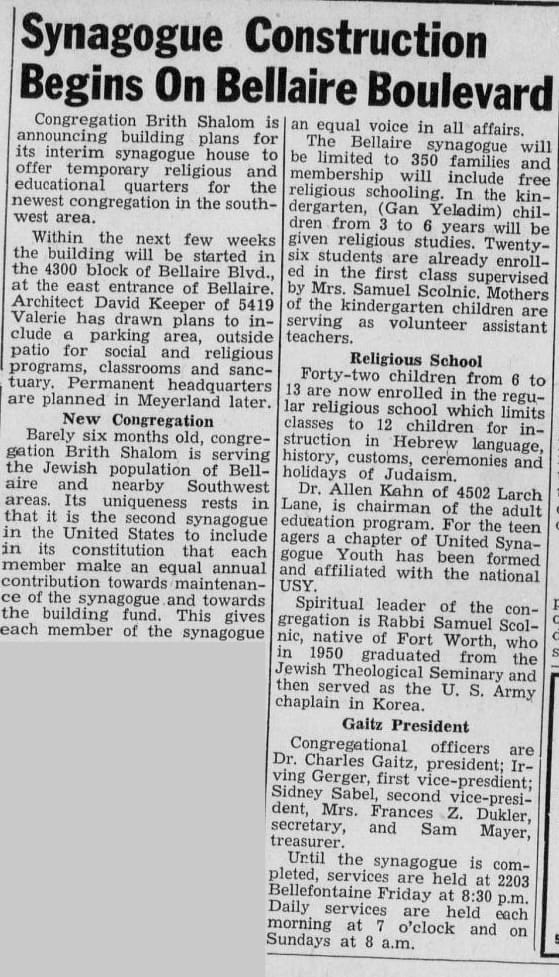
Rabbi Harry Z. Sky and the Moral Argument
In 1956, a rabbi named Harry Z. Sky took the pulpit at Congregation Brith Shalom.
He had arrived in Bellaire on a day when, he later wrote, the papers were announcing that oil had been found in the municipal dump. Sudden, unearned wealth. A debate broke out almost immediately: should this windfall change the community's tax obligations? Should this luck be shared? He described two factions: "refugees from New York" who argued for equal communal obligation, and oil-country "nouveau riche" who resisted redistribution. The oil-in-the-dump story is almost too perfect as a metaphor for Bellaire itself—wealth discovered beneath ordinary ground, and then the immediate question of who it belongs to and what it obligates.
His description of the synagogue at the time is worth including in full:
"Our synagogue consisted of a small shack-like building. A pre-school group met there. The daily minyan (prayer quorum) was the leadership's preoccupation. Little effort was put into Shabbat or holiday programming. Somehow, the High Holidays—Rosh Hashanah and Yom Kippur—re-kindled whatever smoldering piety that lay dormant in these people's souls. They had a High Holiday choir. Sometimes there would be a minyan, at other times, not."
This is a community that has just moved somewhere new and is still deciding what it's going to be.
Rabbi Sky was born in 1924 in northern New Jersey, the son of immigrants. His father had come from Latvia at age thirty. His mother had come from Russia at twelve. They spoke to him in Yiddish at home. He was a child of the immigrant Jewish experience—the people who had crossed an ocean to escape persecution and arrived in a country that was not entirely sure it wanted them either. He was also the 32nd consecutive generation of his family to be ordained as a rabbi.
He arrived at a specific historical moment. The Supreme Court's Brown v. Board of Education decision had come down in 1954, and the entire white South was in various stages of losing its mind about it. To understand why Rabbi Sky's columns mattered, you need to understand what Brown actually did and didn't do.
Brown declared segregated public schools unconstitutional—a ruling that overturned the 1896 Plessy v. Ferguson doctrine of "separate but equal" that had governed American race law for nearly sixty years. It was a landmark. It was also, in practice, a starting gun for resistance. The follow-up ruling in 1955 ordered desegregation with "all deliberate speed"—a phrase that Southern states interpreted as permission to delay indefinitely. What followed was a decade of bureaucratic obstruction, legal maneuvering, administrative foot-dragging, and in some cases outright violence, all packaged under the language of "law and order" and "states' rights." In 1956, 101 Southern congressmen signed the "Southern Manifesto," declaring Brown an abuse of judicial power and pledging to resist it by all lawful means. In 1957, federal troops had to escort nine Black students into Central High School in Little Rock, Arkansas, while a mob screamed outside.
Bellaire’s segregation was quieter than Little Rock’s. Bellaire High School was part of Houston Independent School District, which did not immediately desegregate after Brown. But the more fundamental point is that Bellaire barely needed to worry about school desegregation because it had already solved the problem in advance—through the careful maintenance of a demographic that made integration a theoretical concern rather than a practical one. You can have an integrated school policy in a city that is 99% white and it costs you nothing.
When Bellaire residents were asked directly in a 1960 referendum on desegregation within HISD, they answered clearly: in every single Bellaire precinct, roughly two thirds voted against integration. The quiet suburb had a clear opinion. It just preferred not to say it out loud.
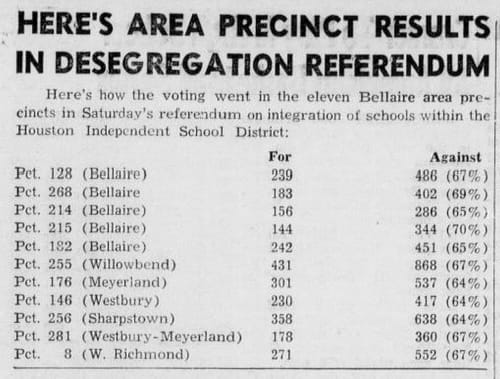
Into this context, Rabbi Harry Z. Sky began writing a regular column for the local newspaper, The Bellaire Texan. Not everyone in his community was pleased.
As he recalled later in his life: "There were people who said to me that I shouldn't write in the paper. Their parents had always taught them that we Jews should not be seen and heard. It is safer for us if we are not."
The American Jewish experience at that time had taught that visibility invites backlash. Keep your head down. Don't agitate. Don't give them a reason. It was the same instinct that had guided Jewish survival in Europe for centuries, and it had followed Jewish families across the ocean and into the Houston suburbs. Rabbi Sky disagreed.
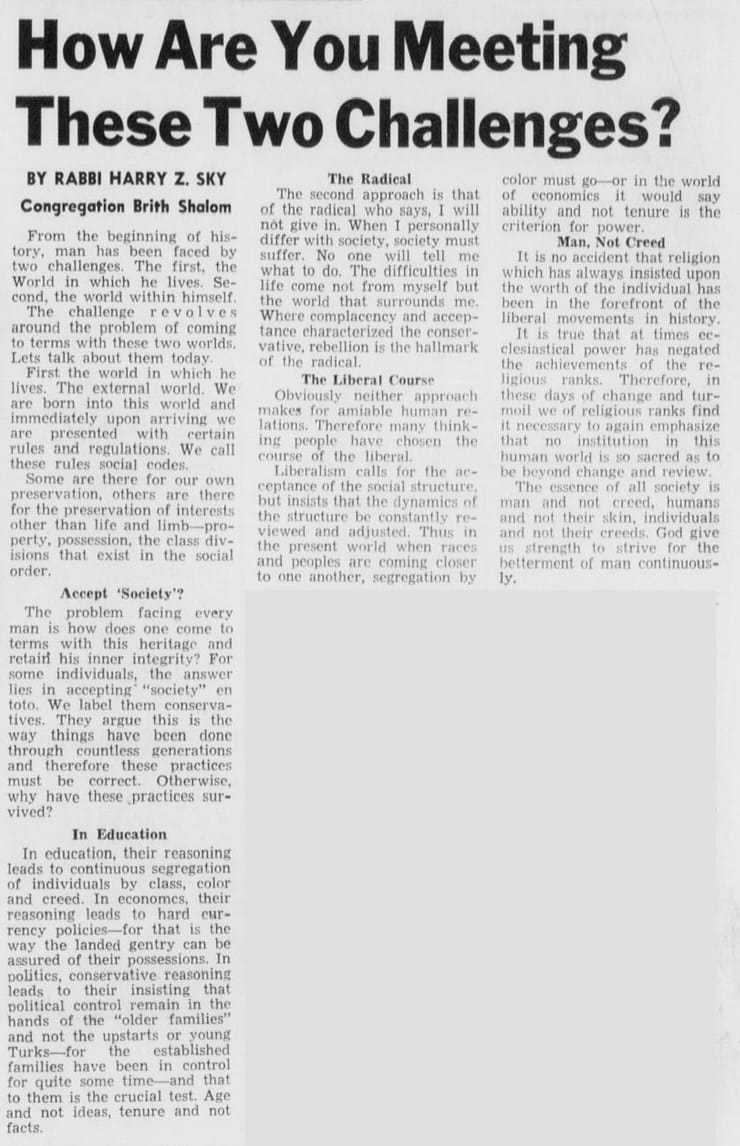
In May 1957, he wrote a column titled "How Are You Meeting These Two Challenges?" that laid out his framework for thinking about the moral challenges facing his congregation. He described two forces pulling at every person: the social codes and rules we inherit, and the inner life we are responsible for developing. He rejected the conservative approach of accepting the social structure as given and rejected the purely radical approach as well. What he argued for was something harder: constant examination, refusing to let comfort become an excuse for moral passivity.
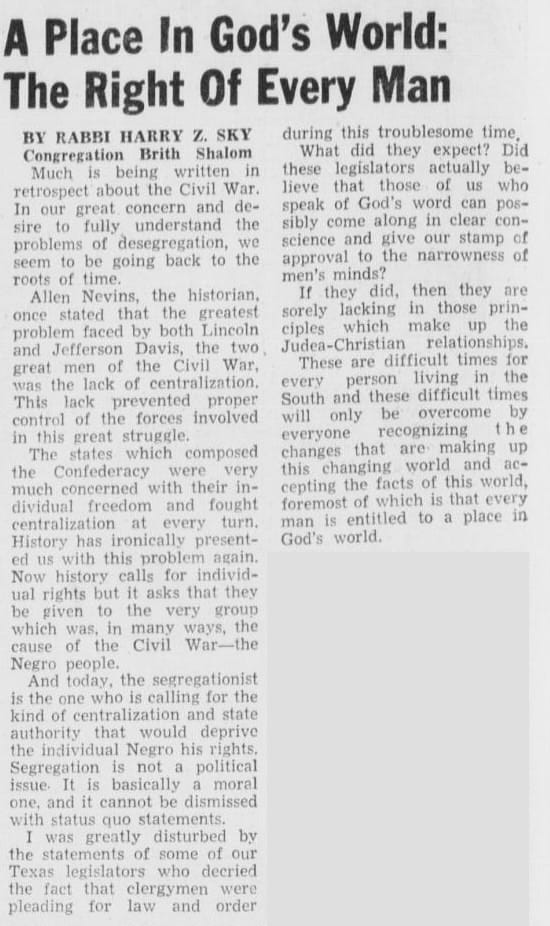
Six months later, he made the argument explicit. In a column titled "A Place in God's World: The Right of Every Man," he wrote that Negro segregation was "not a political issue" but "basically a moral one." He rejected the "law and order" framing that segregationists used to launder their position. He invoked the Civil War, the moral failure of Reconstruction, the history of a nation that had repeatedly deferred its founding promise. He was disturbed, he wrote, by Texas legislators who hid behind calls for law and order while pleading for the status quo. Segregation, he insisted, could not be dismissed as tradition. It was a failure of theology, democracy, and basic human recognition.
He was writing this in a local suburban newspaper to an audience of upper class, mostly non-Jewish families who mostly supported seggregation. Three years before the Greensboro sit-ins. Seven years before the Civil Rights Act.
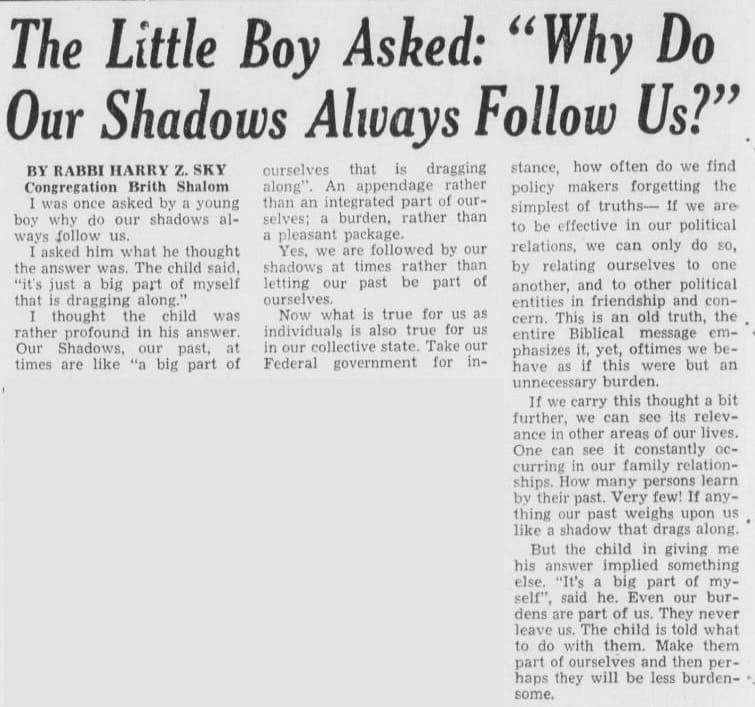
By May 1958, he was writing about the weight of the past itself. The column began with a young boy who asked his father why shadows always follow us. Rabbi Sky used the question to argue that communities, like people, are followed by their histories whether they acknowledge them or not. The shadow of segregation, of inherited inequality, of collective moral failure—these don't disappear when you move to a nice suburb. They follow you there. He connected it directly to the way federal power and individual rights were being debated in the context of integration and to the tendency of comfortable people to treat their past as someone else's problem.
Rabbi Sky saw that transition happening in real time, and he understood it historically. In a 1977 interview, years after leaving Bellaire, he reflected on the generational shift he had witnessed in the American Jewish community:
"Something is evolving. It hasn't even come to the surface yet, but there is something evolving. You now have people who were born in this country. Their parents were born in this country. Some of them have even intermarried and have opted to be Jews and the spouses converted in order to keep the Jewish home, and they are really searching for themselves and for their kids. This has had an impact on the community."
What he was describing was the move from immigrant survival mode to native belonging. The first generation keeps its head down and builds the synagogue. The next generations ask what the synagogue is for, what it owes, what it means to belong somewhere rather than simply to survive in it. Rabbi Sky was pressing that question on a community that had barely finished building the building.
His tenure at Brith Shalom ended in 1959 under the weight of two things that, in that era, could not comfortably coexist in Bellaire: a rabbi who said what he believed about race, and a rabbi whose private life had become controversial.
While training in hospital chaplaincy, Sky had confided to a Baptist instructor something that, in 1950s America, was treated as disqualifying: that as a young man at Yeshiva University and the Jewish Theological Seminary, he had experienced what he called "fleeting, and later realized quite common and normal, homoerotic encounters." The Baptist instructor moved for his expulsion. The rest of the faculty offered to help him on the condition that he enter therapy. He did—first with a psychiatrist he found deeply ineffective, then with a group therapy program that he described in vivid, painful detail in his memoirs. The experience was destabilizing and he eventually left the program. He resigned from his position that same year. He recorded it simply: "Politics being what they are, my contract at the synagogue wasn't renewed."
What makes Sky's story worth telling is its arc. After Bellaire, he kept going. In 1965, he marched with Dr. Martin Luther King Jr. in Selma, Alabama. Later in life, he would become a vocal advocate for LGBTQ rights. He was not ahead of his time in the heroic sense. He was just honest about things that his moment punished people for being honest about.
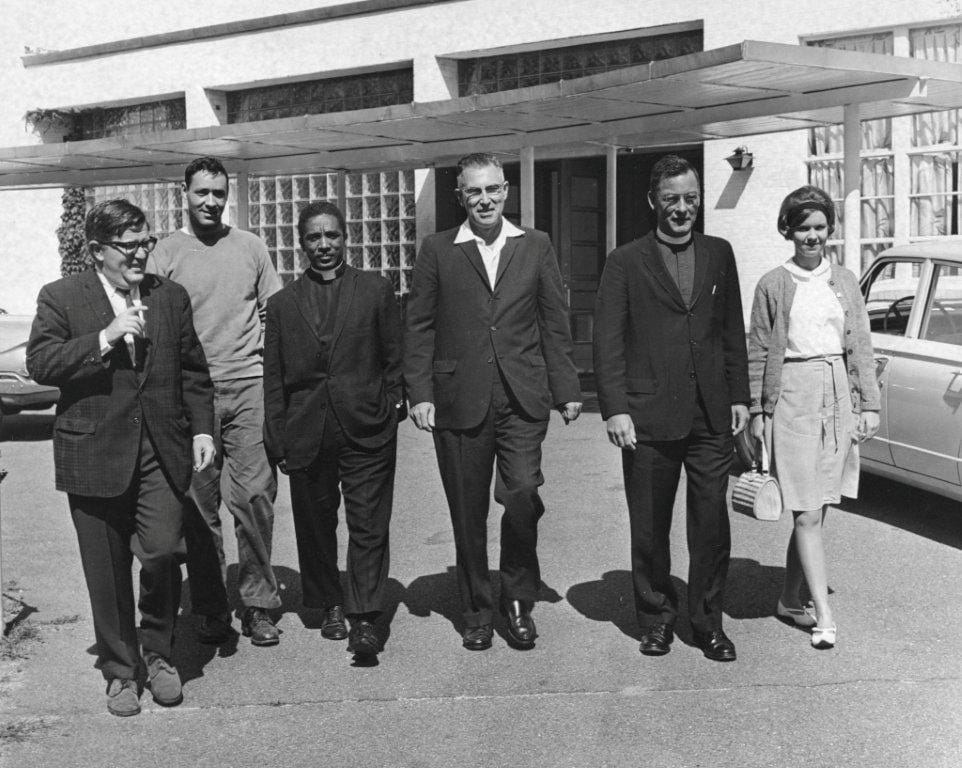
The arc of Bellaire itself tells a similar story, though a slower one. After Rabbi Sky left, the battles over integration continued. Bellaire High School eventually desegregated as part of HISD’s gradual, court-pressured process.
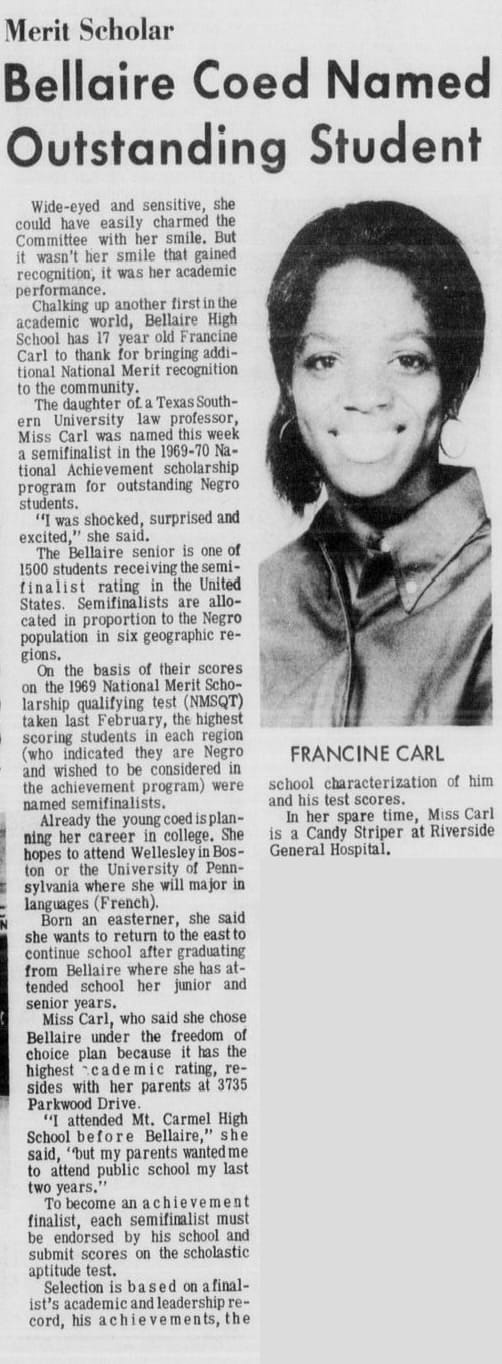
In 1969, a Bellaire senior named Francine Carl became one of 1,500 students nationwide to reach semifinalist ranking in the National Merit Scholarship program. She was also named a National Achievement semifinalist, a program recognizing outstanding Black students. Carl was seventeen years old and planning to study law.
She had accomplished this at the same school that two thirds of Bellaire’s voters had tried to keep segregated just nine years earlier. The Bellaire & Southwestern Texan put her on the front page. The city that had voted against her presence was now printing her picture. But as we will see, while the schools integrated, the zip code did not.
The postwar Jewish story in Bellaire is a story about a minority group that learned how to enter the system of American affluence and used it. Jewish Houstonians had faced exclusion and then, with the opening of the suburbs, moved into the same areas that had excluded them and became part of their structure.
What made Rabbi Sky exceptional was that he refused to let arrival be the end of the story. He understood that the question isn't whether a minority group can make it. The question is how to use your newfound privilege towards the pursuit of justice. He challenged his congregation and community to realize that the arrangement they were benefiting from was morally indefensible. Then he marched to prove he meant it.
He represents the moral seriousness that is available to any community that has climbed far enough to have a choice. The Jewish community in Bellaire had that choice in the 1950s and chose the side of civil rights.
As more Muslims move into these same arrangements we should learn from the example of those before us and ask ourselves—what will be our choice?
Part Three: The Situation Today
The Wealth Gap, or Why "Safe" Isn't Accidental
Fast forward to today and the data shows us why there are no Black people in the park.
Start with income. In 1967, the median Black family earned about 58 cents for every dollar earned by the median white family. In 2024, that number was 64 cents. Fifty-seven years later and the income gap has barely moved.
| Year | White | Black | Ratio |
|---|---|---|---|
| 1967 | $57,230 | $33,230 | 58.1% |
| 1977 | $63,010 | $37,180 | 59.0% |
| 1987 | $68,120 | $38,880 | 57.1% |
| 1997 | $71,320 | $45,840 | 64.3% |
| 2007 | $73,000 | $46,100 | 63.2% |
| 2017 | $81,340 | $50,170 | 61.7% |
| 2024 | $88,010 | $56,290 | 64.0% |
That income gap is terrible, but it is at least comprehensible. It reflects ongoing discrimination in hiring, occupational segregation, and unequal school funding. It is a number that could, in theory, narrow with the right policies.
The wealth picture is different in kind.
In 1992, the median Black family held about 14 cents of wealth for every dollar held by the median white family. In 2022, thirty years later, that number is 15 cents. It has barely moved. In between, it actually got worse—falling as low as 9 cents on the dollar in the aftermath of the Global Financial Crisis and associated housing crash. Thirty years of economic growth, two bull markets, and the longest peacetime expansion in American history, and Black wealth went from 14 cents to 15 cents.
Median Black-to-White Wealth (Net Worth) Ratio (2022 dollars)
| Year | White | Black | Ratio |
|---|---|---|---|
| 1989 | $166,420 | $9,910 | 6.0% |
| 1992 | $144,420 | $20,510 | 14.2% |
| 1995 | $148,640 | $21,130 | 14.2% |
| 1998 | $175,000 | $28,260 | 16.2% |
| 2001 | $205,740 | $32,310 | 15.7% |
| 2004 | $221,500 | $32,050 | 14.5% |
| 2007 | $245,450 | $30,050 | 12.2% |
| 2010 | $177,210 | $21,720 | 12.3% |
| 2013 | $180,620 | $16,650 | 9.2% |
| 2016 | $210,910 | $21,150 | 10.0% |
| 2019 | $219,210 | $27,940 | 12.8% |
| 2022 | $284,310 | $44,100 | 15.5% |
The reason the wealth gap is so much larger and more resistant to change than the income gap is compounding. Income is what you earn this year. Wealth is what you have accumulated over time, plus what was handed to you, plus what was handed to the people who handed it to you. The median white family in 1950 held roughly seven times the wealth of the median Black family—and that advantage has had seventy-five years to compound, to be invested in stocks that appreciated faster than housing, to be passed through inheritances, and to anchor the next generation's down payment. You cannot close a gap like that by earning a good salary.
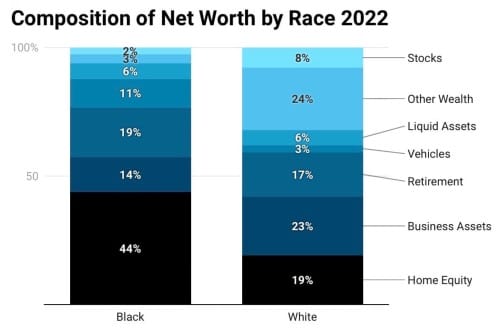
The composition of that wealth matters too. Black families hold roughly 43% of their wealth in home equity. By contrast, white families hold only 19% in home equity—the rest is spread across stocks, business assets, and other investments. When the 2008 financial crisis hit, Black families lost a disproportionately catastrophic share of everything they had, because what they had was mostly in housing. White families, holding more stock-based wealth, bounced back faster when the market recovered. One crisis. Two completely different experiences of it.
This is the background against which Bellaire exists.
Houston vs. Bellaire: The Inequality Contrast
| Metric (2024-2026 Est.) | Houston (City) | Bellaire (City) |
|---|---|---|
| Median Household Income | $64,813 | $244,015 |
| Poverty Rate | 14.4% | 2.4% |
| Median Home Value | $277,800 | $1,037,500 |
| Owner-Occupied Rate | 42.8% | 87.9% |
| Black Population % | 22.6% | 1.6% |
The numbers are stark even without a table. Bellaire's median household income is more than $244,000 while Houston’s is around $65,000. Bellaire's median home value is over a million dollars while Houston's is $277,800. Nearly 90% of Bellaire residents own their homes, meaning they are capturing the compounding capital gains of the real estate market. In the city of Houston, more than half of residents rent—meaning their rising housing costs are building someone else's wealth, not their own. And remember, Bellaire's Black population is 1.6%. Houston's is 22.6%.
These numbers don't describe discrimination. They its outcome—discrimination that happened before most of Bellaire's current residents were born, whose effects have been compounding ever since. The people like me who are moving to Bellaire today didn’t do the thing. We inherited the thing. We bought into it. We are now the stewards of the thing.
Who I Am in This Story
My parents came from somewhere else. They were professionals—engineers, in the case of my father—who arrived in the United States with education and ambition and, eventually, with the kind of income that makes Austin suburbs accessible. I grew up in a majority-minority environment that had effectively reproduced the demographics of segregation through the mechanisms of school quality and housing prices rather than through explicit exclusion. My story is not unusual. It is, increasingly, the Muslim American story.
My wife is a surgeon. I am home with our child. This is the contemporary professional-class Muslim American family: second-generation, highly educated, economically comfortable in ways our grandparents could not have predicted. We are not an anomaly inside our community—we are its leading edge. America, for people who look like us and have the right credentials, is a place that mostly works. We are, by most metrics, exactly the success story that the American dream was designed to produce. And we are arriving, in growing numbers, in neighborhoods exactly like this one.
The geographic pattern of Muslim settlement reflects this. Affluent Muslim communities have clustered in the same kinds of places affluent communities always cluster: Northern Virginia, central New Jersey, Chicago's north shore, Dearborn, the Irvine and Fremont corridors in California, Richardson near Dallas.
In Houston, the Muslim migration has a near-literal geographical overlap with the Jewish migration of seventy years earlier. Both communities made the same southwest shift: from dense urban neighborhoods near downtown, outward through Meyerland and Fondren, and eventually into the affluent suburbs of Sugar Land and Fort Bend County. Both movements were anchored by the same institution: the Texas Medical Center. Jewish doctors in the 1950s wanted quality housing within fifteen minutes of the hospital. Muslim physicians today follow the same commuter line. If you pull up the physician directories at the Medical Center, the generational shift is visible in the names.
Bellaire sits at the end of that timeline for both communities. What was a gateway suburb for mid-century Jewish families moving out of the city has become, in the last decade, a landing point for second-generation Muslims moving back toward it—close enough to the Medical Center, prestigious enough to signal arrival, suburban enough for the schools and the sidewalks.
We are, as a whole, not poor. We are not marginal. We are, increasingly, exactly the kind of high-income, high-education, minority group that gets invited into the spatial arrangement of American affluence.
However, the community is not one thing. It never was.
Roughly 24% of Muslim households now earn over $100,000 annually—on par with the national average. But that headline number conceals a starker internal reality. While 44% of white Muslims and 34% of Asian Muslims earn more than $100,000, only 7% of Black Muslims do. The Muslim community in America is just as racially divided as the rest of the country.
Divisions of wealth and status, and a lack of social mixing prevail among different Muslim ethnicities in America. This is particularly pronounced between high-income, Arab-South Asian-American Muslim populations, and the lower-income "indigenous" Muslim populations, composed primarily of Black Americans.
Black American Muslims—whose history in this country includes enslaved people, Malcolm X, W.D. Mohammed, and decades of community-building in some of the most underserved urban neighborhoods in America—share a faith with the Pakistani doctor moving to Bellaire and the Egyptian entrepreneur in Sugar Land. We read the same Qur’an but live in very different zip codes.
The professional immigrant Muslim moving to an affluent suburb is not doing something wrong. He is finding safety and good schools and a park with nice sidewalks. But the structure he is moving into was built on the exclusion of people who share his faith and some of whom attend his mosque.
This is the paradox. The Jewish version of this paradox was Rabbi Sky's burden in 1957. The Muslim version of this paradox is mine today.
What We Owe
I want to be honest about what the choice actually looks like, because the way I've seen it discussed in Muslim community spaces tends to make it sound like a dilemma between two legitimate options. It isn't. One path is a default. The other is an obligation.
The default is comfortable and it is not shameful. You move to Bellaire, pay your taxes, send your kids to good schools, give your zakat to Islamic relief organizations that send money overseas, and live a life that is, by every visible measure, decent, religious, and successful. Most of us will take this path most of the time, myself included. I am not condemning it. I am saying it is not enough.
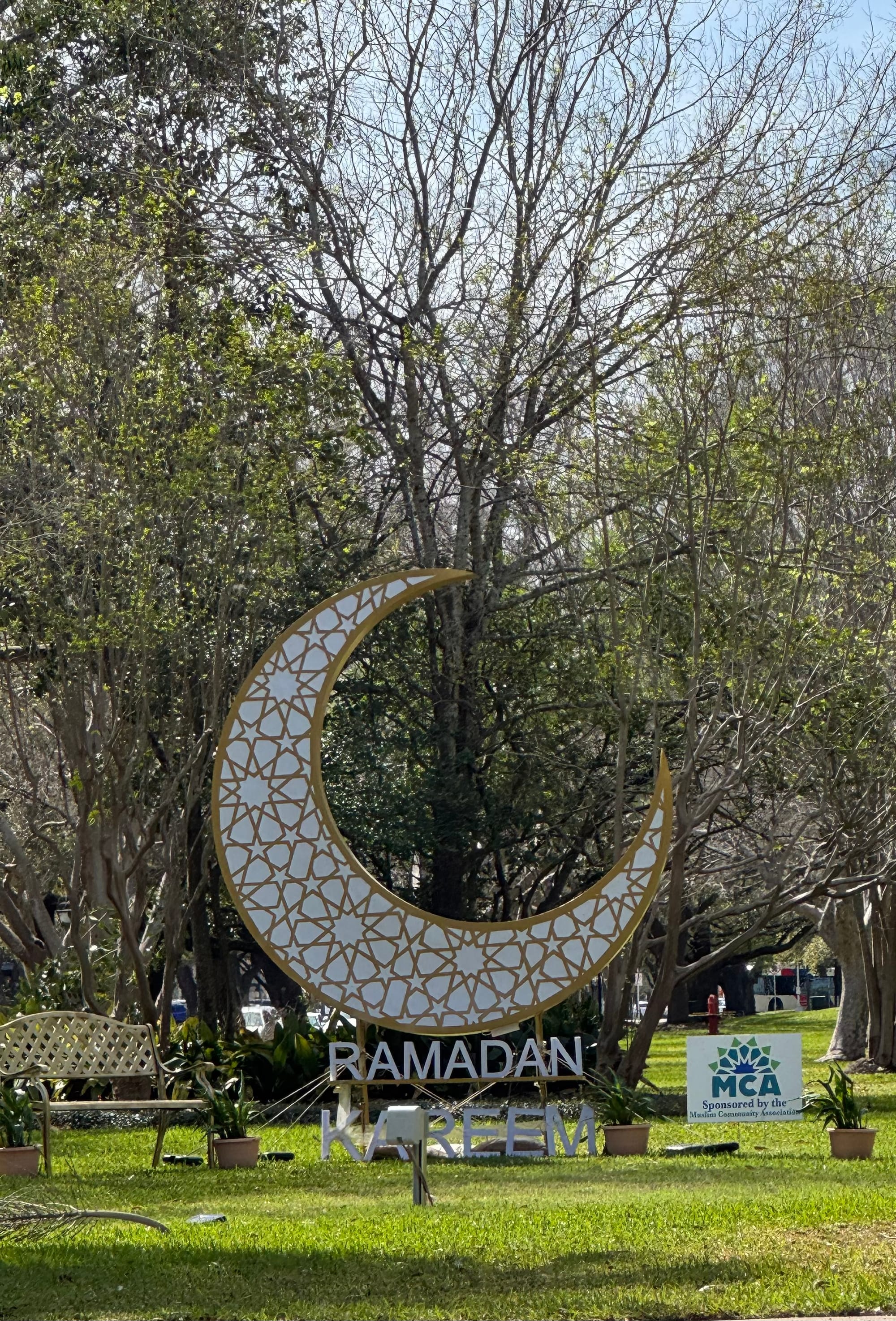
The obligation is harder to describe because it isn't a single dramatic act. It is about what you do with your presence in a place. It isn't running for city council or joining an activist organization, though it might include those things. It's more like a sustained orientation—a refusal to let the comfort of the suburb become the boundary of your moral imagination. It's asking what your mosque is doing for Houston's Black community, and not just doing disaster relief but doing the structural work: the housing fund, the legal clinic, the relationship with the school district, the willingness to show up in rooms that are not comfortable and not prestigious. It's being the version of Rabbi Sky who writes the column even when no one asked you to, even when it costs you something.
The Muslim tradition is not neutral on this question. The concept of justice is one of the pillars of Islamic ethics. The obligation to the poor and marginalized is woven into the fabric of Islam in ways that make pure insularity not just politically problematic but theologically untenable. We are not supposed to build a fortress and call it a community.
Yet, the mosque in the affluent suburb tends to look a lot like the church in the affluent suburb: beautiful, well-funded, serving the people who are already comfortable. The speeches are about personal piety and family values and the importance of Islamic education and “halal” mortgages. The fundraising is for the new prayer hall. The school is for families who can afford the tuition. I have sat in these speeches and I always feel that something was missing—that the sermon and the geography and the zip code were all conspiring to produce a vision of Islam that is, in the most literal sense, segregated.
I want my son to know Black Houstonians not as background characters.
I want him to grow up understanding that the park we love is clean because of the property tax base, and the property tax base is what it is because of decisions made before he was born, and those decisions hurt people, and those people are still here, in the city that surrounds us on every side. I want him to have the scan—the automatic reflex to notice who is and isn't in the room—and I want him to understand what he's seeing when he uses it.
And I want him to understand that this experiential knowledge of marginalization, is not a weapon to deploy in our own defense as Muslims while ignoring what's happening to someone else. It is an obligation. It is the thing that should make us incapable of looking at the demographics of Bellaire and shrugging.
Part Four: What It Would Actually Mean
What would it mean for Muslim communities in places like Bellaire to fulfill the obligation?
It would mean, first of all, being honest about the stratification inside our own community. The gap between the Muslim doctor in Bellaire and the Black Muslim family in the Third Ward is not just about income. It is about the compounding of wealth and the compounding of disadvantage—the same dynamic I've been describing in racial terms, playing out inside our own community. A community that serves only the professional class is not a community. It is a club with a prayer ritual.
It would mean scholarship funds that are not only for elite universities. Transportation stipends for kids in underfunded public schools. Legal aid for families facing eviction. Security deposits. Emergency rent. Not just charity, but responsibility. A recognition that our stability exists partly because the same system produced their instability, and that the least we can do is refuse to look away from it.
It would mean cross-neighborhood civic commitments that go beyond interfaith dinners. It would mean showing up at HISD board meetings and the board meetings of our private schools. It would mean caring about city zoning decisions—and yes, Bellaire's political boundaries—in ways that go beyond protecting our own property values.
And it would mean political engagement, which is the part that makes many professional-class Muslims visibly uncomfortable. There is a strand of immigrant Muslim culture in America that treats political engagement as dangerous—a legacy of the countries our parents came from, where politics was something the powerful did to everyone else. I understand this instinct. I do not respect it. It is exactly the instinct that the comfortable always develop when they move somewhere nice. It is the instinct to make peace with the arrangement.
Rabbi Sky did not make that peace. He was in Bellaire for three years, in a small shack of a synagogue, and he wrote in a local newspaper that segregation was a moral issue and not a political one. He continued to do so for the rest of his life.
The question is what it cost him, and whether we are willing to pay that cost. Whether we will choose comfort over conscience.
The Scan, Again
We are moving to Bellaire. I have made my peace with the decision, which is not the same as having no questions about it.
The last time I walked through Evelyn's park it was my wife that was scanning. She was now the one noticing the effects of history on the places that we enjoy.
The scan is the refusal to pretend that race is not shaping the room I am standing in—my inheritance from a country that I love that has been having this argument since before I was born, and the correct response to an inheritance is not to throw it away. It is to understand what you received, and why, and what you're going to do with it.
I am a second-generation Muslim American moving into a neighborhood that was built, in part, on the systematic exclusion of Black Americans. I did not build it. I am not responsible for the minstrel shows or the deed restrictions or the HOLC maps. But I am going to live here. I am going to benefit from the park and the schools and the compounding property value. My son is going to grow up here and learn to love this place.
The least I can do is make sure he understands what it cost, and who paid for it, and that there is still a debt outstanding.