
With Friends Like These
When solidarity with the oppressed backfires.
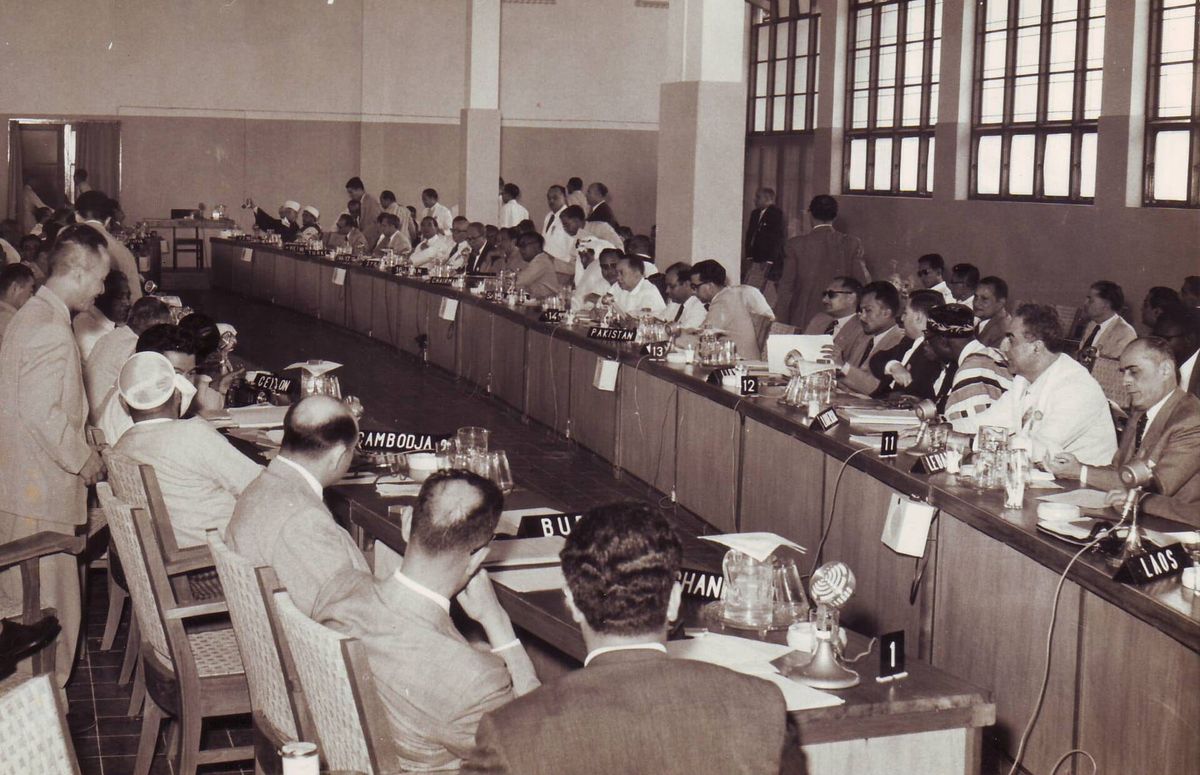
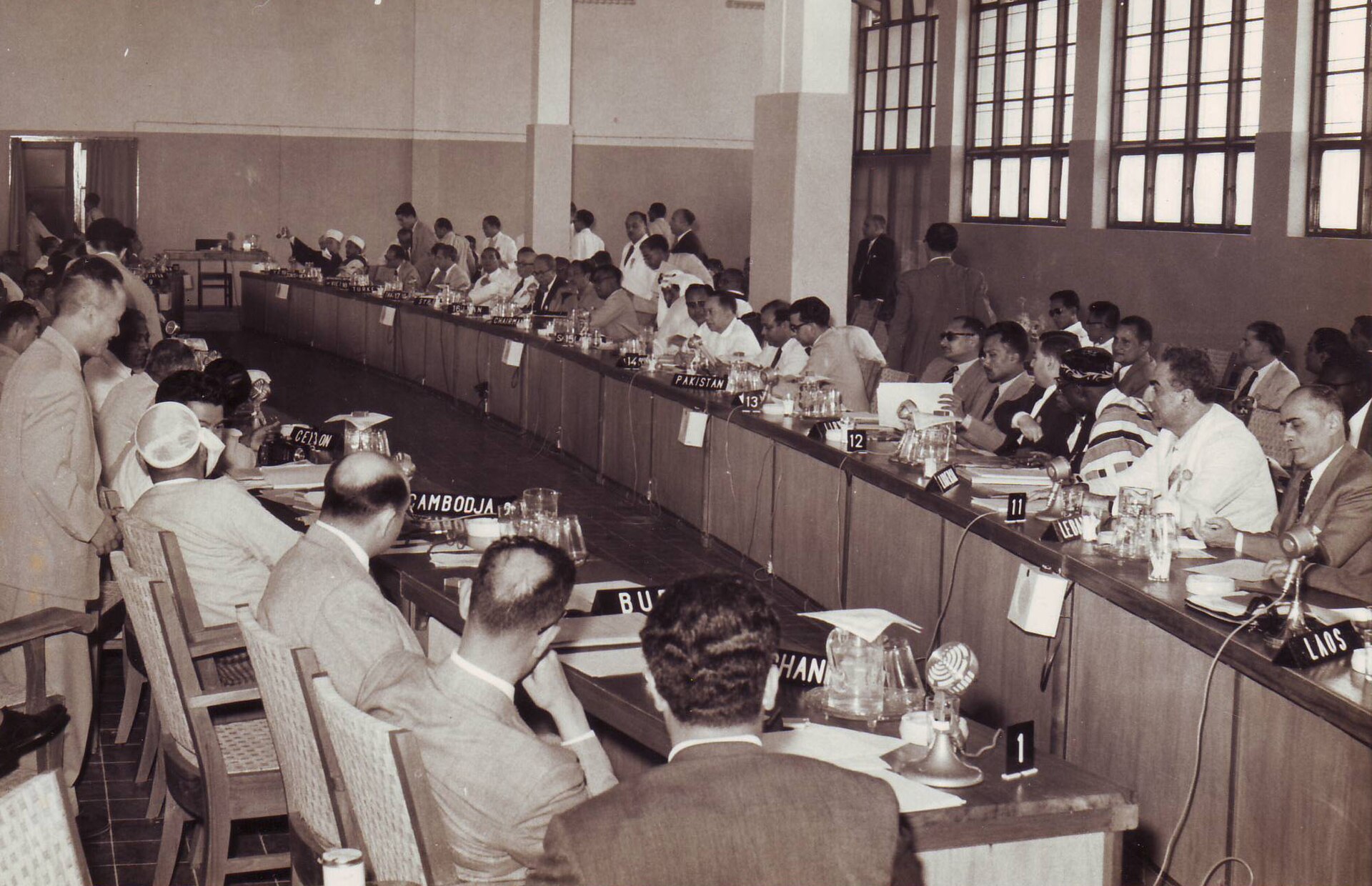
On Monday morning, April 18, 1955, crowds of people packed the streets of Bandung, Indonesia, cheering delegates from twenty-nine Asian and African countries, many in traditional national dress, as they walked inside the city’s newly renamed Freedom Building. Inside, beneath a sweeping arched ceiling and before a row of national flags, President Sukarno, wearing a military-style uniform and a traditional black peci cap, stood up to address a gathering unlike any the world had seen before. “Our nations and countries are colonies no more. Now we are free, sovereign and independent. We are again masters in our own house. We do not need to go to other continents to confer.”
What came to be known as the Bandung Conference was a who’s who of revolutionary leaders of the Global South at the time: India’s Jawaharlal Nehru, China’s Zhou Enlai, Egypt’s Gamal Abdel Nasser, and representatives from Japan, Pakistan, Iran, Saudi Arabia, and both North and South Vietnam. Their shared determination to shape a world long dominated by European empires transcended the vastly different political systems of their home countries. Here, communist China, democratic India, and Western-aligned Turkey sat together and munched on satay and sticky rice. Sukarno made no attempt to conceal their differences. “Practically every economic doctrine has its representative in this hall,” he observed, from socialism and capitalism to communism. But “what harm is in diversity, when there is unity in desire?” This was “not an Islam Conference, nor a Christian Conference, nor a Buddhist Conference,” nor was it a bloc seeking to oppose another bloc. Rather, it was a demonstration that countries could “live together, meet together, speak to each other, without losing one's individual identity.”
What united them was their experience of colonialism and their suspicion that their newfound independence would not be enough to escape its legacy. “Colonialism is not yet dead,” Sukarno warned. It has “its modern dress, in the form of economic control, intellectual control, actual physical control by a small but alien community within a nation.” The newly independent nations faced similar problems of poverty and underdevelopment, and Sukarno believed they could learn from one another. He was under no illusion about their material weakness. Still, they represented more than half of humanity. “What can we do? We can do much!” the future tyrant declared, calling on the delegates to mobilize their collective moral and political strength for peace. “We can demonstrate to the minority of the world which lives on the other continents that we, the majority, are for peace, not for war.”
Over the following week, the delegates adopted the Ten Principles of Bandung, affirming national sovereignty, racial equality, peaceful coexistence, opposition to colonialism, and non-interference, including “abstention by any country from exerting pressures on other countries.” They also called for expanded trade, technical cooperation, and economic development in order to reduce their dependence on the industrial powers of the time. There wasn’t a binding economic or military alliance, but it gave voice to the ambition that Asia and Africa might collectively determine their own futures. Richard Wright, the Black American novelist and one of the few American attendees, wrote in his account, “The conference at Bandung was the first attempt in history on the part of man as man to organize himself… And he is not prepared to do so. He has been kept too long in ignorance and superstition and darkness. (But to use this as an excuse to keep him under tutelage longer will certainly not help matters.) But now, there he is, free and on the stage of history!” Six years later, that ambition would help give birth to the Non-Aligned Movement in Belgrade.
Political independence was only half the battle. Across Asia, Africa, and Latin America, the newly independent countries found themselves exporting cheap raw materials, like oil and copper, and importing expensive manufactured goods from their former colonizers. As the tent-pitching dictator Muammar Qaddafi liked to put it, “Why are Pepsi-Cola and Coca-Cola expensive? Because they have taken our kola, produced it, and sold it back to us. We should produce it ourselves and sell it to them.” The new countries might have their own flags and seats at the United Nations, but their place in the global economy hadn’t changed much. What they wanted was to industrialize, control their own natural resources, secure better prices for their raw goods, and get the same sort of access to financing and technology that made the rich world rich.
These demands led the Global South to develop institutions of their own. In 1964, seventy-seven developing countries came together at the first United Nations Conference on Trade and Development (UNCTAD) in Geneva, forming what became known as the Group of 77. By September 1973, at a meeting of Non-Aligned Movement leaders in Algiers, their complaints led to calls for a New International Economic Order — a new way to structure the world economy that would give developing countries more control of their own stuff. In May 1974, the United Nations General Assembly adopted a declaration calling for “THE ESTABLISHMENT OF A NEW INTERNATIONAL ECONOMIC ORDER based on equity, sovereign equality, interdependence, common interest and cooperation among all States, irrespective of their economic and social systems which shall correct inequalities and redress existing injustices, make it possible to eliminate the widening gap between the developed and the developing countries and ensure steadily accelerating economic and social development and peace and justice for present and future generations.” Noble goals, until they hit a wall.
About a month after the Algiers conference, on October 6, 1973, Egypt and Syria launched a surprise attack on Israel in an attempt to take back the land they had lost in the 1967 war. As the United States rushed to help Israel, Saudi Arabia and other Arab oil producers decided to put their newfound economic power to work. The Organization of Arab Petroleum Exporting Countries (OAPEC) announced production cuts and ultimately an outright embargo on the United States and other countries supporting Israel. The Arab oil ministers appealed to the world “to support the Arab nation in its struggle against imperialism and Israeli occupation.” They also stated their “readiness to supply the world with its oil needs as soon as the world shows its sympathy with us and denounces the aggression against us.” Meanwhile, the broader Organization of the Petroleum Exporting Countries (OPEC) started hiking up oil prices. In just four months, the price of oil nearly quadrupled. Saudi oil minister Ahmed Zaki Yamani was triumphant: “The moment has come. We are masters of our own commodity.”
The master’s plan caused panic not only in the United States, but across the whole world. It was especially bad for the poorer countries who thought they were signing up to a New International Economic Order. Oil was essential to their daily lives and development plans. Governments that imported it needed to find enough foreign currency to pay for it, while also trying to keep fuel and basic necessities affordable for their people. Suddenly, the bill was almost four times higher, with no extra money coming in. In Senegal, a contemporary assessment projected that the country’s increased petroleum bill would be more than a quarter of the entire national budget. Money that would have built schools, roads, and factories would instead go toward paying for imported fuel. Senegal was hardly alone. From India to Jamaica, oil-importing developing countries faced unsustainable pressure on their budgets and foreign exchange reserves. In response, some countries would cut their spending or imports; others would borrow heavily to keep their economies running. The result was a boatload of debt and a sputtering in development.
To their credit, the oil producers weren’t blind to the damage they were doing to their comrades. Several OPEC members started pouring billions of dollars into foreign aid and development assistance. Between 1974 and 1984, OPEC countries threw up twenty-two percent of the aid supplied by the world’s major donors. These small monarchies were quite generous for their size. In 1975, Kuwait gave the equivalent of seven percent of its national income, Saudi Arabia eight percent, and the United Arab Emirates twelve percent. These were hardly token gestures. They also tried to make their help more institutional and permanent. In 1975, the OPEC Fund for International Development opened up. Its first transaction was a loan to help Sudan pay its bills. Similar deals were done with Samoa, Sri Lanka, Guinea, Pakistan, and the Central African Republic. Unlike loans from institutions that demanded changes to domestic economic policy (cough, IMF, cough), the OPEC Fund prided itself on offering financing without those types of conditions. “We should leave the political issues to other organizations whose mandate is political reform and political rights,” the fund’s first director-general would say. By July 1983, it had approved 328 loans worth more than $1.8 billion across eighty-two countries. It was a real attempt to turn the South-South cooperation declarations into something real, even though the problem started South-on-South.
But all this money didn’t cut it. In 1973, developing countries spent about $9 billion importing oil. The following year, that bill jumped to $24 billion. For all their hoopla, OPEC countries only gave $3.5 billion in development aid. To fill the hole, countries had to borrow. The oil exporters parked their newfound wealth in Western banks, which then lent it to poorer countries desperate for cash, a process economists called petrodollar recycling. It worked for a while, but the debt piled up. Between 1973 and 1977, the foreign debt of one hundred developing countries rose by one hundred fifty percent. Then came another oil shock in 1979, followed by an era of sky-high interest rates that made those loans much harder to repay. By 1982, Mexico’s debt crisis helped trigger a wave of defaults, bailouts, and austerity across the developing world. The oil producers had shown that the Global South could challenge incumbent economic power, but left their oil-poor bedfellows bankrupt and running on fumes. By the 1980s, the New International Economic Order was basically dead.
On February 28, 2026, just a few hours after the U.S. and Israel launched a joint bombing campaign, the Islamic Revolutionary Guard Corps transmitted a warning directly to civilian ships over VHF maritime radio: “No ship is allowed to pass the Strait of Hormuz.” A few days later, on March 2, Brigadier General Ebrahim Jabbari made a more explicit declaration on Iranian state television: “The Strait is closed. If anyone tries to pass, the heroes of the Revolutionary Guard and the regular navy will set those ships ablaze.” On March 11, military spokesman Ebrahim Zolfaqari, with a picture of the assassinated Supreme Leader behind him, parroted the regime’s justification for the blockade: “We won't allow even one litre of oil to reach the U.S., Zionists and their partners.”
Bold talk, but there was a problem. The overwhelming majority of the oil and gas threading the Hormuz needle went to Asia, — China, India, Japan, South Korea — countries that had nothing to do with Trump’s mess. Qatar, a country with supposedly cordial relations with Iran, found that it couldn’t get its liquefied natural gas out. On top of that, almost a third of the world’s fertilizer and raw materials passed through the Gulf, with countries like India getting most of their fertilizer products from the now-closed pass.
Bangladesh, home to one hundred seventy-five million people who had nothing to do with the war, started rationing fuel and shutting down most of its fertilizer factories to conserve energy. Across Africa, farmers in Kenya, Tanzania, Somalia, and Sudan faced rising fertilizer prices just as they were getting ready for planting season. We like to think of the Gulf saga as an oil war, but the people most affected were trying to grow some food. Even halfway around the world in Brazil, farmers faced disruptions to the fertilizer supplies feeding the country’s agricultural powerhouse. We focus on gas prices, but for most of the world, higher food prices would bite harder.
When Iran said “you shall not pass,” they thought they were Gandalf protecting the Fellowship. Instead, they were starving the hobbits. By October 2026, the oil market was in a bad-but-not-terrible state. Thank you Chinese import reductions and alternative routes to get oil out. Meanwhile, four of Bangladesh’s five urea factories were still out of service, and the government was scrambling to get fertilizer from other places ahead of the winter growing season. Growers were turning to countries like Russia, Malaysia, Egypt, China, and Vietnam to get what they could. The UN warned that the damage could extend into 2027 because fertilizer has to be used at the right point in the growing season, not made up for later.
History rhymes. When the Arab producers tried to punish the U.S. for supporting Israel, they screwed over the developing countries that had supported their cause. More than fifty years later, Iran was once again trying to make the world’s dependence on the Persian Gulf an economic weapon, with countries that had nothing to do with the war again bending over and taking it. There is an important difference, though. The Arab producers of 1973 withheld their own oil from the market. One could say it was theirs to do with as they pleased. Iran, however, was threatening everyone else’s right to move their own stuff. Nor was Tehran solely responsible for the economic brutalization of its comrades. American and Israeli strikes started the war, and the U.S. itself was adding to the disruption by blockading Iranian ports. But the old contradiction remains. You try to punish your enemies and end up shafting your friends.
Honey badger don’t care. There is no Iranian equivalent of the OPEC Fund that can serve as a token show of solidarity, however futile. They are going broke themselves. But Tehran hasn’t given up on its solidarity line. Speaking at a BRICS summit in India that September, President Masoud Pezeshkian urged the organization to transform the scattered resources of the Global South into a common strength. He even offered Iran's energy and transit infrastructure — the stuff that’s blocked — as a means of promoting cooperation. By October, the UN was still begging Iran and the U.S. to allow just five fertilizer ships a day to pass.
It wasn’t just Hormuz, though. Just a week into the war, Pezeshkian went on TV to talk to the folks across the puddle: “I personally apologize to neighboring countries that were attacked by Iran.” He called them brothers and promised that his country would stop hitting them unless Iran was hit from their territory. Iran was a hot mess. Other Iranian leaders in its then-bickering cabal insisted that American military facilities in those countries remained legitimate targets. Fireworks kept lighting up the skies of the formerly “stable” Gulf countries.
There is, of course, a strategic argument for all this. The Iranian regime was fighting for its survival against two superior powers. It couldn’t win a conventional war, but maybe holding the world economy hostage would force the orange man to negotiate. Fair enough. But at what cost? Speaking in India in September, Pezeshkian claimed “Iran will never trample on the rights of the oppressed; rather, it will always be a supporter and ally of the oppressed.” The oppressed farmers paying more for fertilizer may have appreciated less support. By October, the Financial Times was warning of a possible global food shock: nearly a third of the world’s traded urea and half its sulfur normally passed through Hormuz, and fertilizer shortages, compounded by potentially severe droughts and floods, threatened harvests in 2027. My country doesn’t get a free pass. As I wrote before, we started this, and I am duly disappointed. A just strategy should consider not just how much pain it inflicts on an enemy, but who else is made to suffer in the process.
There is another way for developing countries to exercise power. Instead of holding everyone hostage, they could become indispensable to keeping everyone running. In Capitalism: A Global History, Sven Beckert describes how China’s gradual, state-controlled turn toward markets connected its workers and industry to the world. Made in China became a huge deal. The Communist Party tolerated quite a lot of buying and selling without handing over the keys to the Forbidden City. The results were epic. A 2022 World Bank report estimated that over four decades, almost eight hundred million people moved out of extreme poverty.
Those gains changed the world’s economic hierarchy. Between 1990 and 2019, the global Gini index, where a lower number means less inequality, fell from seventy to sixty-two. Much of that improvement came from populous Asian countries, especially China, catching up with the richer world. Some of what the delegates at Bandung wanted was actually happening. People in formerly impoverished countries were gaining the means to make a better life for themselves. Sure, it wasn't, and isn't, perfect. But liberals like me should celebrate the gains while recognizing how much more needs to be done on education, retraining, and transition support for those who lost out.
People think the world is unfair. Iran and the Arab oil producers before it claimed to be fighting an inherently unjust economic order dominated by former colonizers. The evil West. Income inequality. The paradox is that inequality is falling worldwide even as it rises when we look at specific countries. In 1980, the richest ten percent of the world earned about fifty-three times more than the poorest half. By 2020, that gap had narrowed to thirty-eight times. Of course, the world is still unequal, but poorer countries, especially in Asia, are finally beginning to catch up with richer ones. What remains is how we draw the line. Are we responsible for our own country’s development, or the whole world? Or both at different levels? What counts as success and solidarity? I can’t answer for everyone, but it is interesting to think about how little railing against the Great Satan or the Little Satan — which, since 1973, went on to become one of the richest countries in the world — has contributed to world development.
Speaking at Bandung, Prime Minister Jawaharlal Nehru of India criticized those who define themselves in purely negative terms: “I am a positive person, not an 'anti' person,” the meeting’s joint organizer said. “I want positive good for my country and the world... Has it come to this, that the leaders of thought who have given religions and all kinds of things to the world have to tag on to this kind of group or that and be hangers-on of this party or the other carrying out their wishes and occasionally giving an idea?” Seventy years on, that still rings true. If you claim to stand with the oppressed, you should care about whether they can afford to eat.