The First Frame
Reconstructing a week in October.
Note: I have anonymized the individuals and institutions in this essay.
The message came in sometime in the afternoon. We had spent the morning at the zoo with my wife’s family. After the zoo we returned home so that people could take their midday naps before going to one of those arcade-and-bowling places in the evening. I checked my phone somewhere in the middle of all this. On the WhatsApp group I was in with my seminary classmates, a student had written, Guys there’s a war going on in Gaza rn. I opened CNN and then The Times of Israel. They quoted Netanyahu saying “We are at war.” I told my wife about it before her nap. She said “that’s horrible.” We didn’t talk about it any further that day.
I’d been off social media for years. Still am — it’s bad for you. I wasn’t reading the major business and policy papers either, which I had dropped sometime in the fall of 2022 when I started memorizing the Qur’an full time. I was somewhere between Surat al-Muʾminūn and Sūrat an-Nūr that week. During the two and a half years I spent memorizing, my information about the world arrived primarily through two channels — that seminary WhatsApp chat, and YouTube lectures from a handful of Muslim scholars I trusted. The day before, on Friday morning, I had typed into the seminary chat, unprompted: may Allah bless the students and teachers of [our seminary]. No specific reason. Just feeling extra grateful. Three people reacted with hearts and prayer hands and three replied āmīn.
This essay is not about what happened on October 7. It is about how news of that day reached me, and what I did with it over the next week, ending on the Saturday I stood downtown holding a sign that read stop the Palestinian holocaust.
Two and a half years earlier, in May 2021, I had gone to a Palestine rally while we were sort of living in Washington, D.C. I went because my wife wanted to go. I didn't know much about what had triggered that round of fighting, and I didn't care that much either. I stood in the crowd, I said some chants for about an hour, and we left to get dinner. If anyone had asked me afterward what I thought about the situation, I would have said something about how it was a hard problem and I didn't know enough.
But I was still reading the news at that time. The Financial Times every morning, The Economist every week. I'd put both in my dating profile on the app where I met my wife. I don’t think she understood the full extent of my relationship with those sources until later. After the May fighting, The Economist ran a cover I remember: “Two states or one?” The briefing inside argued that the land-for-peace framework was finished, that some Israelis and Palestinians were beginning to talk about a confederation, that the alternatives to a two-state solution were hard but no longer harder than the status quo. One sentence stayed with me: “The problem with the peace process is not a lack of process; it is that process has become a substitute for peace.” That was the kind of sober, unsentimental sentence I liked back then.
I shared The Economist article with my wife along with another piece from the Financial Times about Instagram quietly throttling Palestinian content during the May fighting. Then I went back to whatever else I was reading.
Sometime in the fall of 2022, I stopped both subscriptions. Memorizing the Qur'an takes so much time that I had no hours left over for the news. I was temporarily exchanging something worldly for something eternal, and this sort of trade has been understood by Muslims for a long time. I felt good about it.
What I didn't notice was that I had also traded one set of voices for another. The English-language news voices simply stopped being in my day. The voices of my Islamic teachers, the tafsīr lectures I listened to, the seminary's WhatsApp chat — those filled the space. For about a year before October 7, my understanding of public events came mostly through people whose authority in my life came from Islamic studies — not from reporting.
The seminary chat that Saturday morning had been pretty normal. Someone had announced that they were leaving their post as religious director at their mosque and was open to leads. Someone replied, may Allah make it easy for you. Four reactions. There was another thread about a community discussion on how to streamline funeral arrangements for families.
Then, at 12:21 in the afternoon, Houston time, the message about Gaza. The replies came quickly. Someone asked if anyone had family there. Someone said yes — that their cousin and her family had evacuated their house in Gaza and then been allowed to return. Subḥān Allāh hasn't happened since 1948 — that the battle has been brought that close. The early reaction was shock of the familiar soft. Allāhu akbar. Alḥamdulillāh for the person’s family. Prayers for protection.
Within ninety minutes the mood shifted. What is more important is the number of Israelis that they have captured alhamdulilah. Can exchange a lot of Palestinian prisoners for them.
I think I just scrolled past that message at the time.
In the afternoon, someone wrote: I wonder what [so-and-so] is going to say about it. He used the initials of one of the popular American Muslim scholars we all listened to. I will call him a popular scholar of the traditional variety — the kind whose lectures circulate widely on YouTube and whose statements are received as something close to communal positions.
By mid-afternoon the chat was circulating a tweet from a well-known American media commentator — he had written Give 'em hell @netanyahu. Enough is enough. — and later that popular Muslim scholar's video response. I had no idea who the media commentator was. I learned he existed because Muslim influencers were responding to him.
That evening I logged into the Saturday session of an online institute I'd been following for years. Its founder is a well-known reformist Muslim scholar — a legal academic by training, with a long record of work on ethics and human rights. His tafsīr series is among the best things available to an English-speaking Muslim. I still recommend it. When his session that evening opened with the phrase this didn't come out of a vacuum and proceeded into a careful, structural account of decades of occupation, I took it seriously.
The session ran for several hours. It included a panel with a Palestinian-American immigration attorney whose family had been expelled from their village in 1948. They traced a timeline of military operations from 2007 forward — operation by operation, casualty count by casualty count. The point of the timeline was that October 7 had not come out of nowhere. The point was correct. The point also took up most of the time available to discuss what had happened that morning, of which almost nothing was described.
There is one line in the transcript I missed at the time and noticed when I went back to it. They said, in passing, just because Tel Aviv has nightclubs doesn't make it not an open war zone. It went by quickly. At the time it sounded descriptive. Reading it now, I hear the way it quietly moved civilians closer to the field of war.
During the panel, someone in the YouTube chat asked about civilian casualties. The question came in the form of a confession: I understand the general concept of returning the gaze, but I was wondering what the moral position is on killing civilians during war. Like when the US invaded Iraq, if someone killed me because I live in New York, should my family be okay with it? Sorry if this sounds like settler apologetics, it could be the output of my colonized mind. The panelist’s answer wandered for several minutes through the ethics of decolonization, the idea that no occupied people is ever a perfect victim, and the difference between theory and practice. The answer eventually arrived at no, civilians shouldn't be killed, but by then the question had been made to feel smaller than the conditions around it.
At the time, the response felt morally serious. It sounded like the kind of careful reasoning a lawyer trained in international law would offer. Reading the transcript now, I can see how the framing quietly dissolved the question before it was fully formed. I didn’t notice that for a long time.
I watched the whole session, then closed my iPad and went to bed.
Through most of that week I wasn't entirely inside one narrative. I was reading both Al Jazeera and CNN coverage online. A paywall stood between me and my usual sources of news; my wife was watching things on social media. I was doing what reading the Financial Times and The Economist had trained me to do — comparing across sources, attending to who was reporting what. The hesitation was real.
I did not write anything in the seminary chat that week, but I read it constantly. I watched the language harden by the hour — messages about the necessity of retaliation, about the cowardice of Arab states, about which scholar would speak and which would stay quiet. I was just absorbing.
On Wednesday afternoon, my wife texted me. Is there a good way to help Palestinian people right now? Maybe we can donate. This was the first text message about the conflict that I could find. I read the message while working on that day’s Qur’an portion. I wrote back that I wouldn't donate yet, because we should first research which organizations might get designated as terrorist organizations, and because nothing was getting into Gaza anyway. Israel had cut off food and water. The Egyptian border was closed. Then, immediately:
I'll show you two different outlets' coverage when you come home. It's like reading two completely different accounts. lol.
I attached a CNN article — “Israel hammers Gaza with airstrikes as Hamas atrocities revealed” — with a note: Meanwhile, this is US coverage. So I probably wouldn't talk about it with your patients and co-workers. lol. The lol was my way of signaling that the gap between the two narratives was slightly absurd.
She had asked me a practical question about whether we could help. My hesitation was blinding me from anything but arms-length analysis.
She wrote back. That's why I ask which organizations are okay. Probably something US based is fine. I don't really intend to but I'm also not going to stop myself if it comes up. The least we can do is be open about it because everyone else is silent. Can you send me the article on Israel cutting off food and electricity. I'm pretty sure Allah will ask us if we were too scared even to speak up.
I read this now and feel embarrassed by how small my concerns suddenly sound beside hers. She had already passed through the timidity I was still living with.
On Thursday morning her professional medical society sent an email to its members expressing support for members in Israel and offering links to charities supporting Israeli victims. There was no mention of Gaza, the blockade, or the civilians being killed in airstrikes. My wife forwarded the email to me with one word: Wow. I wrote back: Hi. Love you. Yeah a couple of others have been sending those.
Within an hour she had drafted a response and sent it to me to read before sending. The letter was about a page long. She wrote, as a physician and a human being, that she felt strongly for people throughout the world who suffer from injustice. She wrote that the society's statement disregarded the plight of Palestinians who had been living under occupation for decades. She wrote that she was absolutely struck that an organization of physicians could turn a blind eye to the suffering of any person of any race, nationality, or country of origin. She urged the society to stop spreading misinformation. She listed reputable charities. She signed her full name and her credentials.
I wrote back: That's good, but let me show you the news coverage so you are aware of what people over here are saying. I asked her to wait before sending it.
She sent the letter. We didn’t argue about it — that’s not our style. The next day I texted her: Love you. You are so inspiring 😍. She wrote back something brief and warm, and I wrote back something brief and warm.
On Friday, I kept opening YouTube to look for the Friday sermon from a respected mosque in the UK, an institution attached to one of the great Muslim seminary networks, which I had watched almost every week for the previous year. The Friday before October 7, they had posted as usual. The Friday after, they did not. I refreshed the page on Friday evening, Houston time, and again on Saturday morning, and again on Sunday, when I finally accepted that nothing was coming.
I felt the absence at the time as a small grief. The scholars in one of the most respected Muslim institutions in the English-speaking world had nothing to say, in any recordable form, about the largest moral question my community was facing that week. I went looking and didn't find anything.
I understand why now. The neo-traditionalist orientation that institution represents tends to avoid political discussions on principle. Some of its adherents would say that staying out of immediate political controversies protects the sacred from the worldly.
That silence was the one I felt most personally, because it was my Friday habit. It was part of a larger pattern. When I went back later to look at what other institutions had been publishing that week, I found short evening lectures on dealing with difficult people, on parental supplications, on a humble companion of the Prophet ﷺ who is martyred on his wedding night. These were pulpits, for reasons I will probably never fully reconstruct, did not address October 7 in the week of October 7.
The voices that did speak that week became, by default, the voices of the community.
The Friday prayer I went to was not the one I'd been waiting for. The sermon was generic and short. I think it was about being kind to your parents or something vague like that. The speaker asked God to help our brothers and sisters in Palestine without naming what happened that week. The mosque was the fullest I’d ever seen it, and most of us left dissatisfied in a way we had not been in a long time.
When I got home, I opened my laptop and watched the reformist scholar’s Friday sermon, livestreamed for people who are dissatisfied with their local mosques and prefer to pray online. The title was “The Truth About Palestine and Why I Will Testify Against You If…”
This was one of the most powerful sermons I had heard at the time. He opened with a long passage about the colonized and the colonizer:
If you are born a Muslim and if you come from the majority of Muslim countries, the sense of humiliation, helplessness, powerlessness, an absolute frustration that you feel is born out of the fact that throughout colonial history, throughout the modern history of Islam, we have witnessed — meaning our generations have witnessed — it has become coded in our very cellular structure, in the blood that flows through our veins, that same repeated dynamic.
This passage moved me and still does. The asymmetry of discourse it describes is true.
He went on:
You [the colonized] are a rather flat reality. I deal with you by, largely, for the most part, ignoring the ways that you are nuanced and layered, and I deal with you through dumb litmus tests that either categorize you into a good guy or a bad guy.
He talked about the way Palestinians are expected to hold no memory while Israeli memory is treated as load-bearing. He talked about generational trauma encoded in Muslim populations from Africa, the Middle East, and Asia. He said: we have all been here before. The line gave me a sense that what I was watching a familiar event that my tradition has been addressing for a long time.
He was also clearly against killing civilians. If indeed people who were enjoying themselves dancing were massacred, babies were killed, women were raped — I have no reservations about standing up and praying to God with all my heart to curse any Muslim who would commit such an act. Without a shadow of a doubt.
And then he said something else.
Any Muslim who recognizes the treacherous Muslim regimes of today — anyone, yes, including those scholars who defend positions adopted and raised by the Gulf monarchies — is not my brother and not my sister, and I will meet you as my opponent in the Hereafter.
At the time, the line felt like clarity. It told me who my moral allies were and who they were not. Reading it now I can see the way it foreclosed certain conversations before they could even begin.
I was so affected by this because religious framing of a public crisis offers something the secular press can’t offer by design: a complete moral map. Who is right, who is wrong, what you owe, what you must not do. The frame closes uncertainty quickly because uncertainty in a crisis is intolerable. Journalistic analysis, by contrast, offers procedural humility — here are the considerations, here are the tradeoffs, here are several paths forward, none of them clean. The second mode is more honest, but in a crisis the first is more attractive.
I had been about a year into a religious world where the search for a complete moral map is the whole point. The sermon didn’t have to persuade me. It just had to recognize me.
I turned off the TV and went to eat with my family.
Saturday morning, October 14, we had planned to watch the partial solar eclipse. The eclipse glasses we had ordered online hadn't shown up in time, so we had to go to the Houston Museum of Natural Science’s viewing party to find glasses. It doesn't quite get dark during a partial solar eclipse, but the world does seem to ever so slightly change for a time.
The eclipse was on our calendar for weeks. We decided about the Palestine rally only a day before. My wife continued hanging out with her family at the museum and I went home to coordinate the logistics for the rest of the day. I texted her:
Can my sign say "genocide is bad."
I was going to write "stop the Palestinian holocaust," she wrote back.
Should I add "mmkay"? [a Mr. Mackey allusion from South Park: Genocide is bad, mmkay.]
No, she said. We can share a sign so you can write on the back of mine.
Only the holocaust sign got made. I wrote nothing on the back.
Today, I can see what was wrong with the word holocaust on that sign. To write it seven days after an event whose total cost was not yet knowable was to say: I have already decided the shape of this conflict. One side stands where the Nazis stood; the other where the Jews of Europe stood.
What troubles me now is not simply whether the comparison can or should be made, but how little regard I had for anyone else’s feelings or perspective. I had not spoken to a single Jewish person that week. Nor, for that matter, had I spoken to any Palestinian in real life.
When I was carrying that sign, I was inside a frame that made the word feel accurate.
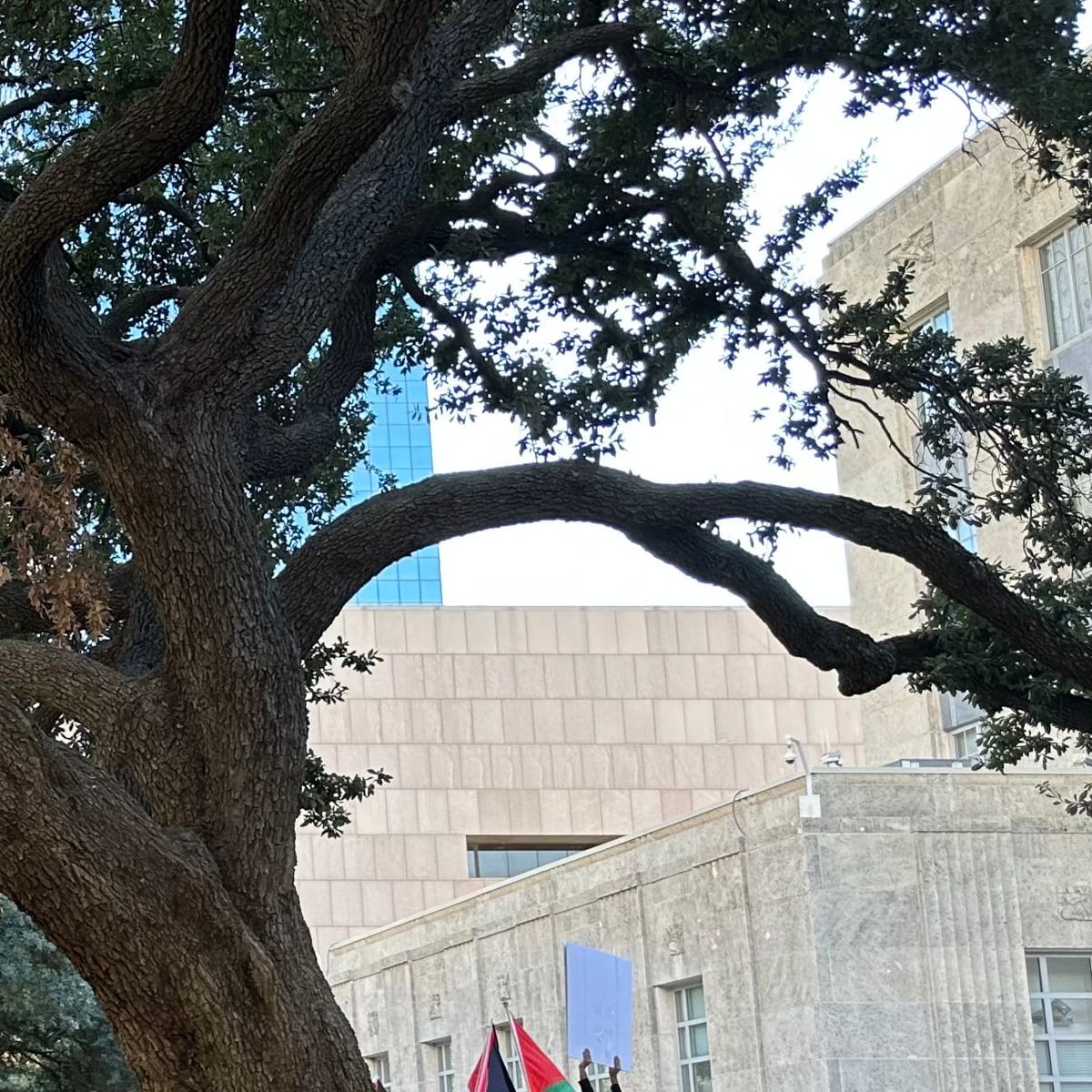
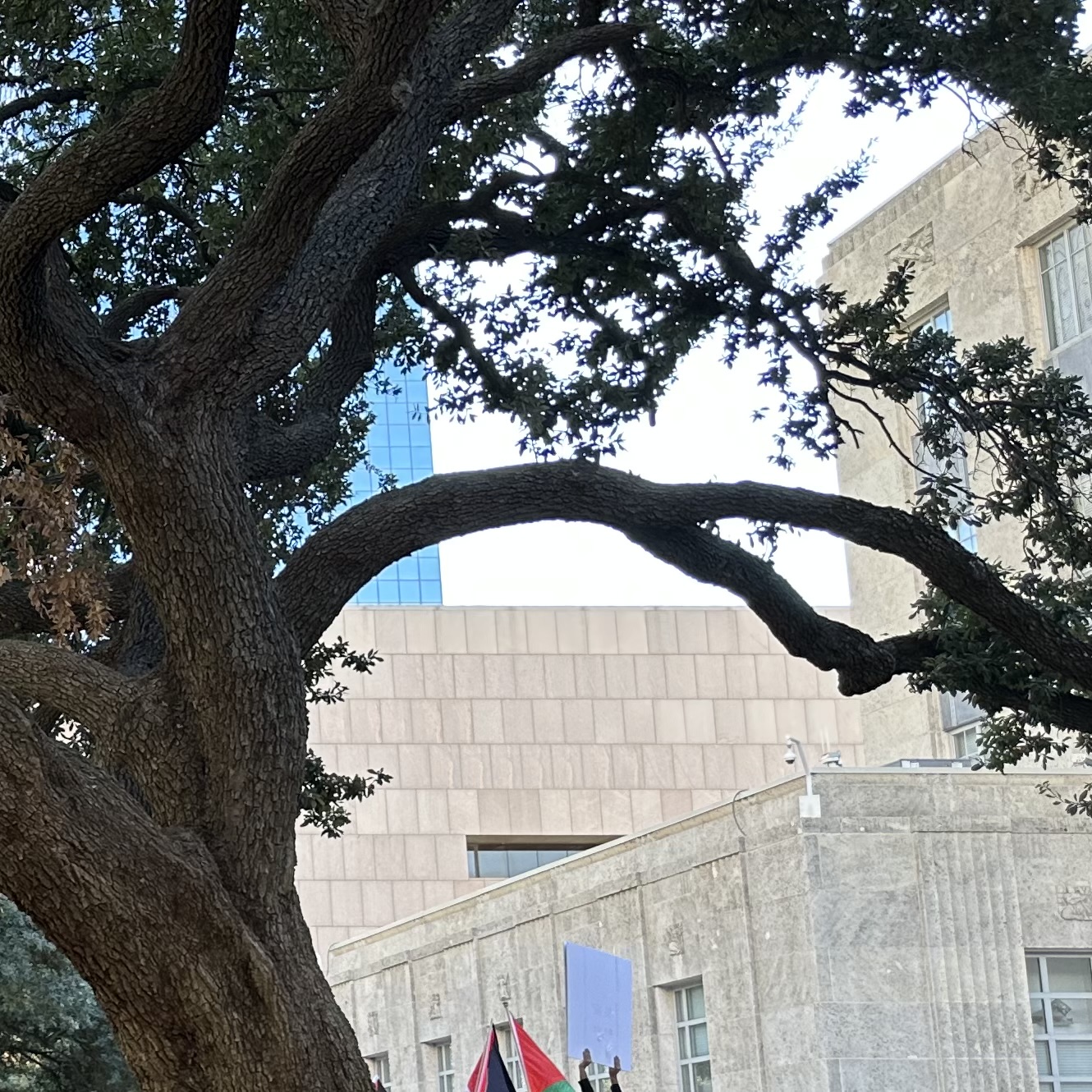
The rally was downtown. I am not good at estimating crowd sizes, but some say it was a few thousand people, mostly Muslim though not entirely. Some chants I could say. Free Palestine. Ceasefire now. Some chants I stayed quiet for. I held a sign for most it. I don’t remember much else, except the feeling that being there was right — that the whole week had been building toward this.
My wife and I walked back to the car together. We drove home.
I started reading The Economist again after I finished memorizing the Qur’an in 2024, and the Financial Times a few months after that. The world had moved while I was away — there were wars I didn't have a position on, elections I hadn't followed, a zeitgeist that had shifted while my attention was on Islamic studies. And, to be honest, the questions I was raising no longer seemed to have clear answers, and I found myself drawn to writing that wasn’t pretending they did.
However, I am not back where I started. The 2021 version of me had been honest about complexity but maybe too quick to file things under too complicated for now. The 2023 version had been wrong in visible ways, but he had also been responding to something previously under-felt: the way analysis can become a form of moral evasion.
What I keep returning to is something more specific than my own drift, though. Most Muslims, like most people, are not actively engaged in their tradition's intellectual life most of the time. They are working, raising kids, just living life. They reach for the tradition at particular moments — a death, before a tough decision, in a crisis. Most of the time, "what does my tradition say about this" is not a question they are asking. They are “just chilling.”
When something happens that makes the question urgent, they reach. And what they find first is what they think the tradition says. The voices that happen to be speaking at that moment become the tradition's voice.
This is what I think the scholars I trusted were doing in October 2023: they were providing the first frame. A large community of people who had not read seriously about Israel–Palestine in years, if ever, suddenly wanted to understand what was happening. So they turned to the first Islamic voices they already trusted or could easily find online. Those scholars became the entry point through which the conflict was interpreted. And once a first frame takes hold, it becomes very difficult to dislodge.
None of this means I regret memorizing the Qur’an. It changed me in ways I still consider overwhelmingly good. It made the world feel morally alive again. But I also think I confused spiritual formation with outsourcing judgment.
For a while, I relied on religious scholars for things that journalism and ordinary human encounter are better designed to handle. Scholars can teach you how a tradition speaks about justice and mercy. But they cannot replace the slow and often unsatisfying work of determining what actually happened in the world, especially in the middle of a crisis.
I think that is what happened to me in October 2023. I entered an interpretive world in which certain moral intuitions arrived already organized for me before I had done much independent thinking at all. What changed afterward was realizing that these scholars themselves belong to a particular American Muslim history. When their words reached me, they had already passed through decades of argument about what Islam in America is, what it stands for, and what it believes it is under threat from.
By the time I encountered October 7 through them, I was also encountering that history.